
Laser Welding Robot: How Robotic Laser Welding Works, Speed, Accuracy & How to Choose (2026)
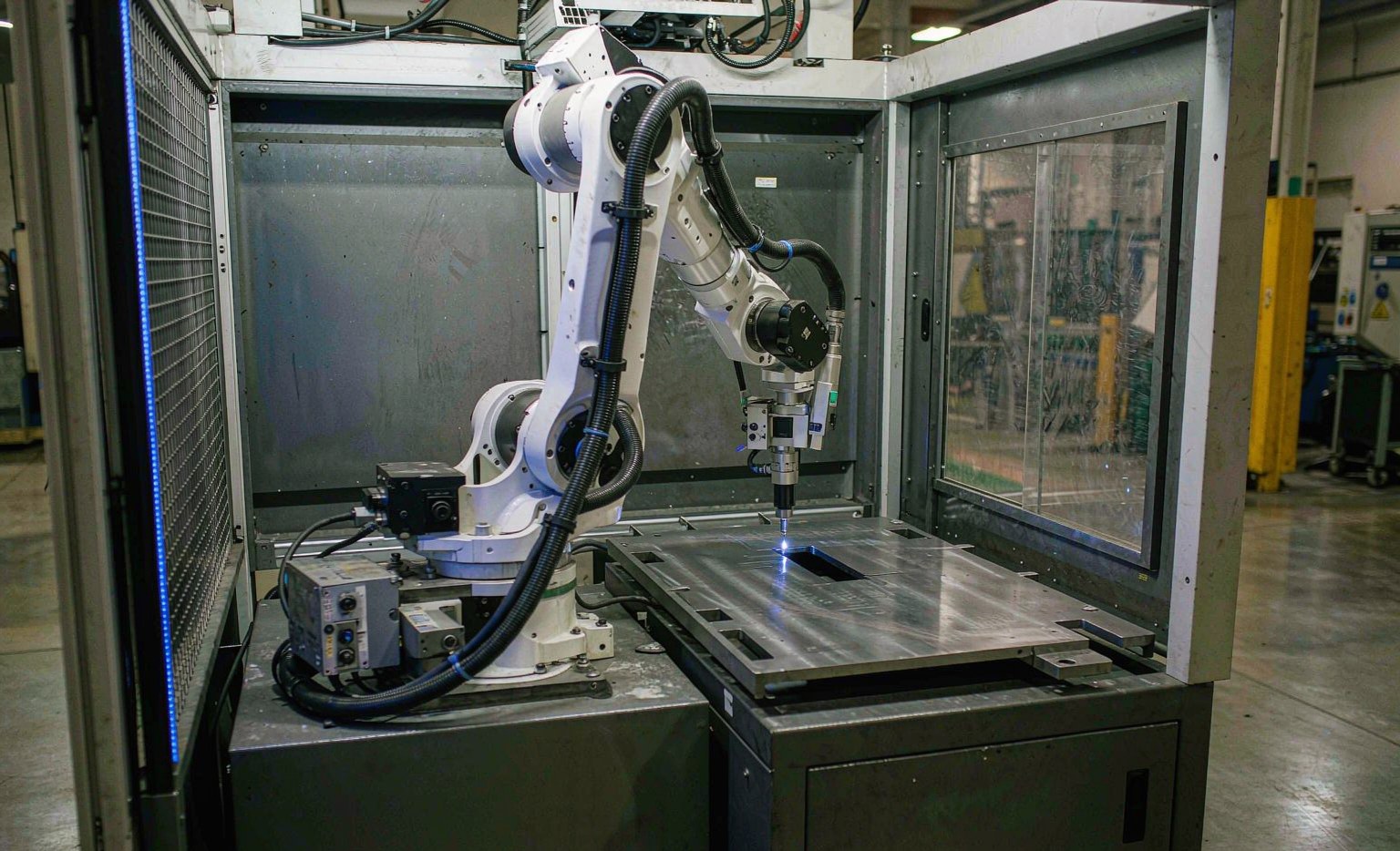
A laser welding robot pairs a high-power fiber laser with a 6-axis industrial robot (or collaborative arm) and real-time process monitoring to make repeatable, distortion-free welds at production speed. For manufacturers moving off manual MIG/TIG, the appeal is concrete: weld travel speeds of 4–10 m/min, heat input 60–80% lower than arc welding, and a heat-affected zone (HAZ) cut by up to 90% — which removes most post-grind and straightening labour. This guide explains how the systems work, how they compare to traditional welding, the specs that actually matter, where they are deployed, and how to choose one.
How a robotic laser welding system works
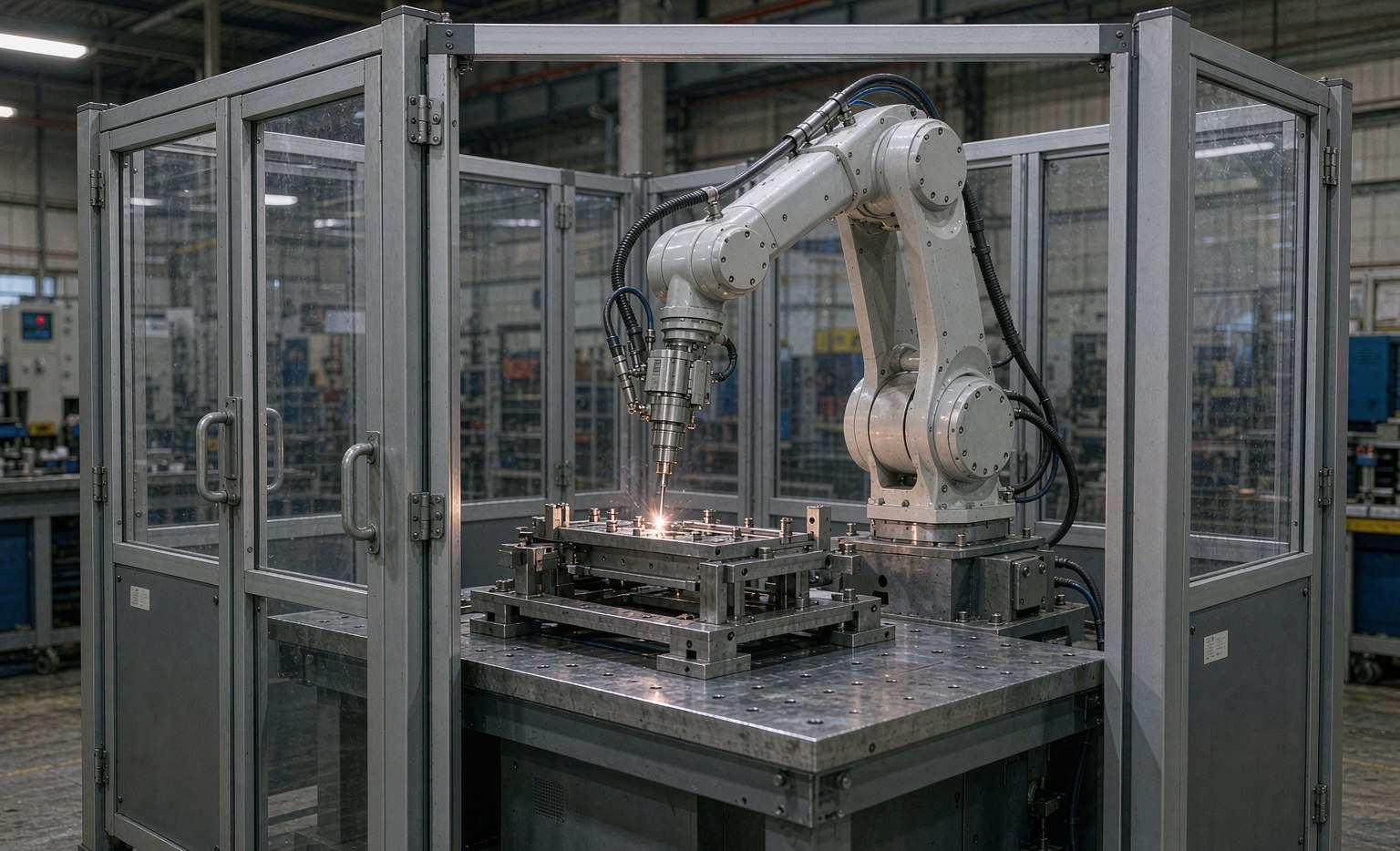
Three subsystems make up a typical cell:
- Fiber laser source. Most industrial units run at a wavelength of 1064–1070 nm, which steel, aluminium and copper absorb efficiently. Robotic welding cells commonly use 1.5–6 kW sources; heavy-plate and shipbuilding lines go to 10–12 kW. Wall-plug efficiency is 25–30%, roughly 2–3× a CO₂ laser (Intouch Ray, fiber vs arc comparison).
- Robot. A 6-axis articulated arm positions the laser head with <50 µm repeatability. Collaborative (cobot) versions reach ±0.025 mm and let an operator work beside the cell without a full fence (Standard Bots, laser welding robots).
- Monitoring. Plasma sensors, pyrometers and vision/seam-tracking watch penetration and temperature in real time, so every cycle stays within specification (e.g. EN ISO 15614-11 for welding procedure qualification).
The beam focuses to a 0.2–0.5 mm spot, creating a keyhole of 6,000–10,000 °C plasma that advances at 1–5 m/min, producing a weld that is roughly 30% deeper and 80% faster than TIG on equivalent joints (KlearLaser, how a laser welder works).
Laser welding vs MIG/TIG: the numbers
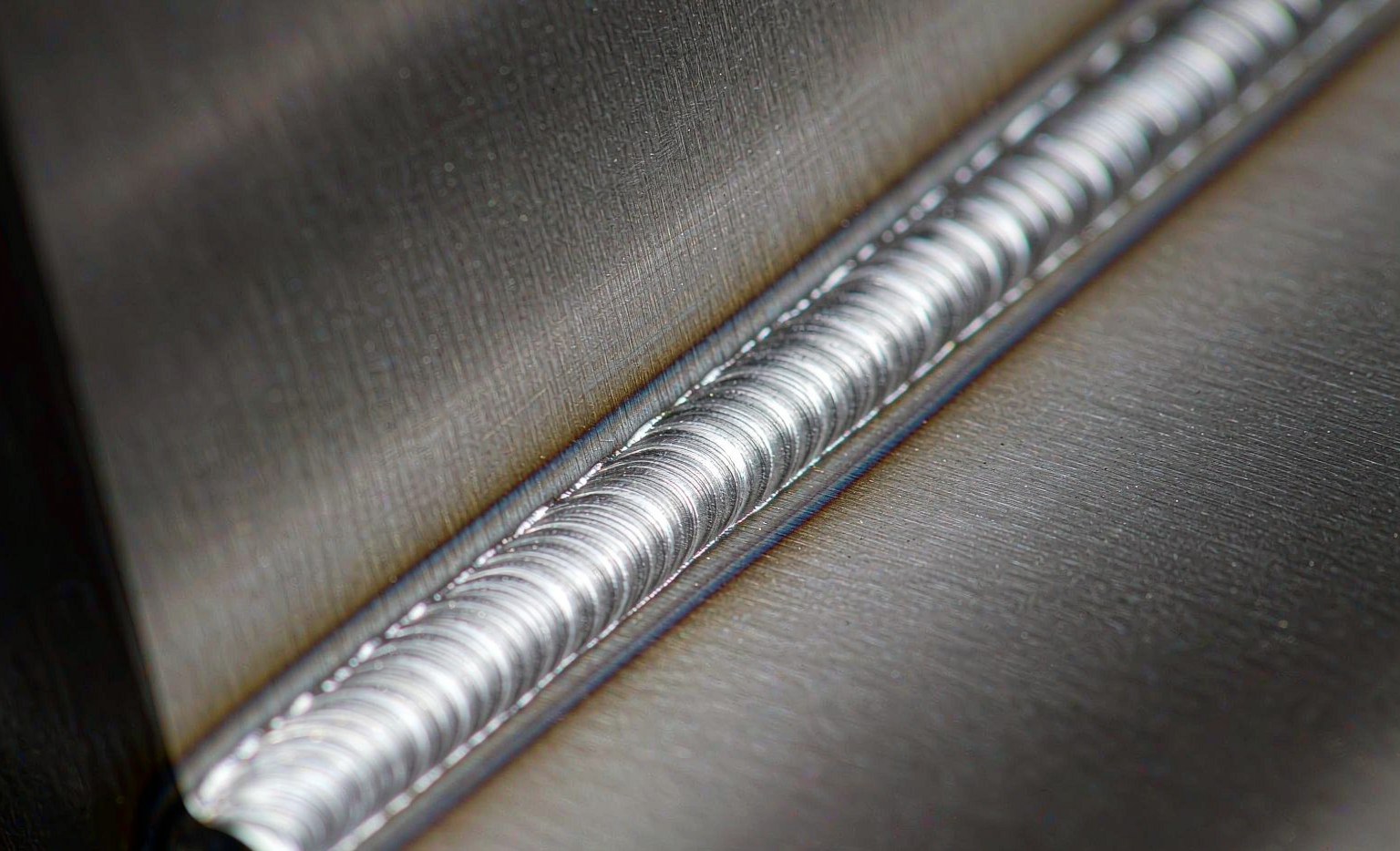
The table below summarises measured differences from automated-cell deployments. Lower heat input and a smaller HAZ are why laser welds need little or no post-processing.
| Parameter | Resistance spot | MIG/TIG (arc) | Robotic laser welding |
|---|---|---|---|
| Travel speed (1 mm steel) | 0.5–1.5 m/min | 0.8–2.0 m/min | 4–10 m/min |
| Heat input | 300–500 J/mm | 200–400 J/mm | 50–150 J/mm |
| Heat-affected zone | Large | Large, warping risk | Minimal (HAZ −90%) |
| Penetration (single pass) | Shallow | 3–6 mm typical | Up to 10 mm |
| Post-weld cleanup | None (but slow) | Spatter, slag, grinding | Near-net-shape, minimal |
| Automation fit | Limited | Often manual | Fully robotic |
Sources: automated laser welding cell benchmarks (M4S News) and fiber-vs-arc parameter tables (Intouch Ray). A 1.5 kW fiber laser achieves full penetration on 4 mm stainless steel from one side; a 2–4 kW source keyholes 3 mm Inconel in a single pass with heat input below 0.5 kJ/mm (Olympus Technologies, laser welding cobots).
Where laser welding robots are used
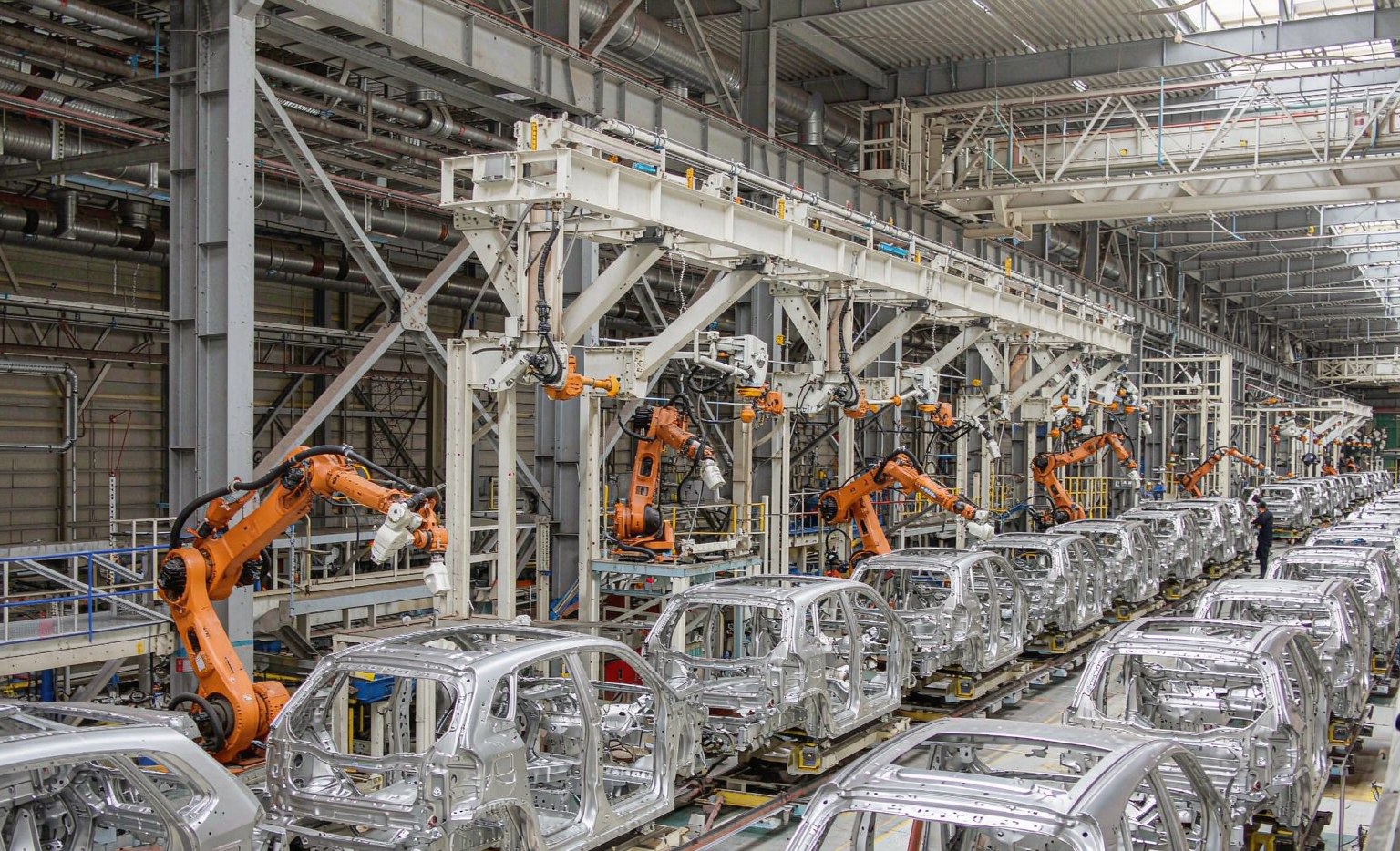
Automotive is the largest market — about 38.6% of laser-welding-robotic-system demand in 2025, with Asia-Pacific alone at $2.8 billion (41.2% global) and a forecast 9.4% CAGR through 2034 (Dataintelo market report). Key applications:
- Body-in-white (BIW). Remote laser welding (RLW) drops roof-side joints from ~3 s/point (resistance spot) to ~1 s/point and saves ~50% of flange material. Cells cut BIW cycle time 30–45% versus plasma/MIG.
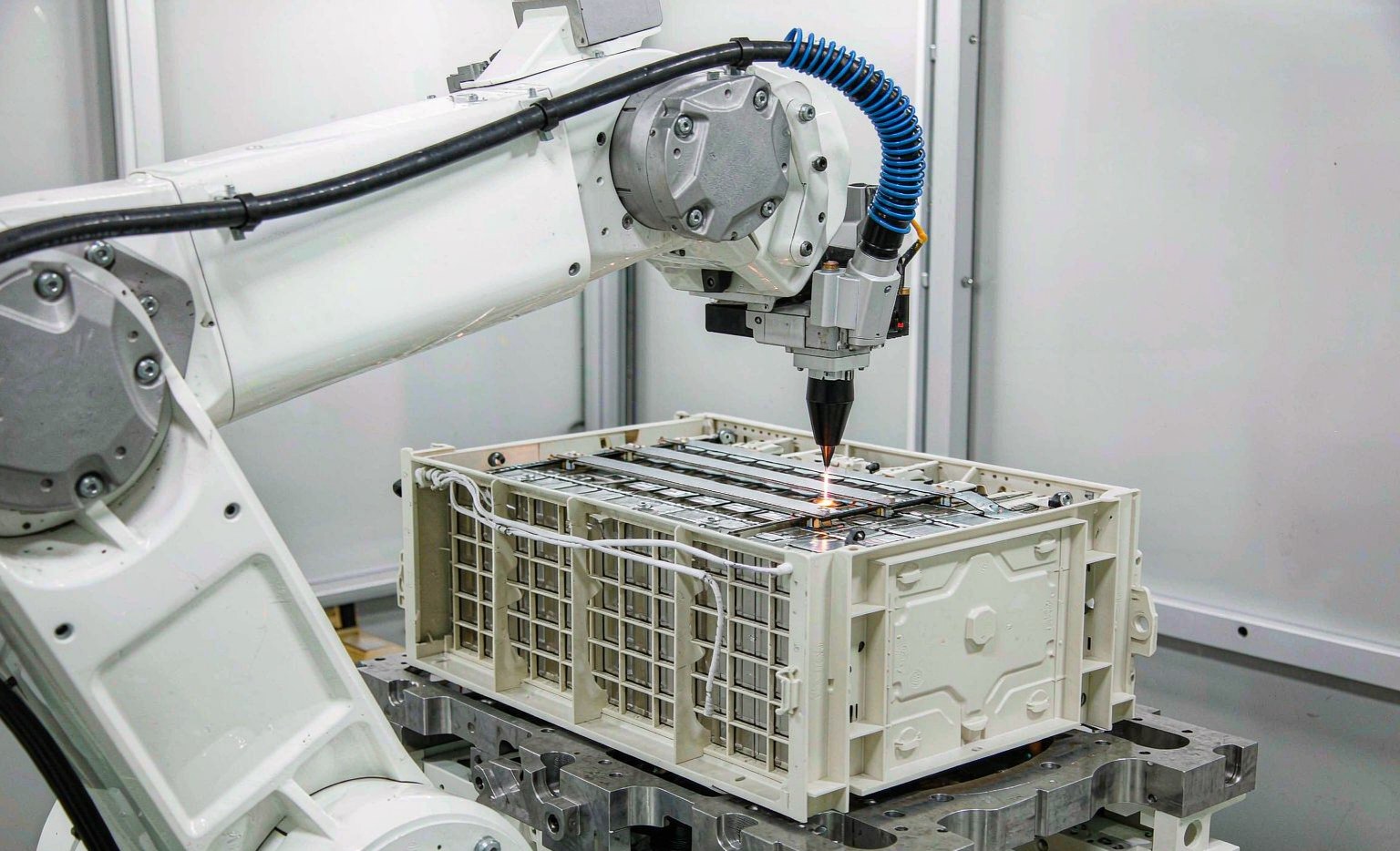
- EV battery packs. Cell-to-busbar, tab and pack-sealing welds need micron consistency: positioning to 0.02 mm, seal rates below 0.5 cc/min, tab yield 99.9%. The EV battery sector alone is projected to need 3,400+ new robotic laser welding cells (2025–2028).
- Aerospace. Titanium and nickel super-alloys welded with minimal distortion; heat input kept below 0.5 kJ/mm so post-weld heat treatment drops off the routing.
- Electronics & medical. Microscale, contamination-free joints meeting ISO 13485 traceability.
- Heavy machinery & shipbuilding. Laser-arc hybrid welds 10–50 mm plates in a single pass, ~5× the efficiency of multi-pass arc.
EV battery welding: the precision case
Battery joining is where robotic laser welding earns its keep. Copper and aluminium busbars, nickel-plated tabs and pack enclosures all demand low heat and tight repeatability to avoid damaging cells. Wobble welding heads oscillate the beam 0–3 mm at 100–1000 Hz to bridge 0.3–2 mm gaps on zinc-coated steel without spatter, delivering Class-A seams at ~5 m/min (KlearLaser). Vision-guided cells auto-compensate for ~0.1 mm assembly deviation, holding weld speed near 100 mm/s.
How to choose a laser welding robot
Matching the cell to the part beats chasing the highest wattage:
- Robot type. 6-axis industrial robots for high throughput and reach; cobots (±0.025 mm) for low-volume flexibility and lower entry cost.
- Power. 1.5–3 kW covers thin-gauge (<3 mm) sheet, enclosures, battery trays and medical housings. 3–6 kW handles structural and dissimilar-thickness joints. Above 6 kW, consider laser-arc hybrid for thick plate.
- Integration. Look for EtherCAT, PROFINET and EtherNet/IP so the laser talks to ABB/FANUC/KUKA/Yaskawa controllers.
- Safety. A Class 4 laser (1064 nm) requires a light-tight, interlocked enclosure to EN 60825-1 with OD7+ viewing glass.
- Joint prep. Gap control <10% of material thickness and edge finish Ra <3.2 µm; tight tolerances are the trade-off for the focused beam.
- ROI. Payback is typically 12–18 months on high-volume lines; complete setups run $70,000–$250,000+ depending on power, optics, robot and integration (Standard Bots).
Internal resources
TrueSyn Robotic builds the laser source, chiller and robot integration as a turnkey cell. Related capabilities:
- Laser welding, cleaning & cutting systems — TrueSyn Robotic
- Robotic laser welding cells
- Laser cleaning machines
- Robotic laser cutting systems
Guide index: more from this series
- How to Choose a Robotic Laser Welding System for Automotive Manufacturing
- Customized Robotic Laser Welding Solution for Condenser & Low-Temperature Radiat
- Laser Welding Robotic solution for Impeller welding
- FANUC Laser Welding Robot Integration: What to Plan Before You Buy
- Laser Welding Robots in EV Battery Manufacturing
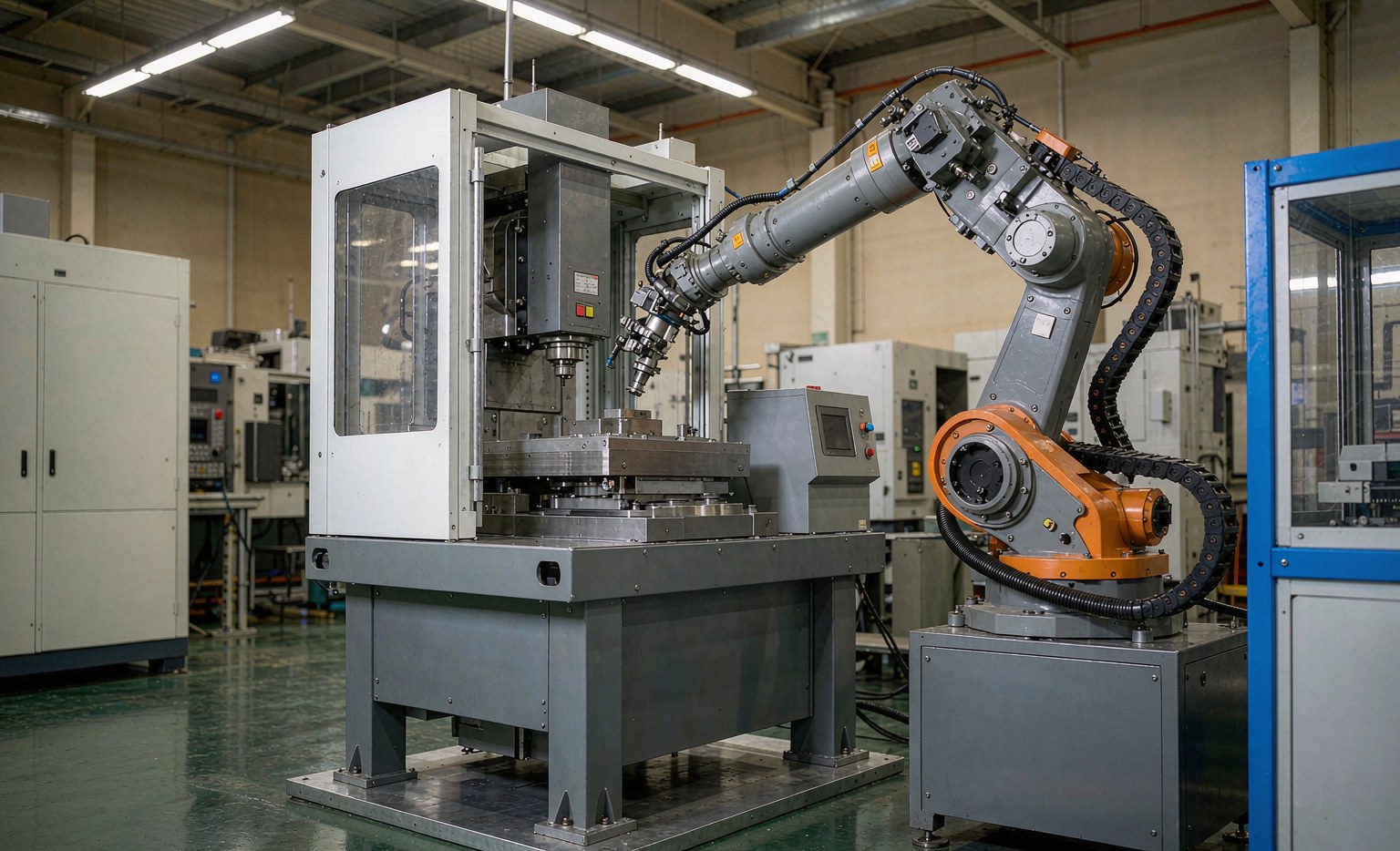
- Multi-Axis CNC Laser Welding Workstations: Technical Selection Guide
- Industrial Robotic Submerged Arc Welding Systems: Technical Integration and Prod
- Laser Welding Robot System Implementation for Industrial Automation
- High-Precision Robotic Laser Cutting Systems for Industrial Automation
- Cobot Welding Systems: When Collaborative Robots Beat Industrial Arms
Multi Axis Welding Machine Configurations
Buyers searching for a multi axis welding machine are usually solving one of two problems: reaching multiple faces of a part without re-fixturing, or coordinating a positioner’s axes with the arm so the seam stays at the optimal angle throughout the weld. Both are configuration questions — the arm’s axes handle reach, the positioner’s axes handle presentation, and the coordination layer between them decides whether the six axes behave as one system. Our multi-axis workstation reference covers the machine-side specification: multi-axis CNC laser welding workstations.