
Cobot Welding Systems: When Collaborative Robots Beat Industrial Arms
Cobot welding systems — collaborative robot arms carrying a welding torch — have become the fastest-growing segment of welding automation, and the marketing around them suggests they suit everyone. They do not. Cobots trade speed and payload for simplicity, safety flexibility and price, and the winning question is whether your workload values what they give up less than what they give. This guide draws that boundary honestly.
What “Collaborative” Actually Buys
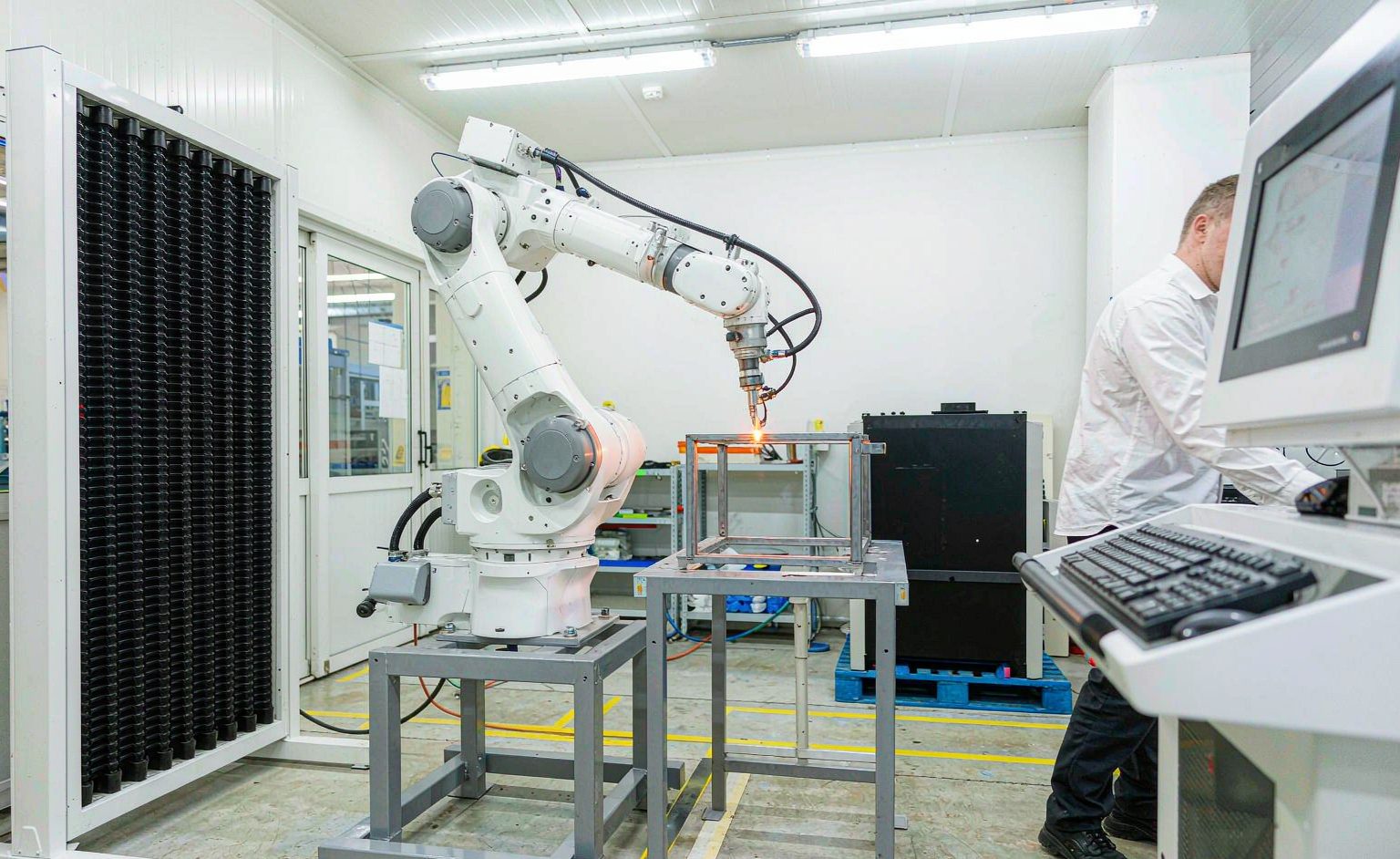
A cobot’s defining feature is its licence to work near people: force-limited joints and rounded geometry let it operate inside a fence-free footprint under the relevant safety standards, subject to a proper application risk assessment. That changes the economics for small shops: a cobot welding cell occupies a corner where an industrial cell would need fencing, floors and foundations. It changes the operating model too — hand-guided programming means a welder, not a robot programmer, teaches the path by dragging the torch along the joint, and the cobot records it. Shops whose bottleneck is welding labour, not throughput, find this model fits: the welder becomes the programmer on Monday and the supervisor on Tuesday.
Where Cobots Win — and Where They Lose
| Condition | Cobot verdict | Why |
|---|---|---|
| Short runs, frequent changeover | Strong win | Hand-guided teaching in minutes, no programmer queue |
| Small shop, no robotics staff | Strong win | Operation fits existing welders’ skills |
| High-volume, long-arcpime parts | Loses to industrial | Cobot speed leaves 20–40% cycle time on the table |
| Heavy parts, long torch reaches | Loses to industrial | Payload and reach ceilings bind |
The speed row is the honest headline: cobots run slower by design — their force-limited joints sacrifice velocity for safety — and on parts that weld for minutes per joint, that sacrifice compounds into real capacity. The high-volume fabricator should buy an industrial arm; the job shop with forty-part families and no robotics engineer should not, because the cobot’s simplicity is worth more than the speed it lacks. The shops that regret cobots are almost always the ones whose volume grew into the industrial case after the cobot was right — which is a success story wearing a frustration costume.
The Welding Package Around the Arm
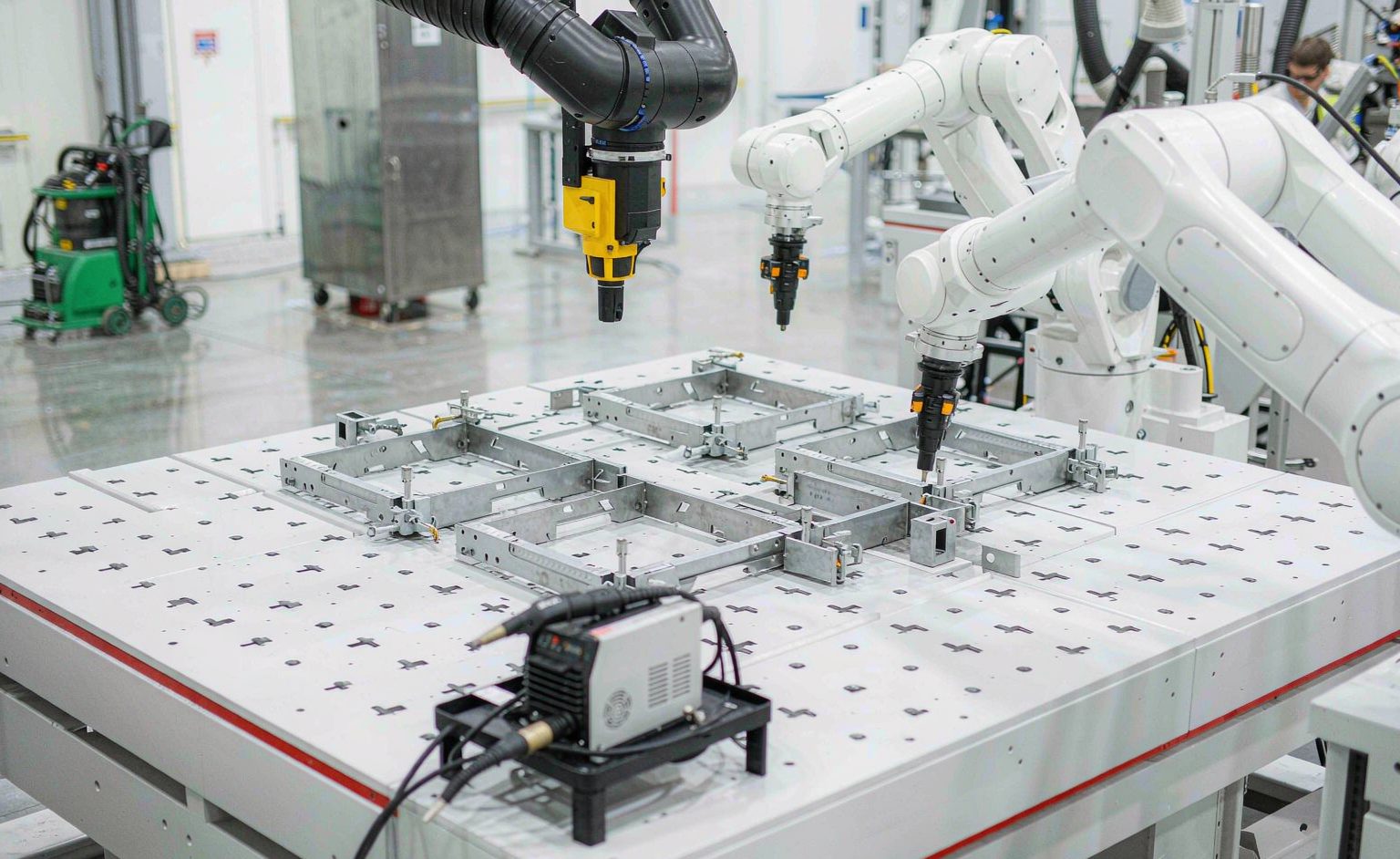
A cobot welding system is more than the arm: torch and cable management rated for cobot motion, a source with the right interface, positioners or tables sized to the work, and fume extraction that a fence-free layout must handle differently — often at the table rather than in an enclosure. The torch package deserves specific attention: cobot wrists are sensitive to cable stiffness, and poorly dressed torch leads fight the arm’s repeatability. Buyers should evaluate the complete package from one accountable supplier, or insist on a named integrator who owns the interfaces between the cobot brand, the source and the table. The industrial-cell counterpart to this planning is in our guide to laser welding workstations, and the positioning hardware in dual-axis positioners.
Safety: Simpler, Not Absent
Force-limited does not mean risk-free — the torch is still hot, the part is still conductive, and the risk assessment is still legally required. The collaborative application must be assessed as a system: cobot, torch, workpiece, workspace and human behaviour together. Shops gain the most from the cobot’s safety characteristics when they keep the application genuinely collaborative — part loading while the robot welds on the other side of the table, supervised — and the least when they fence a cobot off anyway, paying collaborative prices for industrial limitations. Standards background on collaborative robots and arc welding processes grounds the terminology used here.
The Buying Sequence That Works
Start with your part histogram: joint lengths, part weights, changeover frequency. Trial-teach your hardest family at a demo — if your welder cannot produce an acceptable path in an afternoon, the cobot’s simplicity promise is failing on your geometry. Price the complete cell, including fixtures and extraction, and compare it to the industrial alternative’s total, not its robot price. And plan the labour model explicitly: who teaches, who runs, who maintains. Cobots win where that plan uses the welder’s judgment and the robot’s consistency; they disappoint where the plan assumes either does the other’s job.
Frequently Asked Questions
Can a cobot weld as well as an industrial robot? Weld quality is comparable — both execute the path they are taught. The differences are speed, payload and reach, not weld integrity.
Do cobots need fencing? Often not, under a valid collaborative application risk assessment — that fence-free footprint is a large part of their value. The assessment, not the brochure, decides.
What is the realistic cost range? Complete cobot welding cells typically land at a fraction of comparable industrial cells, but the honest comparison includes fixtures, tables and extraction — where cheap packages quietly re-add the cost.