
FANUC Laser Welding Robot Integration: What to Plan Before You Buy
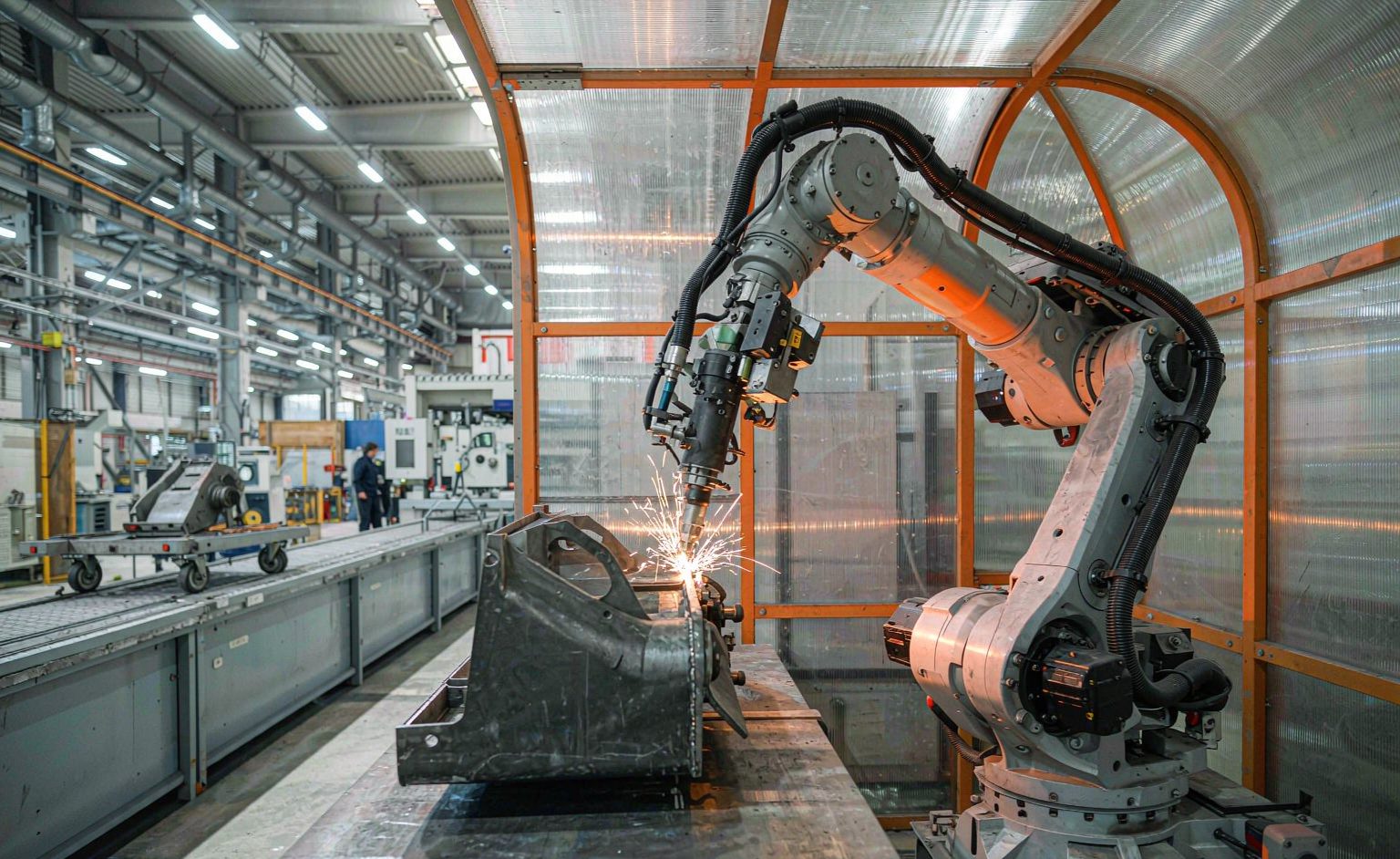
FANUC’s robot lineup is the most requested platform in laser welding integration enquiries, and for good reason: the arms are reliable, the documentation is deep, and the service network is global. But a FANUC laser welding robot is a component, not a solution — the integration decisions around it decide whether the cell delivers. This guide walks through the planning that matters before purchase, from interfaces to fixtures to safety.
Choosing the Arm: Payload, Reach and Mounting
Laser welding cells usually run mid-payload arms (7–35 kg class) because the welding head, cable management and optics weigh far less than the part. The decisions that matter: reach must cover the fixture envelope with clearance for the head’s stand-off; mounting — floor, rail, or overhead — determines whether one arm serves multiple fixtures; and the wrist’s cable routing must survive years of torch-lead flexing without service downtime. Buyers should also insist on seeing the planned reach study for their actual part geometry, not a similar part: a reach miss discovered after delivery is a re-mounting project.
The Interfaces That Decide Integration Cost
| Interface | What it connects | Planning question |
|---|---|---|
| Laser source to head | Fibre delivery, cooling, power | Which source brand, whose warranty applies |
| Robot controller to source | Power modulation during motion | Native interface or gateway needed |
| Fixtures to robot | Part presentation, clamping signals | Who designs the fixtures — and when |
| Cell to factory | Fume extraction, safety PLC, MES hooks | What the factory must provide, in writing |
The controller-to-source row is where quotations diverge quietly: some laser sources offer native FANUC fieldbus integration, others need a gateway whose latency shows up as weld-quality variation at speed. Buyers who name the source brand in the RFQ and ask for the interface architecture in writing compare real costs instead of headline prices. The fixture row carries the schedule risk — fixture design starting after robot delivery is the classic delay generator, and fixtures designed in parallel with the cell save weeks. Our workstation architecture that integrates these interfaces is profiled in the multi-axis CNC laser welding workstation.
Fixtures and Positioners: The Accuracy Foundation
Laser welding tolerates less joint error than MIG or TIG — the beam’s focus zone forgives little — so fixtures and positioners carry the accuracy burden. Rigid clamping that presents the joint consistently beats clever robot path compensation every time. For parts that need welding on multiple faces, a positioner moves the part while the arm holds the head — and the positioner’s axes must be coordinated with the robot’s, which means integration scope must include the positioner controller, not assume it. Dual-axis positioners such as the U-type dual-axis positioner exist precisely for this coordination, letting the arm weld continuously while the part rotates and tilts into position.
Safety and Compliance: Designed In, Not Bolted On
Laser welding adds hazards that MIG cells never carry: the beam itself, its reflections, and fume profiles that differ from arc processes. Cell design must include rated enclosures with viewing windows matched to the laser class, interlocked access that the safety PLC enforces, and extraction sized to the alloy mix. FANUC’s dual-channel safety functions — safe hold, speed limitation, zone control — integrate into this architecture and allow faster, safer human interaction for loading. Buyers should ask prospective integrators for the safety concept document before the quotation: a cell whose safety story starts with the fence is a cell designed backwards.
What the First Months of Production Prove
A well-integrated FANUC laser cell proves itself in three numbers. First-pass weld quality — measured, per shift, against the standard. Changeover time — from last good part of family A to first good part of family B. And availability — because the laser source, not the robot, usually decides it, and the service arrangement for the source deserves the same scrutiny as the robot’s. Integrators confident in their work share these numbers from reference cells; the ones who do not have told you something. For the broader robot-family decisions around laser welding, the background on industrial robot platforms and laser beam welding physics provides the technical grounding.
Frequently Asked Questions
Can the FANUC robot drive the laser source directly? With sources that offer native fieldbus integration, yes — power ramps synchronise with motion, which is what makes weld starts and stops clean. Otherwise a gateway interfaces the two, and its latency specification matters.
What payload class suits laser welding? Mid-payload arms in the 7–35 kg range cover most head-and-cable combinations; the part is moved by the positioner, not the arm, in well-designed cells.
How long does integration take? Eight to sixteen weeks from order to first good part for a standard cell, dominated by fixture design and safety validation — both of which run faster when started before the robot ships.