
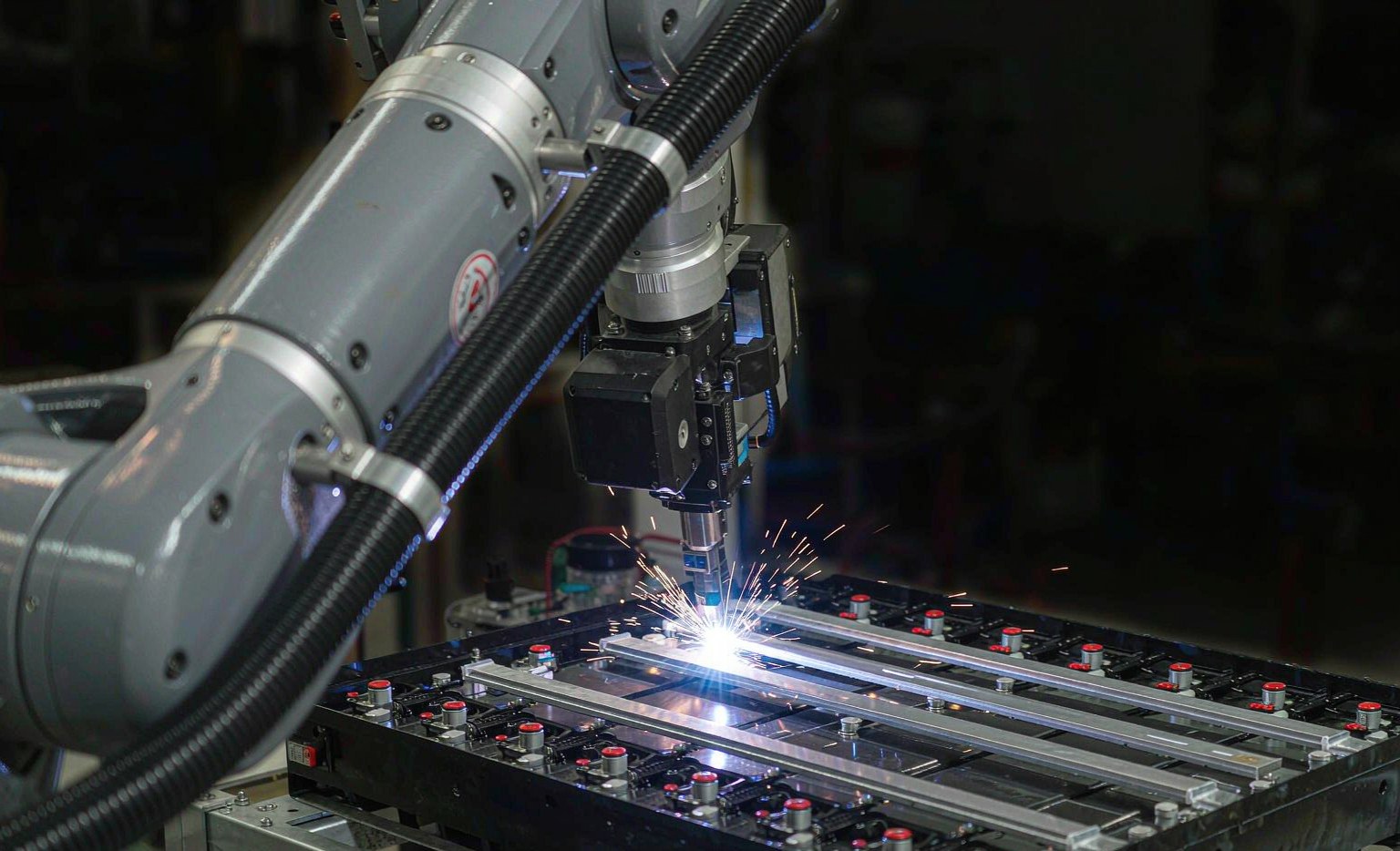
Laser Welding Robots in EV Battery Manufacturing
Electric-vehicle battery packs are assembled from hundreds of cells joined by busbars and tabs, and the dominant joining method is laser welding. It is not a taste choice: near sensitive, energy-dense cells, the low heat and clean weld of a laser are safety-critical. This article covers where lasers are used, why they win, and the material challenges that keep process engineers busy.
The reason laser wins in battery work is a safety argument more than a cost one: a process that puts less heat into the cell and leaves less spatter reduces the chance of damaging a cell that could later fail.
What gets welded in a pack
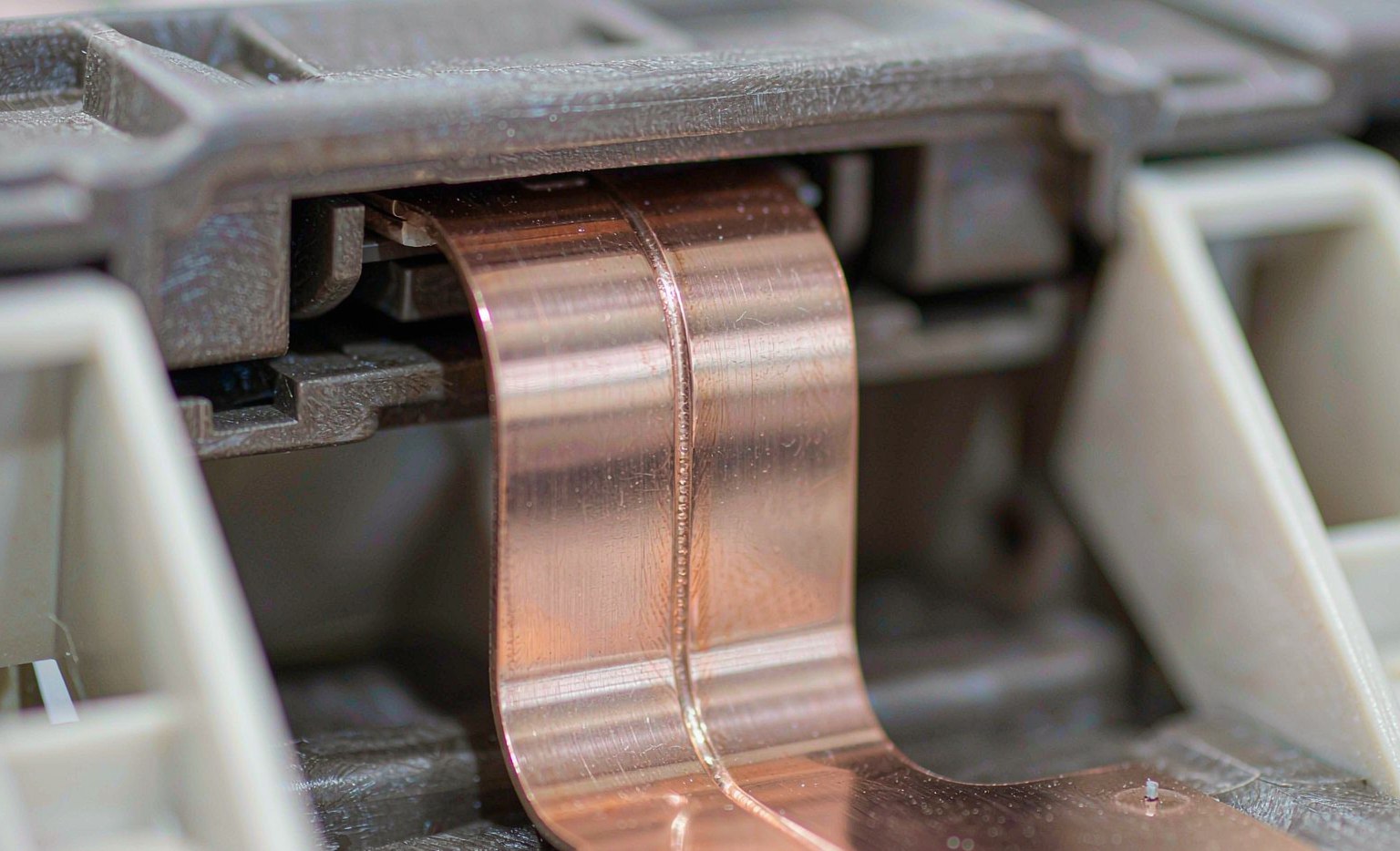
- Busbars to cell terminals — aluminum or nickel-plated copper conductors carrying pack current, joined by continuous seam welds.
- Cell tabs — nickel or nickel-plated steel tabs on cylindrical cells (e.g. 21700 / 4680), joined by spot or stitch welds.
- Module enclosures & sensors — lightweight aluminum housings and brackets.
Why laser, not resistance or arc welding
| Requirement | Why laser fits |
|---|---|
| Low heat input | Minimizes thermal stress on adjacent cells and separators |
| Non-contact | No electrode force or contamination on the cell |
| Minimal spatter | Spatter near a cell is a safety hazard; laser keeps the weld clean |
| Speed & repeatability | Remote (scanner) optics weld several m/min with closed-loop monitoring |
Cell formats and joints
| Cell format | Typical tab/terminal | Joining |
|---|---|---|
| 18650 / 21700 | Nickel-plated steel tab | Spot / stitch laser |
| 4680 | Tabless / steel can | Laser to busbar |
| Prismatic | Al / Cu terminal | Seam laser |
| Pouch | Al / Cu foil tabs | Ultrasonic or laser |
Throughput and quality control
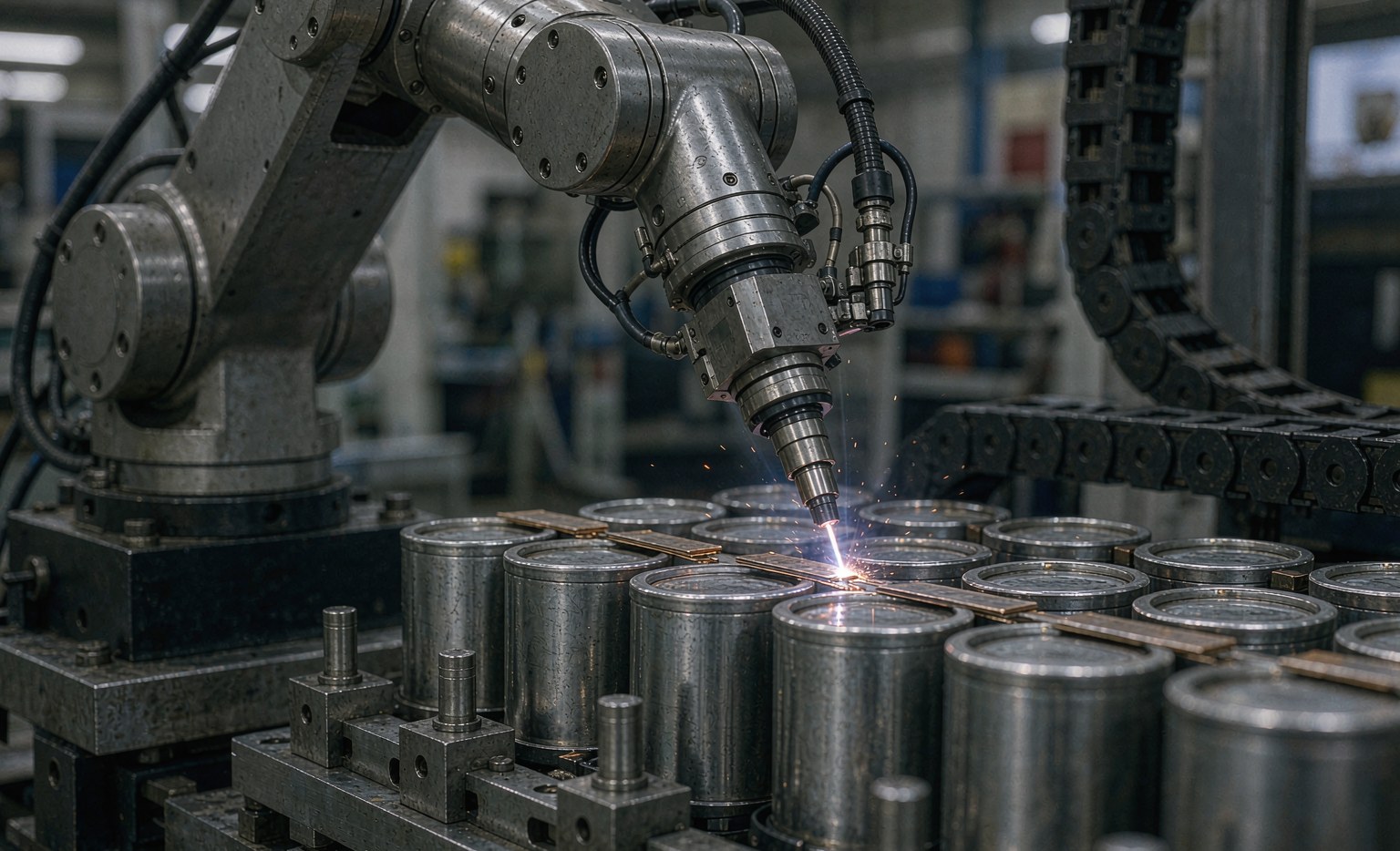
High-speed lines weld cell tabs in well under a second per joint using scanning optics, while seam-welding busbars at several metres per minute. Because a defective weld can precipitate thermal runaway, production cells pair the laser with in-process monitoring (photodiode/plasma or vision) to flag porosity or lack of fusion in real time.
The monitoring loop is what makes the process safe at volume: a bad joint is rejected before the module is sealed, rather than found later in a pack that cannot be opened.
Material challenges
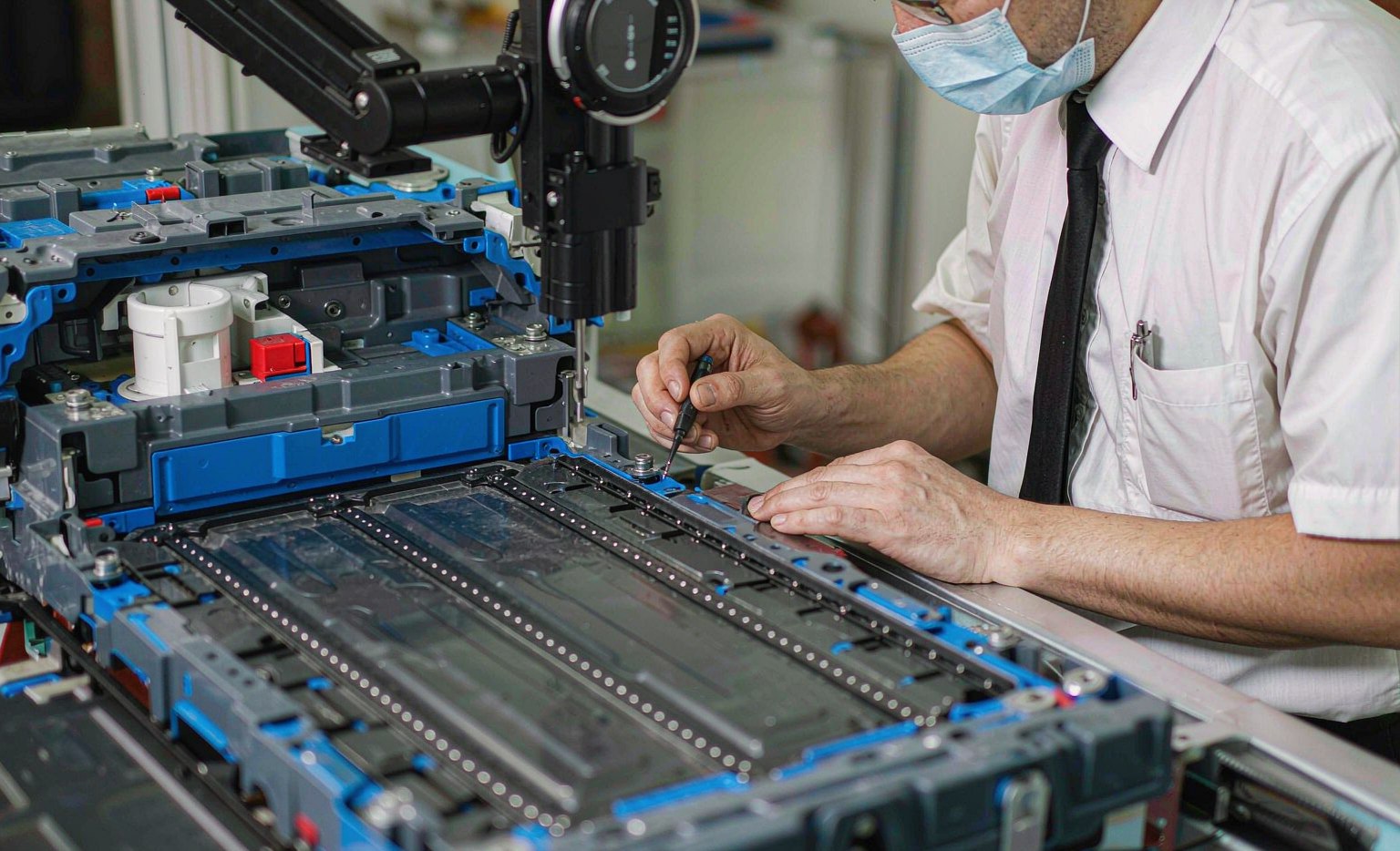
Copper and aluminum are highly reflective at the standard ~1 µm fiber wavelength, which makes them harder to couple and more prone to defects. Vendors address this with optimized parameters, beam shaping, or green/blue lasers for copper.
Aluminum’s oxide layer and porosity sensitivity also demand tight process control, and the joint must survive thousands of thermal cycles over the pack’s life.
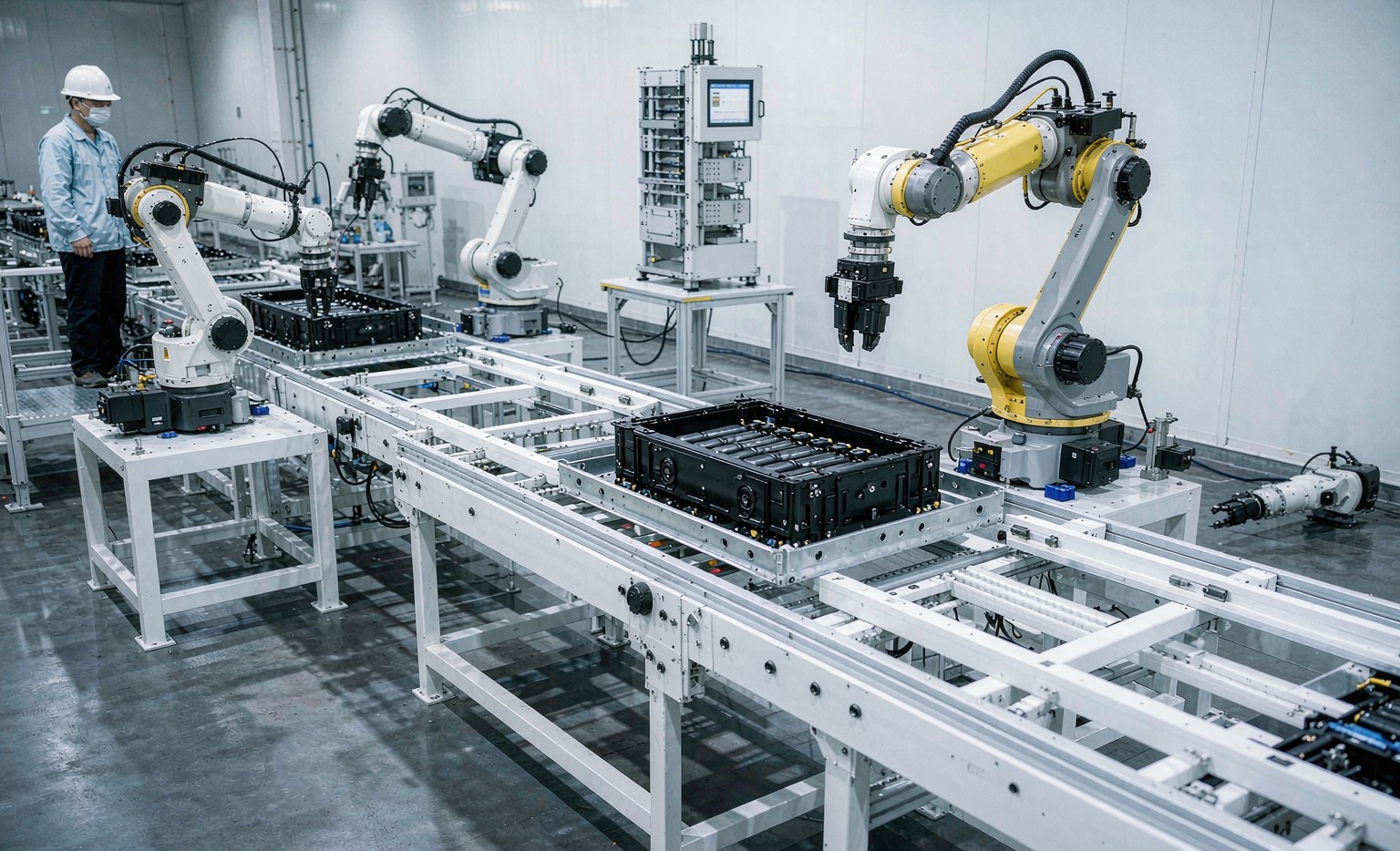
Laser welding is now the backbone of EV battery joining because it is the only method that combines the speed of mass production with the low heat and clean weld that cell safety demands. Any scale-up of pack assembly therefore hinges on reliable, monitored laser cells rather than conventional joining, and the monitoring loop — not just the beam — is what makes it safe at volume.
FAQ
Why not resistance spot welding? Electrode force and heat stress the cell and separators; laser is non-contact and lower heat.
How is weld quality assured? In-process photodiode/plasma or vision monitoring flags bad joints before the module is closed.
Can copper be laser-welded easily? Not at 1 µm — copper reflects it, so green/blue lasers or tuned parameters are used.
What about the oxide layer on aluminum? It changes coupling and can cause porosity, so parameters and cleaning are tightly controlled.
Is one laser enough for a whole line? Usually several cells run in parallel, each seam- or spot-welding different joints.
How does this scale for 4680 cells? Tabless designs shift the joint to the can-to-busbar interface, keeping laser as the joining method.
Process parameters that matter
Laser power, travel or scan speed, focus position and shield-gas flow together set penetration and defect rate. Too little power risks lack of fusion; too much causes spatter and voids. Focus position is especially critical on reflective copper, where a small shift changes coupling sharply. Lines therefore lock parameters from a qualification coupon and monitor every joint against that baseline.
Busbar and tab metallurgy
Joining dissimilar metals — copper busbar to aluminum terminal, or nickel tab to steel can — creates brittle intermetallics if too much heat is applied. Laser’s low heat input limits that growth, which is another reason it fits battery work. Where copper-to-aluminum joints are unavoidable, beam shaping or a transition material keeps the joint ductile.
Cycle-life and traceability
Battery joints must survive thousands of charge cycles without loosening or cracking, so process monitoring data is often stored per joint for traceability. If a pack ever fails, the weld records let engineers find the culprit joint rather than recalling the whole batch — a quality system requirement, not a nicety.