
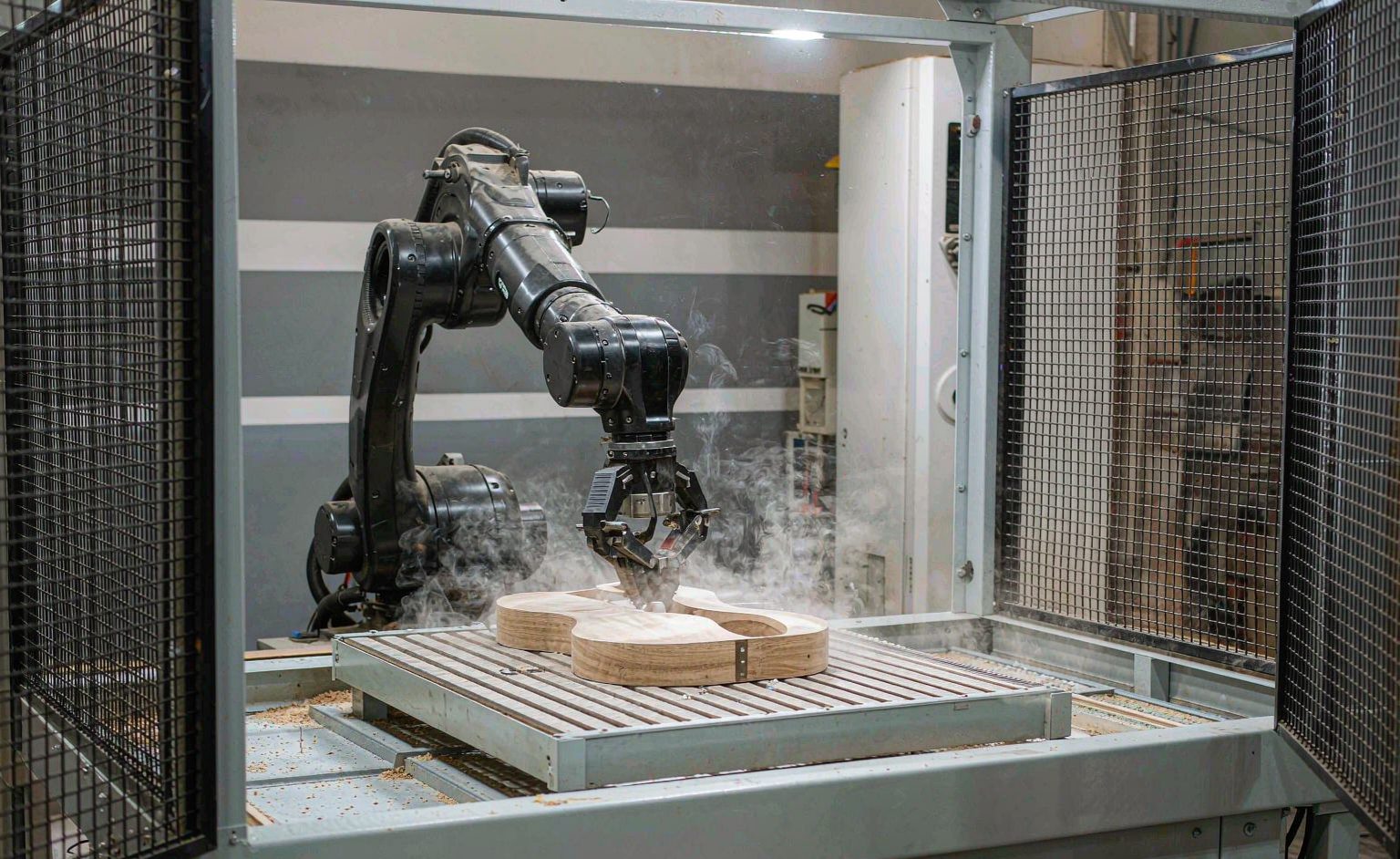
Robotic Polishing Cells: Specification Guide for Finishing Applications
A robotic polishing cell replaces the most skill-dependent station on any finishing line: hand polishing quality depends on the operator’s feel, and feel does not scale. Robotic cells deliver that feel through force control — the robot commands contact pressure, not just position — which is why polished surfaces now hold tolerance across shifts the way machined surfaces always have. This guide covers the specification points that separate productive cells from expensive arms.
The Four Systems Around the Robot
| System | What it does | What its absence costs |
|---|---|---|
| Force control | Constant contact pressure on curved surfaces | Burn-through on curves, under-polish on flats |
| Tool wear compensation | Offsets as buffing wheels wear down | Finish drift within one shift |
| Part presentation | Fixtures that present the seam identically | Every part a new teaching job |
| Slurry & compound management | Consistent media application | Finish varies with operator habit |
Force control is the headline specification — grinding and polishing are force tasks wearing a position-task costume, and cells that command contact force hold finish quality across the curvature that hand polishers chase by feel. A robotic grinding cell shares the same architecture: the polishing variant swaps media and pressures, not principles.
Application Notes: Instruments, Medical, Metalware
Polishing cells earn their keep where surface finish is the product: musical instrument bodies (guitar and violin finishes demand consistent compound application across curved wood), medical device components (finish classes tied to cleanability), and metalware (cutlery, fittings, architectural hardware). Each family changes the media and the pressure profile, not the cell architecture — which is why a well-specified cell serves product families, not just one SKU.
Specification Checklist for Buyers
| Checkpoint | Verify at | Pass condition |
|---|---|---|
| Finish consistency | First and fiftieth part | Identical Ra across the run |
| Force range & resolution | Curved test piece | Holds pressure through curvature |
| Media life | Cycle count per wheel | Documented, not estimated |
| Changeover | Family A to family B | Program call, not re-teach |
The finish-consistency row is the buyer’s strongest test: require the first and fiftieth part from a production run, finished — identical Ra readings are the evidence that force control and wear compensation actually work together. Buyers comparing cells across suppliers should also read the integration-side checklist in the robotic cell guide, since presentation and safety architecture are shared disciplines.
Frequently Asked Questions
Can one polishing cell serve multiple product families? Yes with program-based changeover — families that share fixture mounting change in minutes; families that need new tooling change in a day.
What matters more: robot brand or force control quality? Force control — the robot is a position device, and the force sensor loop is where finish quality is actually made.
How is a polishing cell different from a grinding cell? Media and pressure profile only — the force control, wear compensation and presentation architecture are the same, as detailed in the grinding cell guide above.
Reference: polishing.