
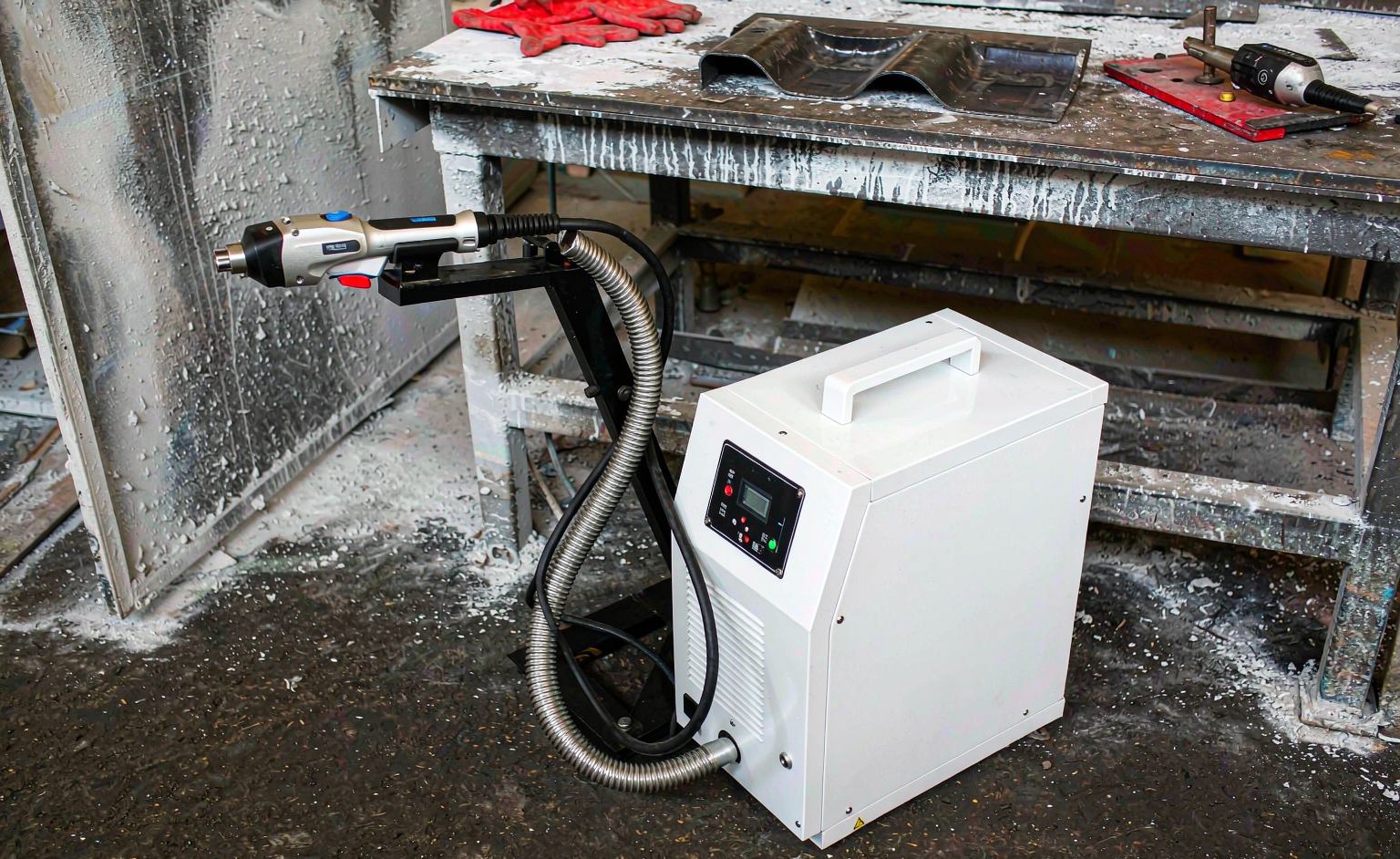
Handheld Fiber Laser Welder Cooling: Water Chiller Selection and Maintenance
A handheld fiber laser welder converts roughly thirty percent of its wall power into the beam — the remaining seventy percent becomes heat that the chiller must remove continuously. Cooling is therefore not an accessory decision: undersized or poorly maintained chillers are the leading cause of power drift, lens contamination and summer shutdowns on handheld units. This guide covers chiller selection, the maintenance schedule that prevents drift, and the failure modes buyers should plan for.
Chiller Selection: Sizing to the Source, Not the Gun
| Parameter | What it decides | Selection rule |
|---|---|---|
| Cooling capacity (kW) | Whether the source holds power at ambient | Size to source heat load + 25% headroom |
| Flow rate & pressure | Cooling channel coverage inside the source | Match the source maker’s spec exactly |
| Temperature stability (±°C) | Wavelength stability, power consistency | ±1°C or better for welding sources |
| Refrigerant & ambient range | Site conditions tolerance | Check summer ambient against chiller curve |
The ambient row is the summer killer: a chiller rated at 25°C ambient loses capacity linearly as workshop temperature climbs, and a handheld welder that performs in March will drift in July if the chiller curve was never checked against site conditions.
Water Quality: The Maintenance That Prevents 90% of Failures
Handheld laser welder cooling loops fail from water, not from refrigeration. Distilled or deionized water only — tap water scales the source’s internal channels within months — and the loop needs scheduled attention: coolant replacement per the source maker’s interval (typically every 6-12 months), filter inspection monthly, and a monthly check of flow-rate readings against the baseline recorded at commissioning. A dropping flow rate is the earliest warning of channel scaling, and it appears months before any power alarm.
Failure Modes Buyers Should Plan For
| Failure | Early symptom | Prevention |
|---|---|---|
| Channel scaling | Flow rate decline, summer power drift | DI water only, scheduled replacement |
| Condensation | Water on optics in humid weather | Chiller setpoint above dew point |
| Pump wear | Pressure flutter, intermittent faults | Annual pump inspection |
| Algae in reservoir | Visible growth, filter clogging | Algaecide additive, sealed reservoir |
The condensation row matters in humid climates: setting the chiller below the workshop’s dew point turns every metal line into a condenser, and the water that forms migrates toward the optics. The fix is a setpoint calculation, not a service call. The integration-side cooling considerations for robotic cells — where the chiller also serves optics in motion — follow the framework in our FANUC laser welding robot integration guide, and the source selection itself in the laser welding robot overview.
Frequently Asked Questions
Can a handheld fiber laser welder run on tap water? Never — dissolved minerals scale the source’s internal cooling channels within months, and scaling is not serviceable in the field.
How often should chiller water be replaced? Every 6-12 months per the source maker’s interval, with monthly flow-rate checks against the commissioning baseline in between.
Why does my handheld welder lose power in summer? Almost always chiller capacity at high ambient — check the chiller’s capacity curve against your workshop’s July temperature before blaming the source.
Reference: industrial chillers.
Refrigeration Cooling for Handheld Fiber Laser Welders: When You Need a Chiller, Not a Tank
Buyers often ask whether a handheld fiber laser welder needs true refrigeration cooling or whether an ambient water tank is enough. The answer depends on duty cycle and ambient temperature:
- Ambient (tank) cooling dissipates heat into still or fan-assisted water. It suits intermittent work — tacking, short seams, repair jobs — where the laser fires well below 60% duty cycle.
- Refrigeration cooling (a compressor chiller) holds the coolant at a set point regardless of ambient temperature. It is required for continuous seam welding, high-power operation at 1500W and above, and any workshop where summer temperatures exceed roughly 30°C.
Watch for these signs that ambient cooling has hit its limit: the chiller alarm trips during long seams, weld penetration drifts as the day heats up, or the power supply derates after 20–30 minutes of continuous firing. All three mean the coolant temperature is climbing past the laser module’s safe window, and a refrigeration chiller is the fix — not a bigger tank.
For chiller sizing and maintenance, see the full water chiller selection guide, or compare complete water-cooled handheld fiber laser welding machines in our portfolio.