
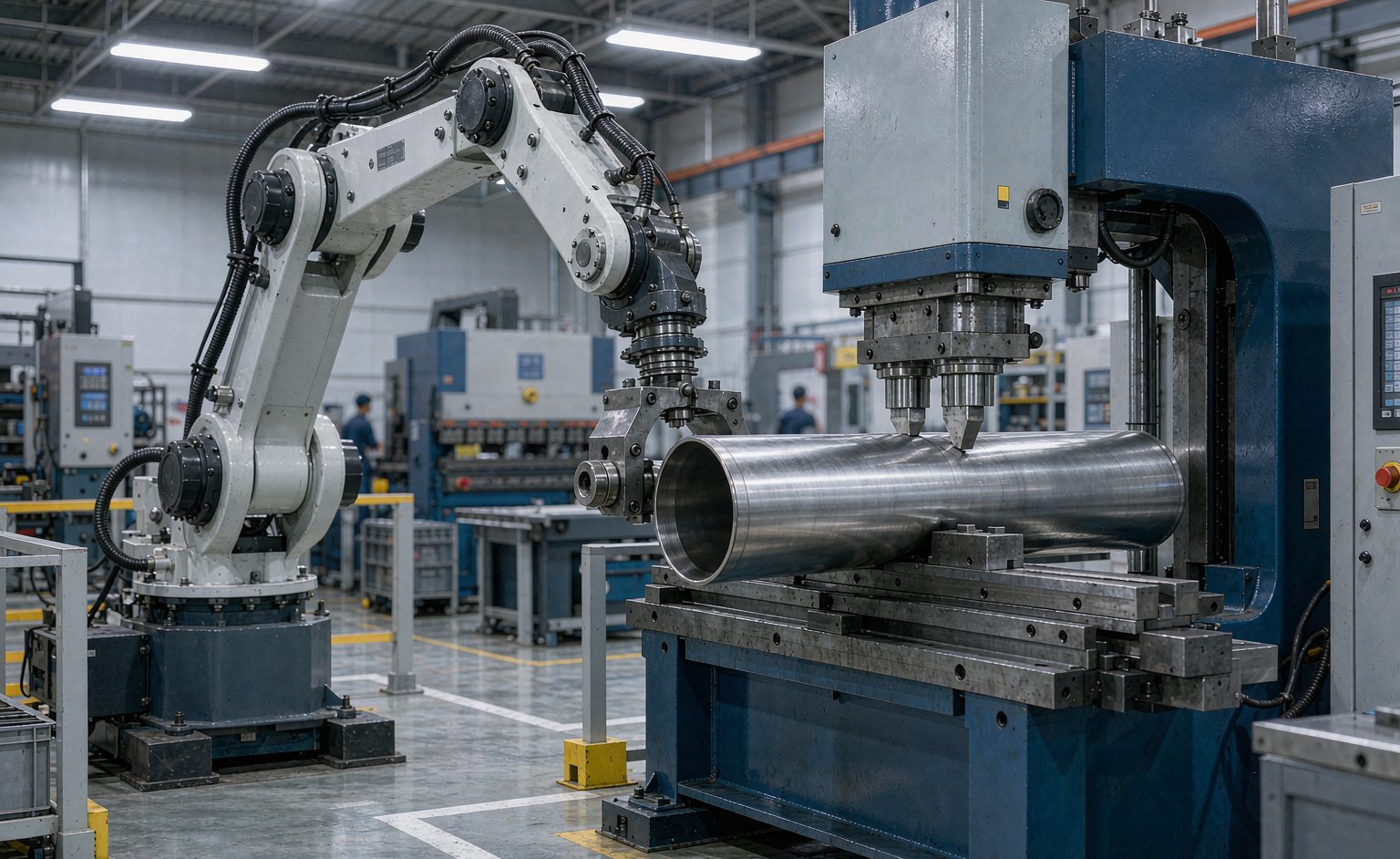
Bending and Forming Robots: Cell Design, Capabilities and ROI for Metal Fabricators
Robotic bending and forming cells have moved from the showcase floor into mainstream metal fabrication, and the operations adopting them report the same pattern: the robot does not replace the press brake — it replaces the inconsistency around it. This guide explains what bending and forming robots actually do, which part families they suit, how a well-designed cell is laid out, and how to build an ROI case that survives contact with your accountant.
What a Robotic Bending Cell Actually Does
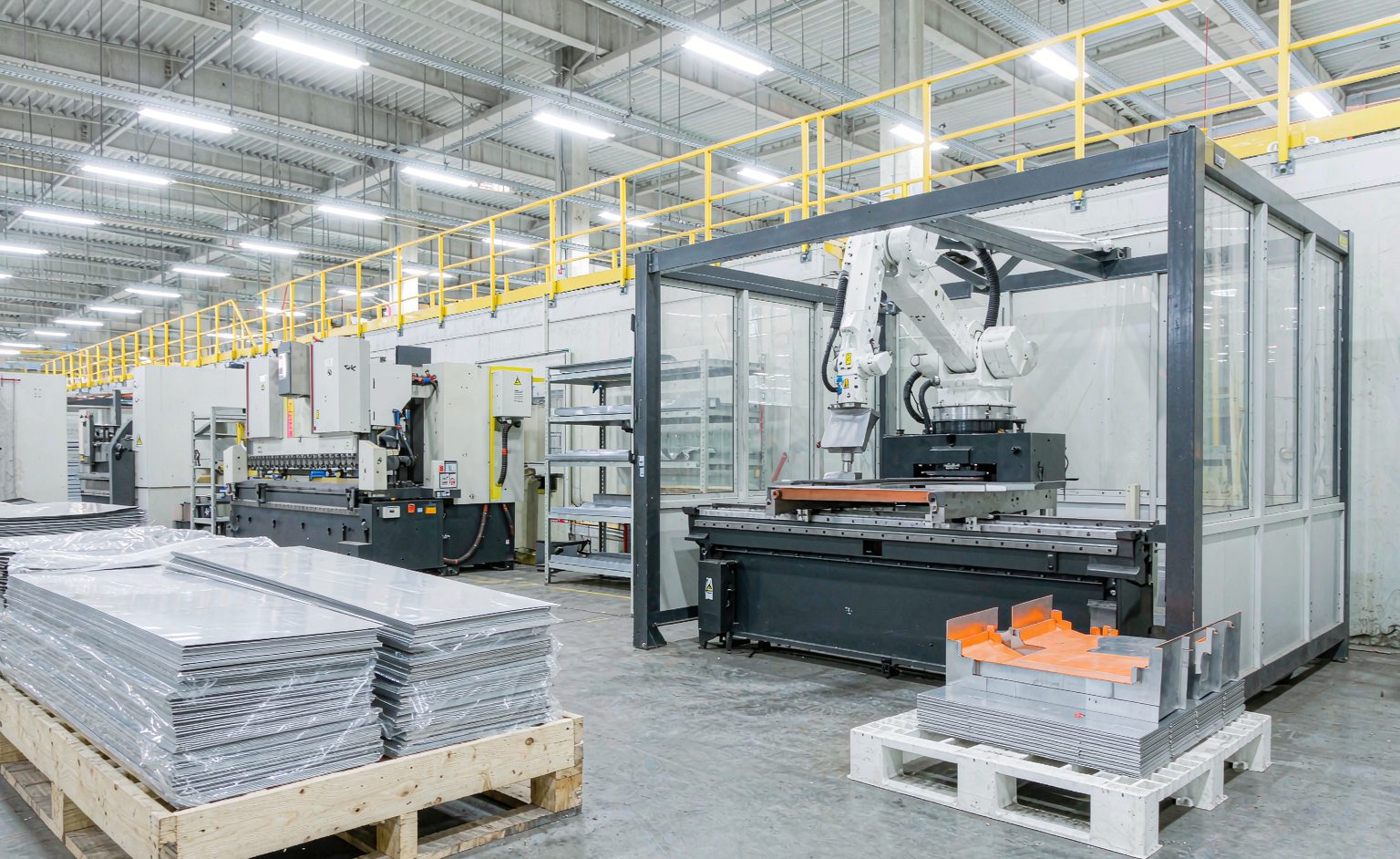
A bending robot cell combines three systems: an industrial arm that handles the part, a CNC press brake or panel bender that forms it, and gripper tooling that bridges the two. The arm loads the blank, repositions it through multiple bends, and unloads the finished part — keeping the brake cutting air instead of waiting for an operator to walk the part through a sequence. The robot’s value is consistency of presentation: the same grip, the same angle, the same timing, every cycle. Fabricators who track their numbers usually find the brake’s utilisation rises from the 30–40% typical of manual operation into the 70–85% range, and that utilisation jump — not the robot’s speed — is where the capacity appears.
Which Parts Suit Robotic Bending — and Which Do Not
| Part character | Robot suitability | Why |
|---|---|---|
| Small-to-medium blanks, 3–8 bends | Ideal | Gripper economies; sequences the robot masters cleanly |
| High-mix, recurring families | Strong | Programs recalled per part, changeovers in minutes |
| Very large panels | Possible with special tooling | Panel benders or dual-arm handling required |
| One-off custom work | Poor | Programming cost exceeds the run’s value |
The one-off row is the honest boundary: robotic bending amortises programming across repeats, and a part that never repeats pays the programming every time. High-mix fabricators solve this with offline programming — bending sequences generated from the 3D model before the blank exists — which shifts the economics back toward variety. Buyers evaluating cells should bring their own part family histogram, not a vendor’s showcase set: the histogram tells you what share of your volume actually sits in the robot’s sweet spot.
Cell Layout: The Decisions You Live With
A bending cell’s layout decides its throughput for life. The blank infeed needs buffer space so the robot never starves; the brake position determines the arm’s reach envelope and therefore its speed; and the outfeed needs sorting or stacking logic so finished parts do not become a new manual bottleneck. Safety architecture — fences, light curtains, area scanners — must be designed in, not retrofitted, because retrofitting shrinks the envelope that justified the cell. Operations adding a bending cell beside an existing welding or machining line should also plan the transport interface: bins, conveyors or AGV paths that connect the cell to the flow, since the cell that runs fast but starves from logistics delivers nothing. The welding-side counterpart to this planning is covered in our guide to multi-axis CNC laser welding workstations.
Building the ROI Case Honestly
| ROI input | Where the number comes from | Common optimism trap |
|---|---|---|
| Current brake utilisation | Measured over two weeks, not estimated | Using nameplate rates as actuals |
| Labour cost per bent part | Fully loaded wage × touch time | Ignoring the operator’s waiting share |
| Scrap and rework rate | Monthly quality data by part family | Averaging across parts that will never run on the cell |
| Volume forecast | Contracted orders, weighted pipeline | Wishful single numbers |
The utilisation row deserves its measurement demand: two weeks of timestamped brake data tells you exactly how much capacity is waiting for hands, and that number — not a vendor’s case study — is the foundation of the payback calculation. The scrap row rewards the same discipline: bending robots reduce the variance that drives rework, but only on the part families that actually migrate to the cell. Fabricators who build the case from their own measured inputs buy with conviction; those who build it from brochures buy a demonstration. Positioner and handling requirements that connect bending cells into full fabrication lines are profiled in the dual-axis U-type positioner.
Implementation: What the First Quarter Looks Like
Realistic implementation runs in three phases. Installation and safety validation take two to four weeks. Program development follows: the first three to five part families are programmed, debugged and measured until their cycle times stabilise — this is where the cell earns or loses its reputation, and scheduling your best parts first builds operator confidence deliberately. The final phase is integration into daily planning: the cell enters the scheduling system, its utilisation joins the weekly review, and the ROI case’s actuals start replacing the forecasts. Operations that treat the first quarter as a measured ramp report smoother adoptions than those that expect nameplate performance on day one — the robot bends metal consistently, but the operation around it learns on a human schedule.
Frequently Asked Questions
Can a bending robot handle different part families in one shift? Yes — that is the core design intent. Gripper changes and program recalls run in minutes, and offline programming lets new families be prepared while the cell runs. The constraint is gripper inventory, not the robot.
How many operators does a bending cell need? Typically one supervisor for one or two cells, loading blanks in bulk and handling exceptions. The labour model shifts from per-part handling to per-cell supervision.
Does robotic bending work with thick plate? It works with what the brake can form — the robot handles the handling. Very thick, very large parts need heavier arms and tooling, and the economics should be checked case by case.
Background reading: industrial robotics and press brake technology explain the underlying technologies referenced throughout this guide.
Choosing the machine rather than the cell? This guide covers cell design and the ROI math. For the equipment side — which bending machine types suit which part families, and how to specify one — see industrial robotic bending machines for precision metal forming automation.