
Ручная и роботизированная лазерная сварка: как выбрать правильную точку входа для вашего производства
Fiber laser welding has reached the price point where the question is no longer whether to switch from TIG and MIG — the physics and economics of that comparison are settled, and our laser versus TIG/MIG breakdown covers them. The question every fabrication shop now faces is more practical: do you enter laser welding with a handheld machine an operator can carry to the work, or with a robotic welding cell that carries the laser instead?
This is a sequencing decision, not just an equipment choice. Pick the wrong entry point and you either under-buy a robot for work that is inherently manual, or over-buy automation for shop that cannot feed it. This guide sets out how the two paths differ in labour, throughput, part fit and cost structure, and how shops typically move from one to the other. The underlying process — a focused beam melting and keyholing the joint — is explained in the laser beam welding overview and in our why fabricators switch to laser primer.
The two product lines, as they actually ship
TrueSyn’s range splits cleanly along the same line as the decision:
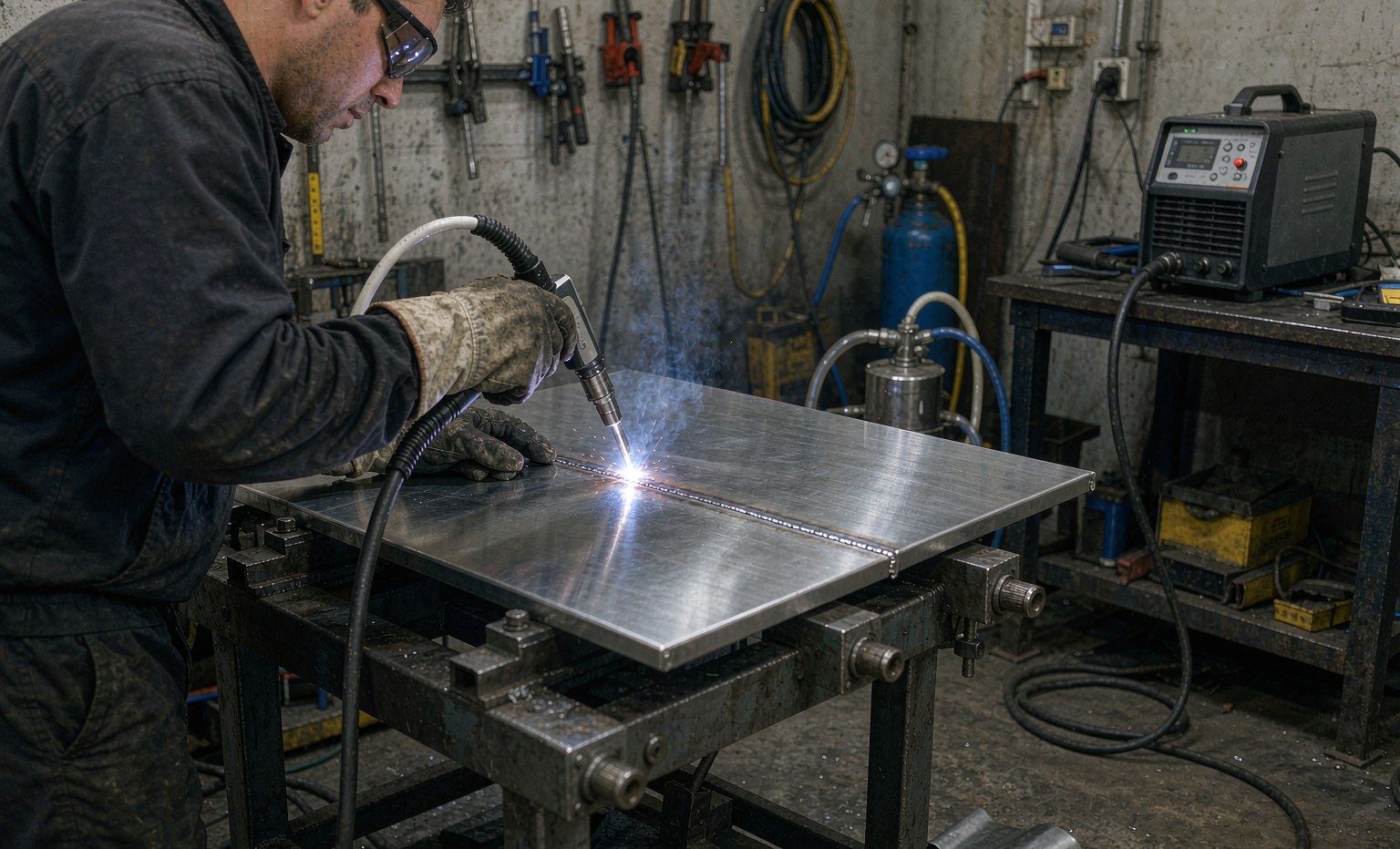
- Ручные лазерные сварочные машины — the handheld series, including water-cooled fiber laser units, where the operator guides a compact welding torch along the joint. Setup is minutes; the machine follows the fitter’s skill.
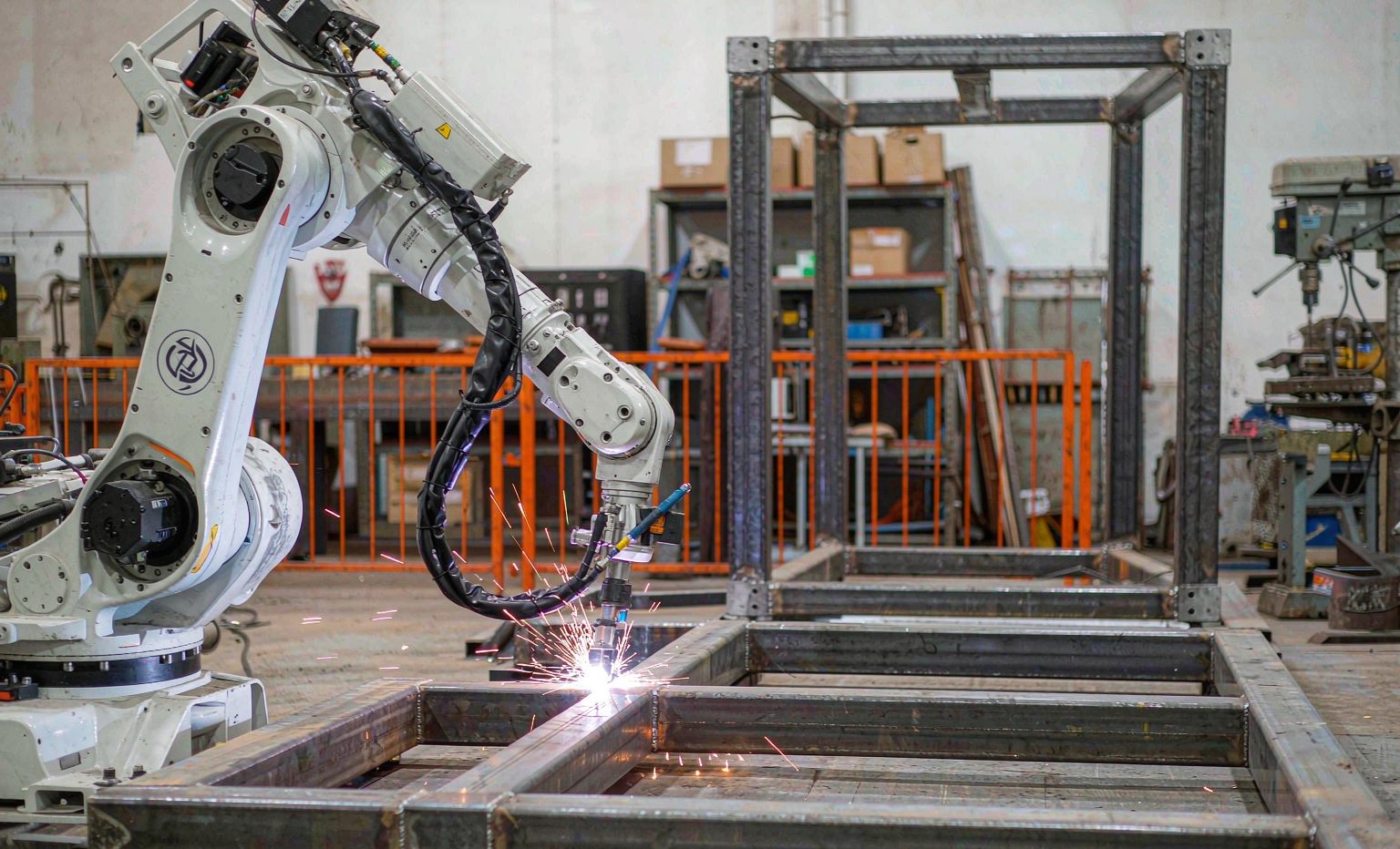
- Роботизированные лазерные сварочные системы — the robot series built on four motion platforms: Yaskawa for motion precision and stability, FANUC for intelligent automation, ABB for high-accuracy positioning and smooth path control, and the TrueSyn series custom-tuned for industry-specific and complex applications. The robot carries the laser head along a programmed path inside a cell.
Handheld: when the work comes to nobody
Handheld laser welding wins where the product mix defeats fixturing: one-off repairs, architectural stainless, railings, tanks, jobbing work where every part is slightly different. The economics are simple — one trained operator, minimal fixture cost, and a working envelope defined by the workshop rather than a robot arm. For shops replacing TIG on thin-gauge stainless and aluminium, a handheld fiber machine is the fastest route to laser speed and distortion control, and it doubles as the training ground for the laser process itself.
The honest limits: output quality follows operator skill, throughput is bounded by one torch and one person, and repetitive production parts waste the machine’s speed on path-following that a fixture and robot would do better. Handheld is also the wrong tool for sealed, high-volume welds where every cycle must be identical — that is repeatability territory, and repeatability is what robots sell.
Robotic: when the part repeats
A robotic cell is the answer when the question is the same joint, thousands of times. The moment a weld moves from an operator’s judgement to a programmed path, three things change: cycle time stabilises, quality becomes statistically predictable instead of individually inspected, and labour scales with cells rather than with certified welders — a constraint that tightens every year. The system-level pieces that make a cell productive (positioners, external axes, fixtures) are covered in the robotic welding cell guide, and the cobot-versus-industrial-robot trade-off for lower-volume automation is compared in our cobot vs industrial robot analysis.
The costs are equally real: fixturing engineering, cell safety integration, programming skills, and a production backlog that justifies the capital. A robot that waits for work is the most expensive torch in the building. That is why the entry question is not “which machine is better” but “does the part repeat, and can we fixture it”.
The typical progression
- Start handheld when work is mixed. Jobbing and repair shops buy the handheld line first; it replaces TIG hours immediately and needs no fixture budget.
- Watch for the repeating part. When one product family grows past a few hundred identical welds per month, that part is a robot candidate — fixture it, program it, and free the handheld for true one-offs.
- Add a cell around the platform that fits. High-speed repeat work suits the FANUC and Yaskawa platforms; complex, industry-specific applications are where the custom-tuned TrueSyn series earns its place; high-accuracy positioning with smooth path control is the ABB case.
- Keep both. Most shops that automate still keep a handheld unit for rework, brackets and the jobs that never see a fixture. The two lines are complementary, not competing.
Whichever line you start on, the downstream engineering questions are shared: joint design and fit-up tolerances (designer’s guide), filler strategy for non-autogenous joints (filler strategy guide), and the budget drivers behind the whole decision (2026 cost factors). Safety practice — enclosures, interlocks and Rated practice for laser operation — belongs in the specification from day one; the Laser Institute of America publishes the baseline guidance most shops reference.
Frequently asked questions
Can a handheld laser welding machine be upgraded to robotic later?
The laser source and the motion system are separate engineering stacks, so the usual path is not upgrading one machine but adding a cell beside it — the handheld stays in service for jobbing work while the robot takes the repeating part. When briefing the cell, specify the same laser process window your operators have already validated on the handheld, which shortens programming and approval.
Which robot brand should a first cell use?
Choose by application, not by badge. Consistent precision and motion stability favour the Yaskawa platform; fast, automation-integrated production favours FANUC; high-accuracy positioning with smooth path control is the ABB strength; and complex, industry-specific applications are where the TrueSyn series is custom-tuned. Tell the integrator the part, the takt time and the accuracy target, and let those three answers pick the platform.
Is handheld laser welding safe for a small workshop?
Yes, with the same discipline as any laser process: rated protective eyewear matched to the wavelength, controlled access to the beam area, and operator training — handheld does not mean unregulated. The convenience of the torch is real, but the beam safety obligations are the shop’s, and they scale with uptime, not with machine size.
Summary
Handheld and robotic laser welding solve different shops’ problems. Handheld — including the water-cooled fiber units in the handheld series — is the fast, low-fixture entry for mixed and jobbing work. Robotic cells on the Yaskawa, FANUC, ABB and TrueSyn platforms are the answer for repeating parts, predictable quality and labour-independent throughput. Most successful shops end up running both, sequenced by one test: does the part repeat, and can it be fixtured? For the application-level decision that follows, continue with the laser welding solution selection guide.