
Revolutionize Light Pole Production with Our Advanced Welding System
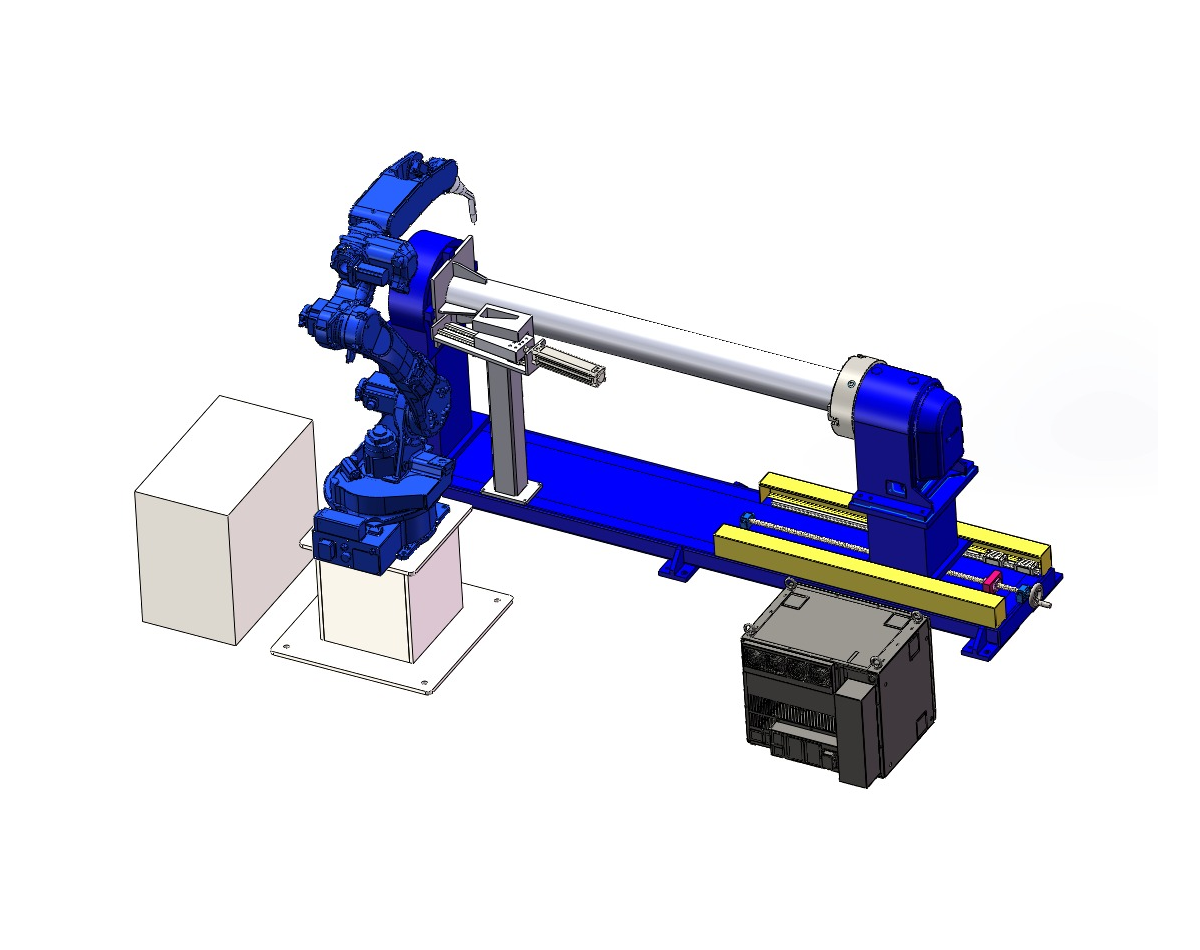
Streetlight Pole Welding Integrated Solution
How It Works:
Easy Setup – Simply manually load the flange and pole into positioner.
Automatic Flange Welding – The robot performs high-quality, consistent welding;
Reinforcing Plate Feeding – The plate feeding mechanism automatically delivers and positions the reinforcing rib.
Automatic Reinforcing Plate – The robot performs high-quality, consistent welding for Reinforcing Plate;
Seamless Rotation – A single-axis rotary positioner ensures smooth welding for a flawless finish.
Key Advantages:
✅ Increased Efficiency – Simple assembly + automated welding = faster production!
✅ Superior Weld Quality – Equipped with a Yaskawa 350A/500A arc welding power source for stable, smooth, and aesthetically pleasing welds.
✅ Reduced Labor Costs – Minimize manual work and maximize productivity with semi-automated operation.
Transform your street light pole welding process today—boost quality, speed, and profitability!
Zhejiang Innovation Laser Equipment Co., Ltd is a leading custom welding solution provider, specializing in robotic welding integration. With deep expertise in automated welding processes, we deliver complete turnkey solutions—from design to implementation—ensuring higher efficiency, precision, and cost savings for your production line.
Light Pole Welding: Long Seams, Thin Walls
A street-light pole is a welding problem of extremes: seams run meters long, walls run 3–6 mm, and roundness must survive both. The challenges, and where the laser answers:
| Challenge | Failure without control | Laser-cell answer |
|---|---|---|
| Meter-long longitudinal seam | Wander, variable penetration | Seam tracking + constant work-distance optics |
| Thin-wall distortion | Ovality beyond install tolerance | Low heat input, balanced seam sequencing |
| Taper and cone sections | Fixture complexity | Rotary axis with synchronized speed control |
| Pre-galvanized surfaces | Zinc outgassing porosity | Parameter windows + ventilation at the seam |
Seam sequencing is the underrated variable: welding both halves in an alternating pattern keeps the pole round, while a single continuous run pulls it oval — a lesson every fixture trial teaches once. For tapered sections, the rotary axis must ramp speed with diameter so the weld pool never sees a moving linear speed; cells that ignore this produce seams that look fine and fail the gauge. Where walls push past the laser’s single-pass comfort, a hybrid laser-MIG arrangement covers medium-thick plate economically — the trade-offs are in hybrid laser-MIG welding, and the cell implementation path in laser welding robot system implementation. Reference: street lighting and hot-dip galvanization.
The Gauge That Decides Acceptance
Poles are judged at installation: a pole that will not accept its base plate or bracket stops a crew for hours, and the crew remembers the supplier. Acceptance therefore runs on gauges, not impressions — an ovality gauge at three heights, a seam visual standard agreed by photo set, and a straightness check over the full length. Specify all three in the purchase order and rehearse them at the trial. The economics favor this severity: one pole replaced in the field costs more than the gauge set, and field rejection rates collapse when ovality is measured at the cell rather than discovered at the job site. Cells that log gauge results per pole also build the quality history that warranty conversations eventually need.
For buyers comparing processes on poles: welded-then-galvanized routes need vent holes and re-galvanizing of the weld zone, while galvanized-then-welded routes need the porosity countermeasures in the table. The choice trades coating integrity against process simplicity, and the trial should run both on sample sections before the line is specified.
Submit Requirements
Technical Evaluation
Design & Production
Delivery & Support
Reliable After-Sales Service You Can Trust.
Our service team offers quick troubleshooting, remote assistance, on-site support, and lifetime technical guidance to keep your production stable and efficient.
Email Address
Company Address
Building 1, Wanli Science&Innovation Industrial Park, 104 National Road, Shangyu District, Shaoxing, Zhejiang, China,312300
Opening Hour
Monday to Friday: 9:00 AM to 7:00 PM Saturday to Sunday: 9:00 AM to 5:00 PM
Get in Touch
Tell us your needs — we’ll reply soon.