
-
4 August, 2026
- 0 Comment
CO2 Laser Welding vs Fiber Laser Welding: What Is the Difference?
When choosing a laser welding system, one question often comes up: CO2 laser or fiber laser?
Both technologies use laser energy for welding, but they are different in terms of laser source, system design and typical applications.
For most modern metal welding applications, fiber laser welding has become a common choice, especially when automation and robotic integration are required.
CO2 Laser Welding
CO2 lasers have been used in industrial applications for many years.
They are still used in some specific processes where existing equipment and production requirements match this technology.
However, for metal welding, CO2 laser systems usually require more complex optical components and are less convenient for integration with robotic welding systems.
Fiber Laser Welding
Fiber laser welding is now widely used in metal fabrication and industrial automation.
Compared with CO2 laser systems, fiber lasers offer:
- More compact design
- Lower maintenance requirements
- Better energy efficiency
- Easier integration with robots
Fiber laser welding is commonly applied to:
- Stainless steel parts
- Aluminum components
- Automotive parts
- Sheet metal products
- Industrial equipment
For manufacturers planning to automate their welding process, fiber laser is often a practical choice.
Which One Should You Choose?
The answer depends on the application.
Before selecting a laser welding system, it is important to check:
- Material type and thickness
- Weld requirements
- Production volume
- Whether robotic automation is needed
In many robotic welding projects, the laser source is only one part of the system. Robot selection, fixture design and welding process adjustment also affect the final result.
Fiber Laser Welding in Robotic Automation
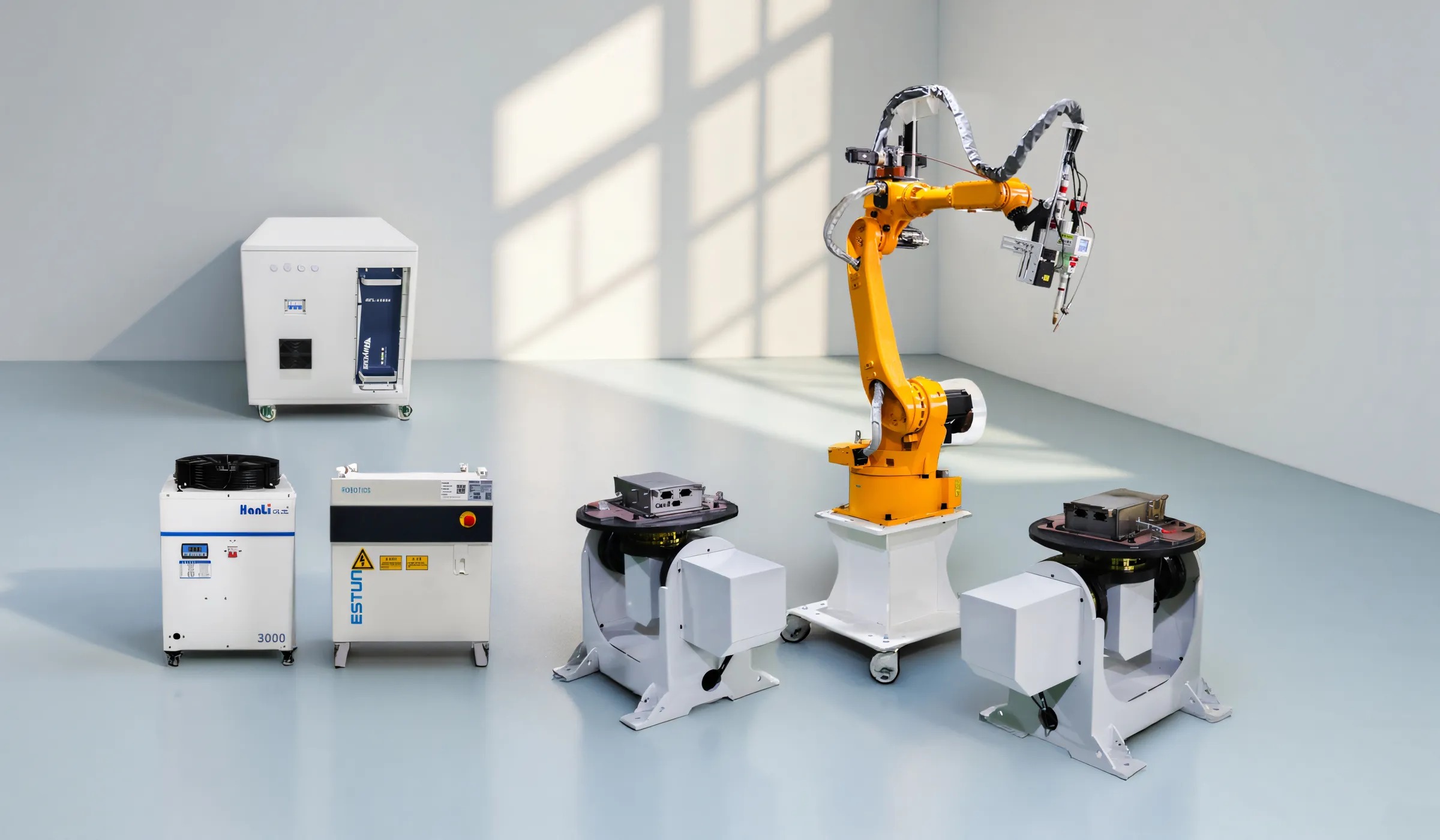
A robotic fiber laser welding system usually combines:
- Industrial robot
- Fiber laser source
- Welding head
- Customized fixture
- Control system
This combination allows manufacturers to improve welding consistency and reduce dependence on manual operation.
At TrueSyn Laser, we focus on customized robotic laser welding solutions, helping manufacturers integrate laser technology with automation systems based on their production needs.
CO2 vs Fiber — The Difference That Decides
The wavelength difference drives everything else. The table translates it into buying terms.
| Aspect | CO2 (10.6 μm) | Fiber (1.07 μm) |
|---|---|---|
| Reflective metals | Poor on Al/Cu | Good with control |
| Electrical efficiency | ~10% | ~40% |
| Thin-sheet speed | Good | Faster |
| Maintenance | Mirrors, gas | Minimal, sealed source |
Frequently Asked Questions
Is CO2 obsolete?
For welding certain non-metal applications and very thick mild steel, legacy CO2 lines still run fine. For new metal-cell purchases, fiber dominates.
Fiber wattage to start?
1.5–3 kW covers most sheet welding; step up only for thick sections or speed targets.
Cell context: laser welding robot and handheld vs robotic. Physics: laser beam welding.
Material Fit at a Glance
Wavelength decides absorption, and absorption decides which source suits which metal:
| Material | 1 µm (fiber) | 10.6 µm (CO2) | Practical note |
|---|---|---|---|
| Mild steel | Good absorption | Good absorption | Both work; fiber for speed and cost |
| Stainless | Good absorption | Good absorption | Fiber wins on thin-gauge speed |
| Aluminum | Absorbs better at 1 µm | High reflectivity challenge | Fiber with ring-mode control preferred |
| Copper/brass | Absorbs, esp. green-boosted | Poor; largely reflected | Fiber (or green laser) effectively required |
| Non-metals | Transparent — unsuitable | Absorbed well | CO2 remains the tool for polymers, wood, acrylic |
Maintenance contrasts follow the same physics. CO2 machines carry mirrors and a laser gas mix — alignment routines and consumable gas that trained staff must service. Fiber machines deliver the beam through armored fiber with no alignment, and their service story is mostly optics cleanliness and chiller health. That difference, as much as efficiency, explains why fiber has become the default for metal fabrication while CO2 holds the non-metal niche it earned decades ago.