
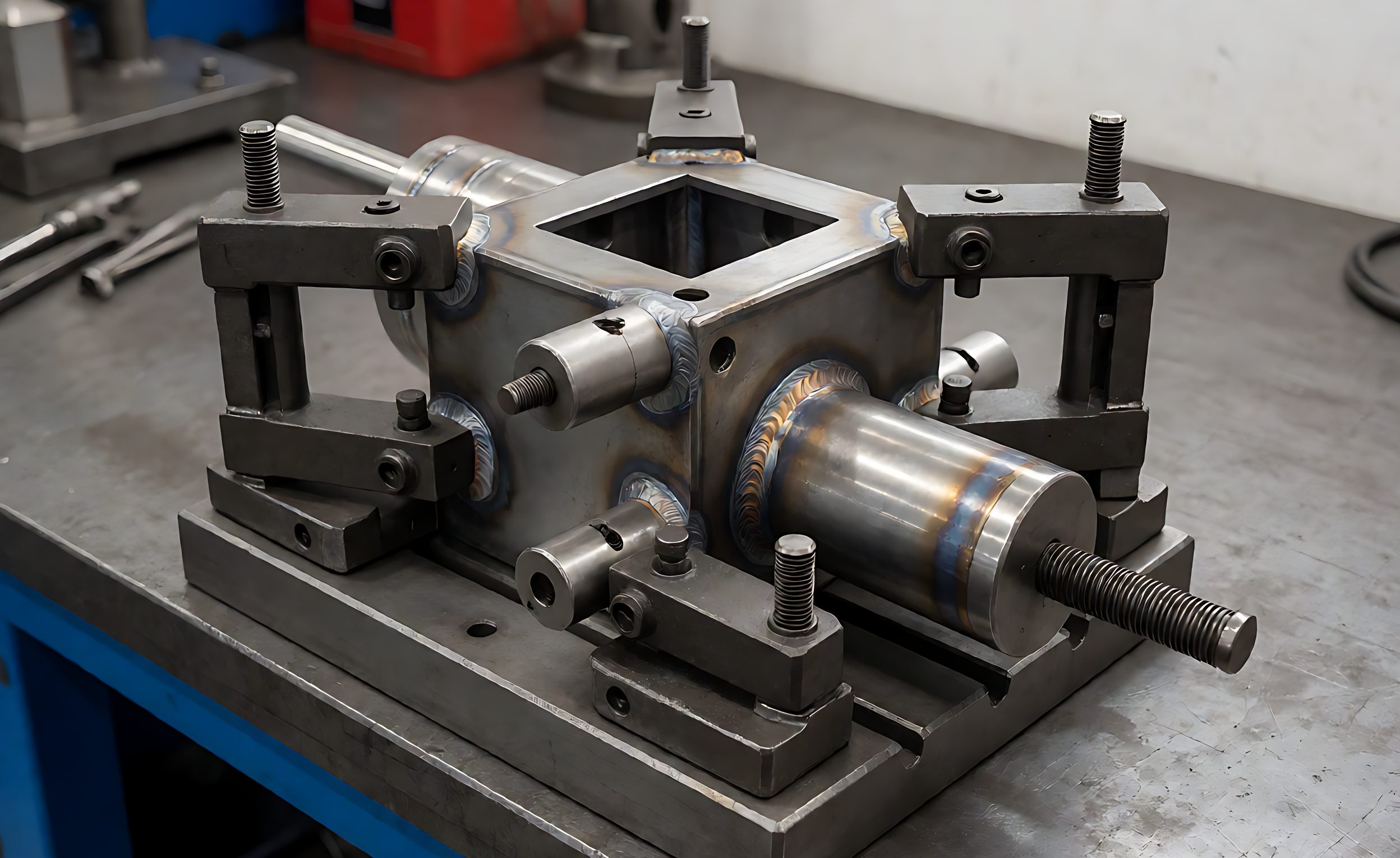
Welding Cell Tooling Repeatability and Locator Design
A robot datasheet quotes repeatability in hundredths of a millimetre, and buyers reasonably assume that is the accuracy their weld will see. It is not. The robot returns to a taught point; what determines where the joint actually is when the beam arrives is the fixture, the locators, the clamps and the part itself. Repeatability at the weld is a property of the tooling, and it is designed rather than inherited from the robot.
This matters commercially because tooling is where cell budgets quietly expand. A joint tolerance that looked achievable on the drawing turns into a fixture redesign, a second fixture iteration, or a permanent seam-tracking requirement. Five topics settle it early: where repeatability comes from, how locators are designed, how clamping and distortion fit in, how repeatability is verified at buyoff, and how it is kept through production.
Where the Repeatability Actually Comes From
Two numbers get confused constantly, and separating them clarifies most arguments:
- Robot repeatability: the ability to return to a taught point. Excellent on any modern robot, and largely irrelevant if the part is somewhere else.
- Fixture repeatability: the ability to put every part in the same place. This is the number that governs weld quality, and it is produced by locators, clamps and part consistency.
- Part variation: the input the fixture cannot remove. If stampings vary by half a millimetre, no fixture will make the joint land the same way twice.
- Programme compensation: seam tracking or a taught search can follow the part, but it cannot correct a joint that is geometrically wrong before welding.
- Thermal growth: a fixture that heats up during a shift moves, which is why warm-up and duty cycle belong in the repeatability conversation.
The combined error is what the weld sees. Buyers who specify only the robot number end up commissioning a cell that meets its datasheet and misses its parts.
Locator Design: Datums and the 3-2-1 Method
Locating is the core of the fixture, and the principles are old, simple and routinely violated:
- Choose datums from function: locate from the features that matter to the finished assembly, not from whatever hole happens to be convenient.
- 3-2-1 restraint: three points define a plane, two define a line, one fixes the remaining position. Over-constraining a part forces it to bend to the fixture.
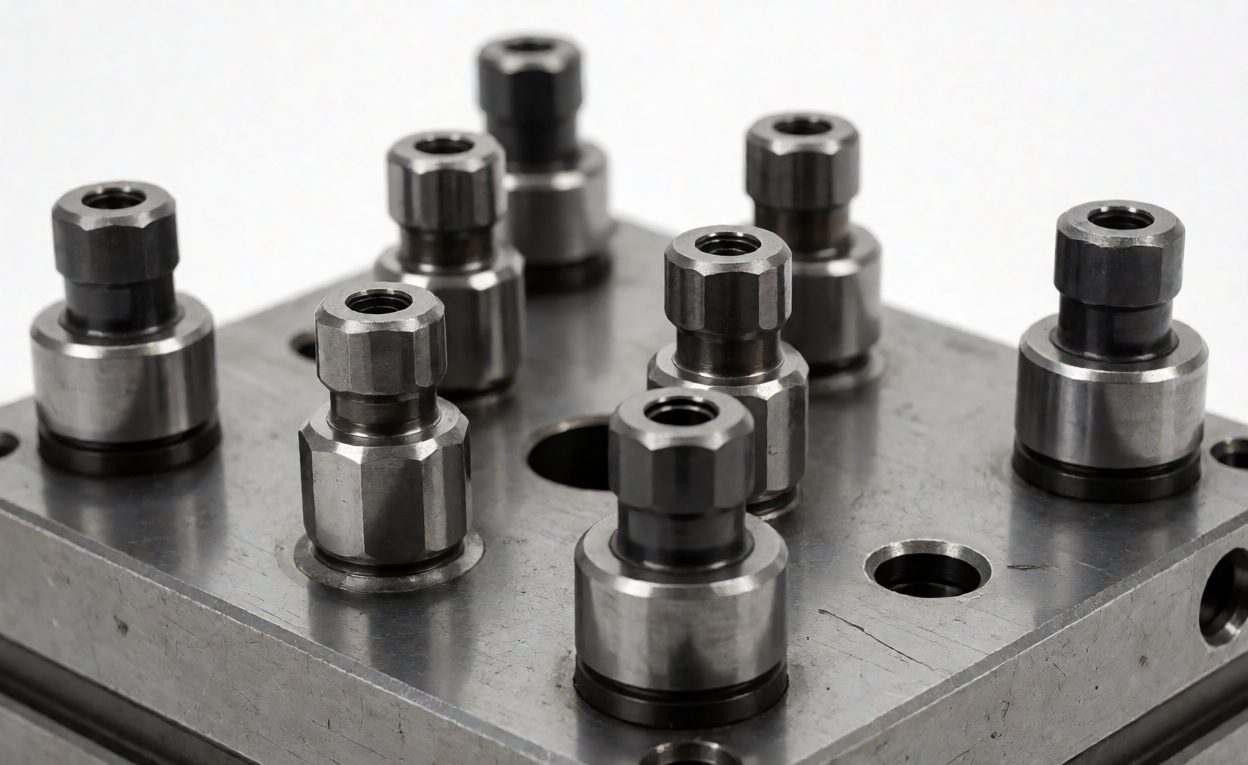
- Hardened, replaceable locators: pins and pads wear, get hit and get spattered. Making them replaceable turns a fixture rebuild into a ten-minute job.
- Positive seating: clamps should push the part onto the locators, never hold it away from them while friction does the locating.
- Relief for variation: locator pads sized and shaped so normal part variation, burrs and coating thickness do not lift the part off its datum.
- Datum features on the print: geometric dimensioning and tolerancing exists to state this unambiguously, and a fixture built without it is built on assumptions.

Clamps, Supports and Distortion
Clamping is not just holding; it is the second half of locating and the main defence against distortion:
- Clamp sequence: locate first, clamp second, and clamp toward the locators. A sequence that clamps in the wrong order moves the part after it has been located.
- Clamp force and placement: enough to resist welding distortion, placed close to the joint where the movement happens.
- Supports under the weld zone: backing bars and copper backing control root shape and sink heat, and they are a process decision as much as a tooling one.
- Access for the head: clamps must clear the welding head and the shielding gas nozzle through the whole path, which is a common reason for a second fixture iteration.
- Quick change: where several part numbers share a cell, the quick-change and pallet systems approach keeps changeover short without giving up locator precision.
Scope matters here too. Who designs the fixture, who owns the drawings, and who holds the spare locators are questions worth answering in writing; the tooling scope and spares article sets out how that split is normally drawn.
Verifying Repeatability at Buyoff
Repeatability that is not measured is a belief. A short verification at commissioning settles it:
- Load and unload the same part ten times and measure the same features each time, on a coordinate measuring machine or with a dial indicator on the fixture itself.
- Measure after clamping, not before, because clamping is where most of the movement happens.
- Run several parts rather than one, so part variation appears separately from fixture variation.
- Weld and re-measure, because distortion is the error the customer sees and the one nobody measures.
- Record the results as the fixture baseline, which becomes the reference when quality drifts a year later.

Keeping It Through Production
Fixtures degrade quietly. A short routine keeps them honest:
- Clean locator faces each shift: spatter on a pad lifts the part by exactly the amount that matters.
- Inspect pins and bushings weekly: wear and impact damage show up as rising variation long before they show up as scrap.
- Re-verify on a schedule: repeat the ten-load check quarterly, or after any fixture repair or crash.
- Control changeovers: the more often a fixture is swapped, the more often its location must be confirmed.
The payoff lands in the same place as every other tooling decision: the weld. Repeatable fixturing is what makes the acceptance criteria achievable and the locator design worth the effort, and it is what lets penetration depth be verified against a stable joint in the first place, as described in the penetration verification article.
Frequently Asked Questions
Is robot repeatability enough on its own?
No. The fixture decides where the joint is; the robot only returns to a taught point accurately.
Why use the 3-2-1 locating method?
It restrains all degrees of freedom without forcing the part to bend against redundant locators.
How much variation should a fixture allow?
Far less than the joint tolerance. Budget fixture error as a small fraction of the weld window.
Should locators be replaceable?
Yes. Hardened, replaceable pins turn wear and impact damage into a short job rather than a rebuild.
How is fixture repeatability verified?
Load the same part repeatedly, measure after clamping, weld and re-measure, and keep the results as a baseline.
Does spatter really affect accuracy?
Yes. Spatter on a locator pad lifts the part by exactly the amount the process cannot tolerate.
Who should own the fixture drawings?
Decide in writing at contract. Ambiguity here is the usual cause of a stalled second fixture order.