
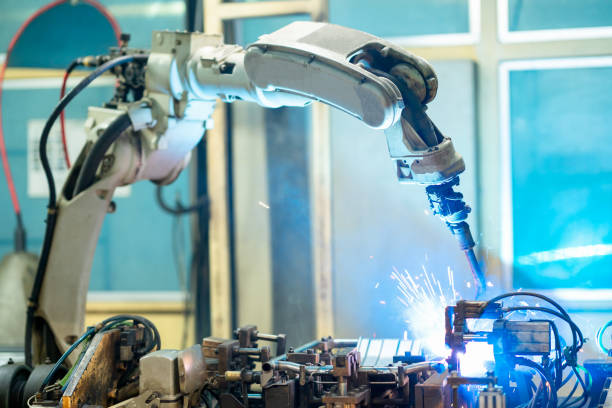
The Future of High-Speed Fabrication: Why Every Tier-1 Supplier is Transitioning to an Automated Fiber Laser Welding Cell
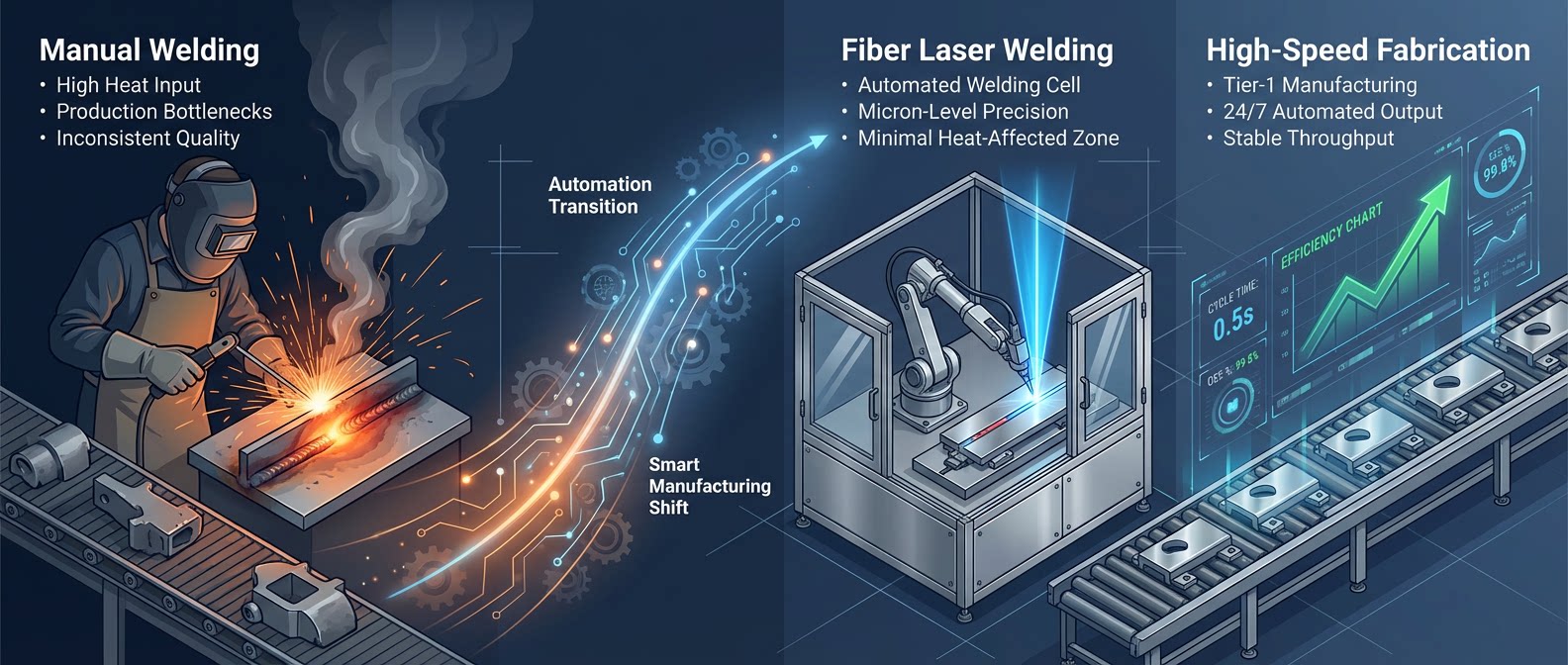
The global manufacturing landscape is facing an unprecedented convergence of labor shortages and tightening tolerance requirements. For factory engineers, the traditional manual welding station has become the ultimate bottleneck. To remain competitive, leading manufacturers are now deploying the Automated Fiber Laser Welding Cell as their primary production engine. These systems offer the rare combination of high-speed processing and surgical precision that legacy arc welding cannot match.
At TrueSyn Intelligent Equipment, we specialize in high-duty cycle automation. An Automated Fiber Laser Welding Cell is not merely a machine; it is a synchronized ecosystem of fiber laser sources, multi-axis robotics, and intelligent workholding. By integrating 2000W to 6000W laser sources with precision motion control, we enable factories to achieve zero-defect production while reducing floor space requirements and energy consumption. Our goal is to provide a turnkey solution that delivers immediate ROI through eliminated post-processing and drastically reduced cycle times.
The Physics of High-Speed Metal Joining: Beam Quality and Weld Pool Stability
The technical superiority of a laser-based system begins with the laser source itself. Unlike traditional heat sources, the fiber laser generates a coherent beam of light that can be focused to a diffraction-limited spot. This results in a power density so high that it bypasses standard heat conduction, entering the “Keyhole Welding” regime. To fully grasp these advanced thermal dynamics, engineers should know about laser principles and the M2 beam quality factor.
In an Automated Fiber Laser Welding Cell, weld pool stability is maintained through high-frequency beam oscillation, or “wobbling.” This technique allows the laser to bridge larger fit-up gaps while controlling the solidification rate of the melt pool. The result is a high-aspect-ratio weld—narrow and deep—that minimizes the Heat-Affected Zone (HAZ) and prevents the structural weakening of the base metal. This is particularly critical for high-strength steels and aluminum alloys used in lightweight vehicle construction.
- Continuous Wave (CW) Delivery: Ensures a steady energy flow for uniform penetration depth across long seams.
- High Aspect Ratio: Achieves deep penetration (up to 5mm-8mm) with a bead width often under 1.5mm.
- Minimal Thermal Input: Prevents macro-deformation, allowing for the welding of pre-finished or precision-machined parts.
First-Hand Experience: Scaling Production with 3,000+ Robotic Sets
Zhejiang TrueSyn Intelligent Equipment Co., Ltd. was founded in 2013 with a single mission: to master the intersection of laser technology and robotics. Today, we have over 5,000 laser units sold globally and 30+ global offices supporting our clients. You can read more about our technical heritage and global footprint about us. Our expertise is built on the factory floor, solving the real-world problems that arise when theory meets reality.
In our experience deploying over 3,000 laser welding sets, the most successful installations are those that prioritize part accessibility. We recently integrated a TrueSyn laser welding robot ABB series with a dual-axis U-type positioner for a heavy equipment manufacturer. By synchronizing the robot’s 6 axes with the positioner’s 2 axes, we maintained a “down-hand” welding position for a complex 3D structural frame. This synchronization ensured that gravity worked with the weld pool, not against it, resulting in a 100% leak-proof seal for hydraulic reservoirs—a task previously impossible with manual welding.
We have found that many factories struggle with “automation anxiety”—the fear that high-tech systems are too complex to maintain. TrueSyn solves this by providing modular cells with integrated self-diagnostics. Our sensors monitor everything from protective window cleanliness to shielding gas flow rates, alerting operators before a defect can occur.
Technical Specifications: Comparing Automated Architecture
Selecting the right Automated Fiber Laser Welding Cell requires an objective analysis of throughput vs. flexibility. The following table highlights the performance differences between manual TIG welding and our integrated robotic cells.
| Technical Metric | Manual TIG Welding | TrueSyn Automated Cell |
|---|---|---|
| Welding Speed (2mm SS) | 0.1 – 0.2 m/min | 3.0 – 5.0 m/min |
| Heat-Affected Zone (HAZ) | Large (8mm+) | Ultra-Narrow (0.5mm) |
| Weld Consistency | Operator Dependent | Digital Repeatability (±0.05mm) |
| Post-Weld Processing | Grinding/Acid Pickling | None (Direct to Paint/Ship) |
Our comprehensive product line includes standard cells for small components and custom-engineered gantry systems for large-scale aerospace parts. Every system is tested with the customer’s specific material to ensure that penetration depth and bead aesthetics meet the required standards before shipment.
Industry Applications: Driving Innovation in Automotive and Beyond
The Automated Fiber Laser Welding Cell has become a cornerstone of “Industry 4.0.” TrueSyn’s equipment is currently deployed across various high-growth industry applications where traditional methods fail to meet modern standards.
- Electric Vehicles (EV): Welding aluminum battery trays and copper busbars with high conductivity and minimal heat input.
- Aerospace: Joining thin-wall titanium tubes and honeycomb structures with zero oxidation.
- Medical Device: Precision hermetic sealing of stainless steel pacemaker housings and surgical instruments.
- Kitchenware & Appliances: Creating seamless, sanitary corner welds on sinks and refrigerators that require no secondary grinding.
In the automotive industry, the transition to aluminum frames has made laser welding mandatory. The speed of the Automated Fiber Laser Welding Cell allows manufacturers to reduce the number of welding stations by 70%, drastically lowering the total cost of ownership while improving the structural crashworthiness of the vehicle.
Frequently Asked Questions (FAQ)
What is the typical ROI for an Automated Fiber Laser Welding Cell?
Most TrueSyn clients achieve full ROI within 12 to 18 months. This is driven by a 5x to 10x increase in welding speed, the elimination of post-weld grinding labor, and a significant reduction in scrap rates compared to manual arc welding.
Can a fiber laser welding cell handle dissimilar metals?
Yes. By utilizing precise power modulation and specialized beam paths, our cells can join dissimilar metals like copper to aluminum or stainless steel to carbon steel. This is critical for modern electronics and heat exchanger manufacturing.
How difficult is it to program a new part for the robot?
TrueSyn utilizes advanced offline programming software. You can import your 3D CAD model, and the software will automatically generate the welding path. This reduces part changeover time from days to just a few hours.
What are the safety requirements for a laser welding cell?
All TrueSyn Automated Fiber Laser Welding Cells are designed as Class 1 safety enclosures. This means they are light-tight and equipped with safety interlocks and laser-rated viewing glass, ensuring that operators are 100% protected from infrared radiation.
Are you ready to eliminate your production bottlenecks? TrueSyn’s engineering team is ready to analyze your parts and provide a custom automation roadmap. Stop fighting thermal distortion and start delivering precision with an Automated Fiber Laser Welding Cell.
Contact us today for a technical consultation: Contact TrueSyn Intelligent Equipment.