
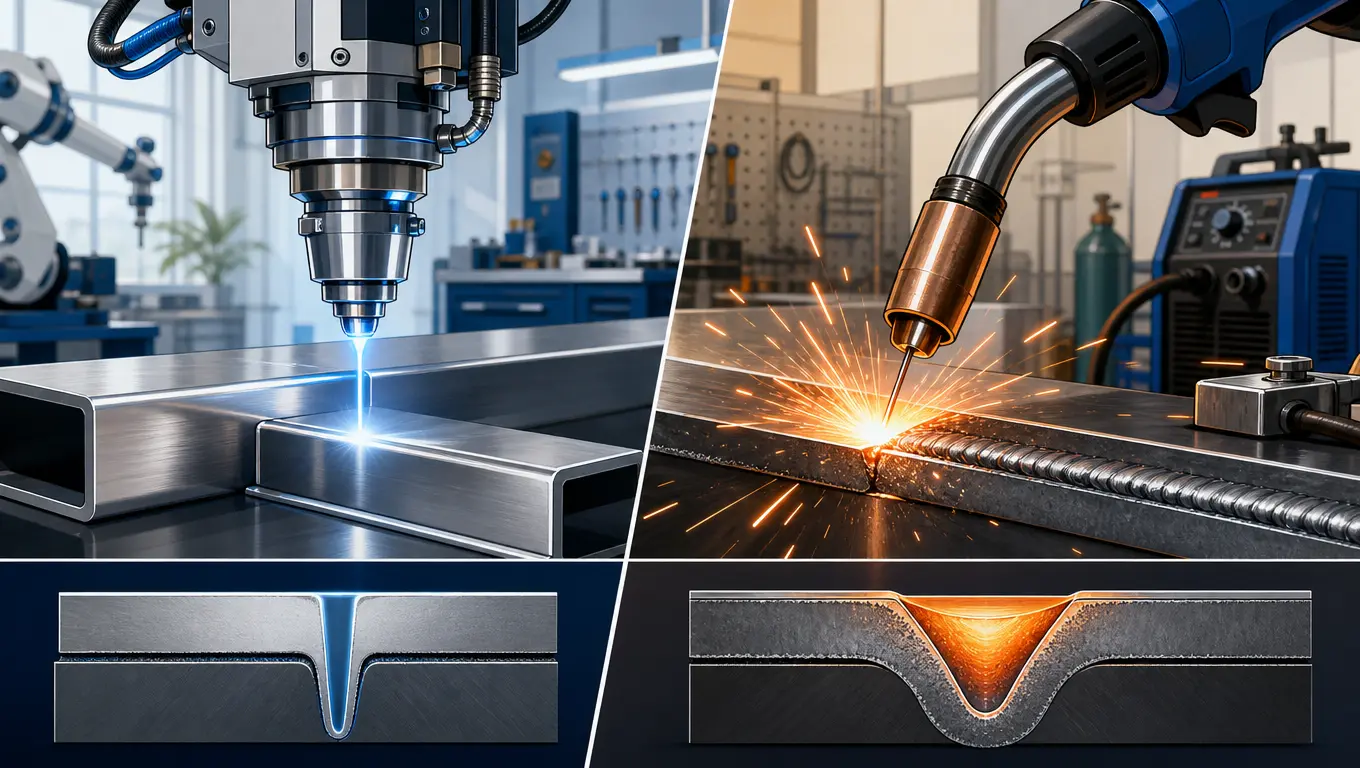
Laser Welding vs MIG Welding: A Technical Comparison for 2026 Industrial Fabrication
As industrial metal fabrication scales toward smarter, more automated manufacturing lines, engineers face a critical decision: should they stick with proven traditional arc methods or upgrade to advanced fiber laser systems? In 2026, stricter global energy conservation guidelines and rising labor costs are pushing manufacturers to optimize joint preparation and assembly speeds.
This comprehensive technical guide evaluates the core differences between laser welding vs mig welding (Metal Inert Gas), as well as TIG (Tungsten Inert Gas), helping you determine which process aligns with your production tolerances, output volumes, and budget requirements.
1. Core Process Comparison
To evaluate these technologies, we must look at how energy is transferred to the base metals. Traditional processes rely on electric arcs to melt consumable wire or the parent metal, while laser systems employ highly concentrated coherent light beams.
- MIG Welding (GMAW): Uses a continuously fed consumable wire electrode shielded by an external gas (typically Argon and CO₂ mixtures). The electrical arc generates thermal energy that melts both the wire and the substrate, forming a relatively wide weld pool.
- TIG Welding (GTAW): Utilizes a non-consumable tungsten electrode and a separate filler rod. It offers excellent cosmetic appearance but requires highly skilled manual labor or complex automation.
- Fiber Laser Welding: Employs a high-density, collimated laser beam to melt metal. In keyhole welding mode, the localized heat vaporizes a tiny column of metal, creating a deep, narrow penetration profile at high speeds.
Technical Comparison Matrix
| Parameter | Fiber Laser Welding | MIG Welding (GMAW) | TIG Welding (GTAW) |
|---|---|---|---|
| Welding Speed | Very High (up to 100 mm/s) | Moderate (10–25 mm/s) | Low (3–8 mm/s) |
| Heat-Affected Zone (HAZ) | Extremely Narrow (<0.5 mm) | Wide (3–6 mm) | Moderate to Wide |
| Post-Weld Processing | Minimal to none | High (grinding & cleaning required) | Low to Moderate (pickling/brushing) |
| Joint Fit-up Tolerance | Strict (typically <10% of sheet thickness) | High (forgiving with filler wire) | Moderate |
| Thermal Distortion | Extremely Low | High | Moderate to High |
| Automation Suitability | Excellent (native to robotic laser welding) | Good (robotic arc welding systems) | Moderate (complex pathing) |
2. Deep Dive: Thermal Dynamics and Structural Integrity
The primary advantage of laser technology lies in its energy density. A fiber laser focusing 1.5kW to 3kW of power onto a spot size of 100 to 150 microns achieves power densities exceeding 106 W/cm². This rapid heat concentration yields distinct metallurgical properties:
Heat-Affected Zone (HAZ) & Microstructure
Because the heat input of a fiber laser is highly localized, the adjacent metal experiences very little thermal conduction. In contrast, MIG welding disperses significant thermal energy into the surrounding material. According to data published by the American Welding Society (AWS), a wider HAZ increases the risk of grain growth, phase transformation, and localized softening—especially in high-strength steels and heat-treated aluminum alloys. Using an industrial laser welding machine maintains the original microstructure of the parent material far better than conventional arc welding.
Engineering Note: When joining thin-gauge stainless steel (e.g., 1.5mm AISI 304), MIG welding often causes buckling, warping, or burn-through due to excess heat accumulation. Fiber laser systems can complete these welds with virtually zero visible deformation, eliminating the need for post-weld straightening fixtures.
Weld Penetration and Aspect Ratio
The aspect ratio (depth-to-width ratio) of a laser weld can exceed 10:1 when operating in keyhole mode. Standard MIG welds typically exhibit an aspect ratio of 1:1 to 1:2. The deep, narrow profile of laser welds ensures strong joints with less deposited filler metal, minimizing both part weight and consumable consumption.
3. The Shift to Robotic Laser Welding
Manual laser welding, while highly efficient with modern lightweight handheld laser welding units, has limitations regarding high-duty cycles and strict repeatability. To maximize throughput, the industry has shifted rapidly toward automation.
A modern robotic laser welding workstation integrates a multi-axis articulated robot arm with a high-power fiber laser source, a water chiller, and a precision wobble welding head. The wobble function (weaving the laser beam in circular, linear, or figure-eight patterns) effectively addresses the tight joint-fitment tolerances of traditional laser systems. By expanding the effective beam diameter up to 2.5mm, wobble heads allow robot systems to weld joints with slightly inconsistent gaps while maintaining high speed and excellent bead aesthetics.
Key Components of an Automated Welding Cell
- Articulated Robot Arm: Typically a 6-axis manipulator designed with high path accuracy (repeatability of ±0.03mm or better).
- Laser Source: IPG, Maxphotonics, or Raycus continuous wave (CW) fiber laser units ranging from 1.5kW to 6kW.
- Wobble Welding Head: Dynamic galvanometer mirrors sweep the beam at high frequencies to bridge fit-up variations.
- Vision and Seam Tracking: Real-time laser seam tracking sensors compensate for part tolerances on-the-fly, ensuring the beam stays centered on the joint.
4. Cost-Benefit Analysis and ROI Calculation
When comparing laser welding vs mig welding from a financial standpoint, we must look beyond initial capital expenditure (CapEx) to analyze operating expenditures (OpEx) and labor costs.
According to 2025 industrial automation market data, here is a comparative breakdown of a typical production run of 50,000 structural brackets made of 3mm carbon steel:
Production Scenario Cost Comparison
- Labor Cost: Standard MIG welding requires highly certified welders, whose wages have risen globally. Robotic laser systems can be operated by a single machine loader/unloader, significantly decreasing labor overhead.
- Consumables: MIG welding consumes wire electrodes and high volumes of shielding gas (typically 15-20 L/min). Laser welding uses minimal shielding gas (typically Nitrogen or Argon at 10-15 L/min) and often requires zero filler wire for autogenous joints.
- Post-Weld Processing: MIG-welded brackets require grinding, spatter removal, and polishing, adding up to 2-3 minutes of secondary labor per part. Laser-welded parts are usually ready for powder coating or immediate assembly without any post-processing.
5. Material and Thickness Limitations
Despite the high-speed advantages of fiber lasers, MIG and TIG processes remain relevant for specific industrial applications due to thickness limitations.
Evaluating Laser Welding Metal Thickness Limits
For standard single-pass joints without filler wire, a typical 3kW fiber laser can weld up to 6mm carbon steel or stainless steel. Increasing this limit requires higher-power lasers (e.g., 6kW to 12kW) or dual-wire feed systems, which significantly increases the system’s capital cost.
For plates thicker than 10mm, conventional MIG welding with multi-pass joint preparations remains the industry standard, providing high weld-metal deposition rates and deep fusion across thick cross-sections.
On the opposite end of the spectrum, when evaluating fiber laser welding vs TIG welding for thin foils or high-precision instrument casings (under 1mm), laser welding provides a degree of speed and heat control that TIG cannot match without risking thermal burn-through.
6. Frequently Asked Questions
Q: What are the primary laser welding metal thickness limits compared to MIG?
A: For autogenous (no filler wire) single-pass fiber laser welding, the practical metal thickness limit is roughly 8mm for stainless and carbon steels. MIG welding can join plates of virtually unlimited thickness by using multi-pass bevel preparations, though this requires more time and filler material.
Q: How does fiber laser welding vs TIG welding compare in terms of cosmetic finish?
A: While manual TIG welding is renowned for its aesthetic “stack of dimes” appearance, it is a slow process. Fiber laser welding achieves a smoother, more uniform, and narrower weld seam at speeds up to 10 times faster than TIG. It also reduces metal discoloration (oxidation) due to its minimal heat input.
Q: What is the typical robotic laser welding system cost?
A: A complete entry-to-mid-level industrial robotic laser welding system generally ranges from $60,000 to $150,000 USD, depending on the laser power, robot reach, safety enclosures, and vision tracking options. While higher than a standard robotic MIG cell ($40,000 to $80,000 USD), the increased productivity and reduction in manual grinding labor typically yield a return on investment within 12 to 18 months.
Q: Is safety a major concern when transitioning to laser welding?
A: Yes. Fiber lasers operate at a 1064nm wavelength, which is invisible to the human eye and can cause permanent retinal damage. Transitioning to laser processes requires a Class 4 safety enclosure with laser-rated viewing windows, safety interlocks, and dedicated personal protective equipment (PPE) complying with ANSI Z136 or EN 60825-1 standards.
7. Summary and Recommendations
The choice between laser and conventional MIG/TIG processes ultimately depends on your production volume, material thickness, and labor availability.
- Choose MIG welding if you regularly weld heavy structural plates (>8mm), have loose joint-tolerances, or require high gap-bridging capability.
- Choose fiber laser welding if you weld high-volume thin-to-medium gauge sheet metal, require minimal thermal distortion, and want to eliminate post-weld grinding and polishing.
At TrueSyn, we design and integrate state-of-the-art robotic cells tailored to your manufacturing goals. Contact our technical team today to evaluate your parts, run test welds, and design a customized welding solution for your factory floor.
Get in Touch with TrueSyn Experts
Discuss your welding automation requirements with our application engineers:
- Email: wangd@zjcxlaser.com
- WhatsApp (Mr. Peng): +86-13615855016
- WhatsApp (Ms. Wang): +86-13185595609
- Watch our systems in action on YouTube: TrueSyn Laser Welding & Cutting Robot Channel