
Удаление сварочных брызг и контроль разбрызгивания в производственных лазерных установках
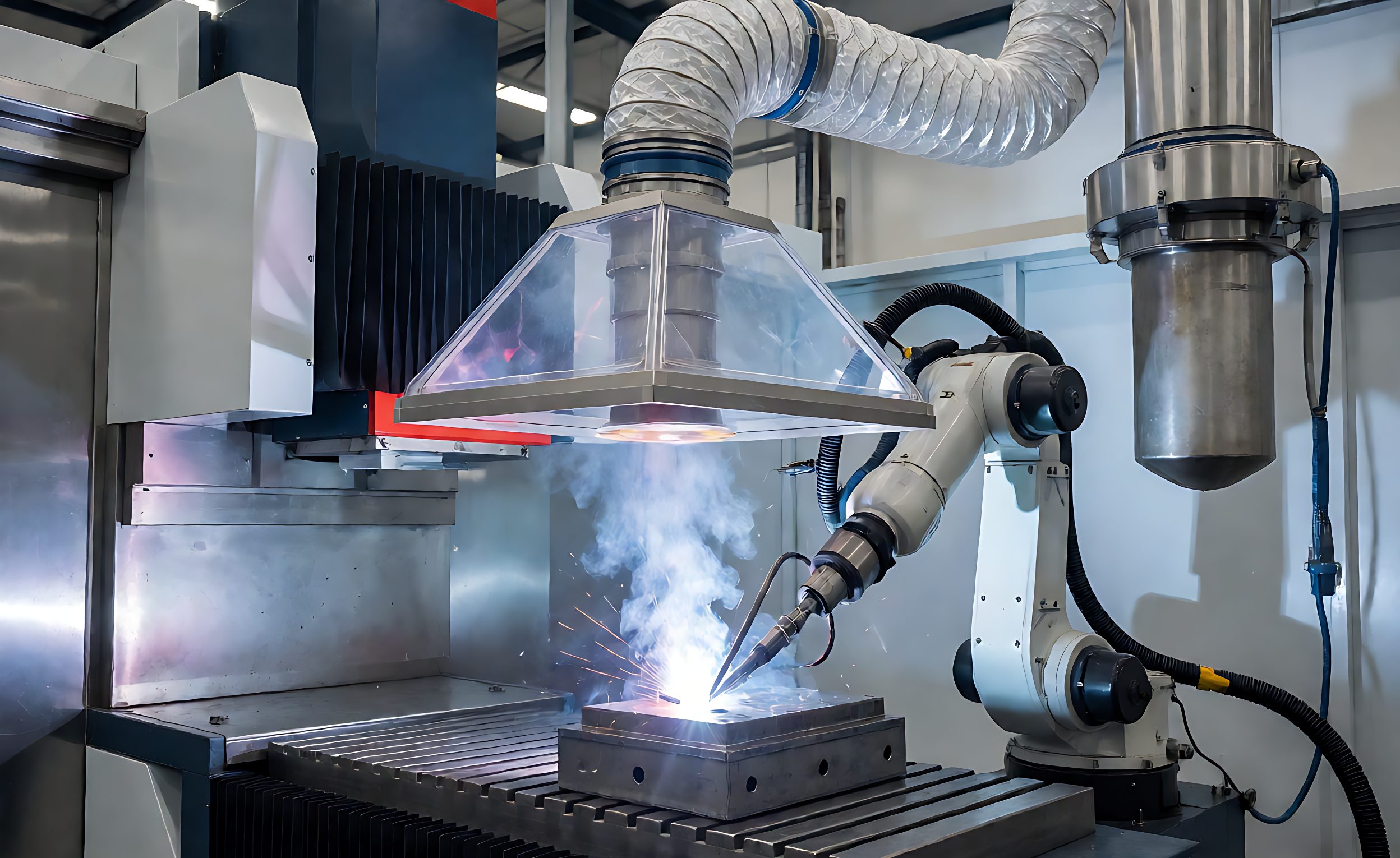
Two complaints dominate the first year of a laser welding cell: the air in the building is not acceptable, and the optics keep getting dirty. They look like separate problems and they are the same problem. Fume and spatter are both ejected material, they both travel toward the head, and they are both managed by the same few design decisions around the nozzle, the extraction and the enclosure.
Buyers tend to treat extraction as a facility item added at the end, and spatter as an operating nuisance handled by cleaning. Both assumptions cost money. Extraction sized after the cell is built is expensive to retrofit, and spatter that reaches the optics becomes a consumable cost and a downtime pattern that nobody budgets for.
What a Laser Welding Cell Actually Emits
The emission profile depends on the material and the process, but four categories cover most production.
- Metal fume and condensate: vaporised metal that condenses into fine particles, often in the sub-micron range. This is the visible plume and the main filter loading.
- Nanoparticles: a fraction of the fume is very fine, which means it behaves like a gas, travels far and penetrates filters that are rated only by mass.
- Ozone and nitrogen oxides: formed by the laser beam and the plasma interacting with air, particularly with high power density and good shielding gas coverage of the surrounding area.
- Metal-specific species: hexavalent chromium from stainless steel, nickel and manganese from alloys, and zinc oxide from galvanised material. These drive the occupational exposure assessment.
The practical consequence is that a filter rated on total mass is not sufficient evidence. The fine fraction is what the operator inhales and what the filter has to capture, and the metal species determine whether the captured dust is hazardous waste.
Capture at Source Beats Dilution
General ventilation dilutes contamination after it has spread. Source capture removes it before it reaches the breathing zone. For laser welding, source capture is the only approach that reliably meets exposure limits, and it is also the only one that protects the optics.
- Close-capture hood: an extraction opening positioned within a short distance of the weld, sized so the capture velocity at the weld is sufficient. Distance is the dominant variable, because capture velocity falls sharply with distance.
- Coaxial or annular extraction: extraction built into the welding nozzle, pulling fume away along the beam axis. Extremely effective at source, but it adds bulk to the head and can interfere with shielding gas flow.
- Cell extraction: the whole enclosure is extracted, which is simpler and protects the environment but is far less efficient per unit of airflow and does not protect the optics as well.
- Laminar cross-flow: a controlled air stream across the cell that pushes fume toward an extraction wall. Useful in cells with large working envelopes where close capture is impractical.
The Class 4 enclosure is usually designed for laser containment, and extraction is added afterwards. Designing them together is materially cheaper, because the enclosure’s internal airflow determines whether close capture works at all.
Sizing the Extraction
Extraction sizing is arithmetic, not judgement. Three numbers drive it.
- Capture velocity at the source: the air speed needed at the fume generation point to entrain the plume. It depends on the process and the plume’s upward velocity.
- Capture distance: the gap between the hood and the weld. Because capture velocity falls roughly with the square of distance, halving the distance can cut the required airflow dramatically.
- Duct velocity: the speed needed inside the duct to keep particulate suspended. Too low and dust settles and blocks the duct; too high and pressure loss and noise increase.
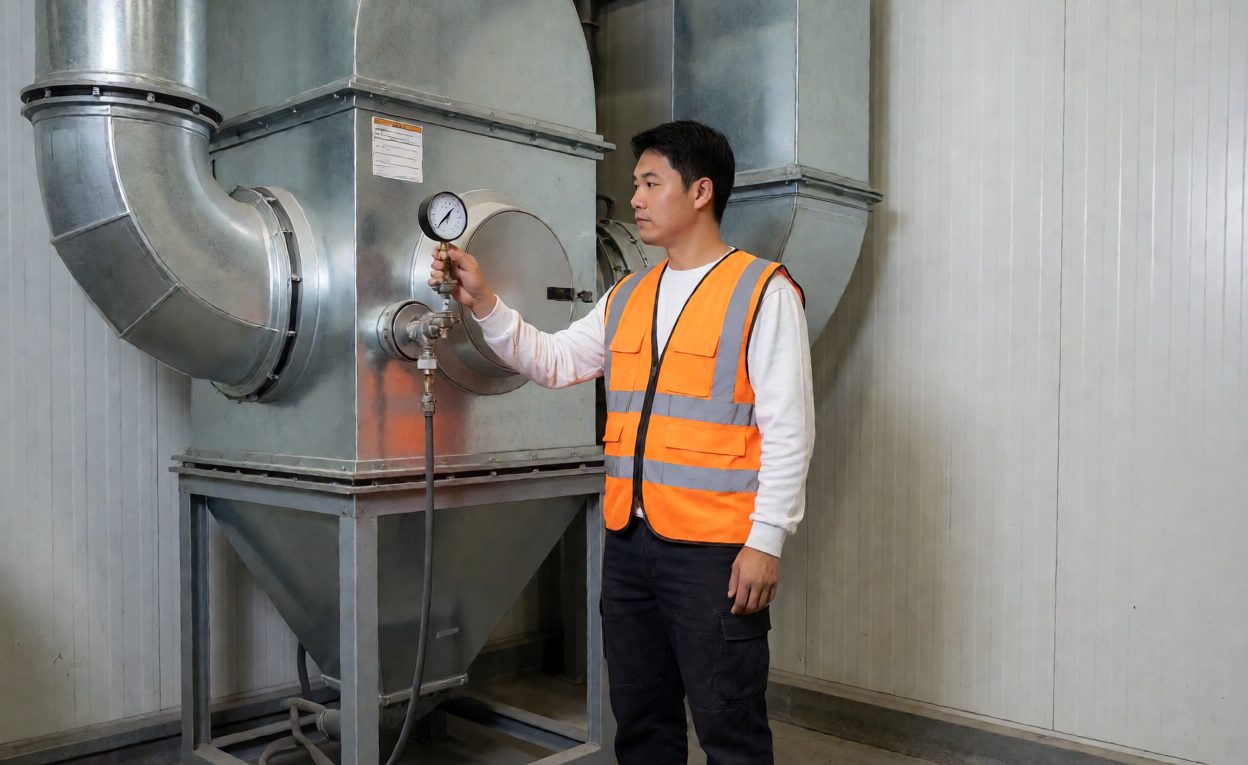
Then add the filter. A multi-stage arrangement, with a pre-filter for coarse spatter and condensate ahead of the fine filter, extends the life of the expensive stage considerably. For nanoparticles, a high-efficiency final stage is required; a filter that captures the visible plume but passes the fine fraction gives a false sense of protection.
Installation requirements usually cover floor, power and enclosure but treat extraction as an afterthought. Retrofitting ducting into a finished cell means cutting the enclosure, rerouting around the robot envelope and re-validating the airflow, which is why extraction should be in the cell layout from the first drawing.
Where Spatter Comes From
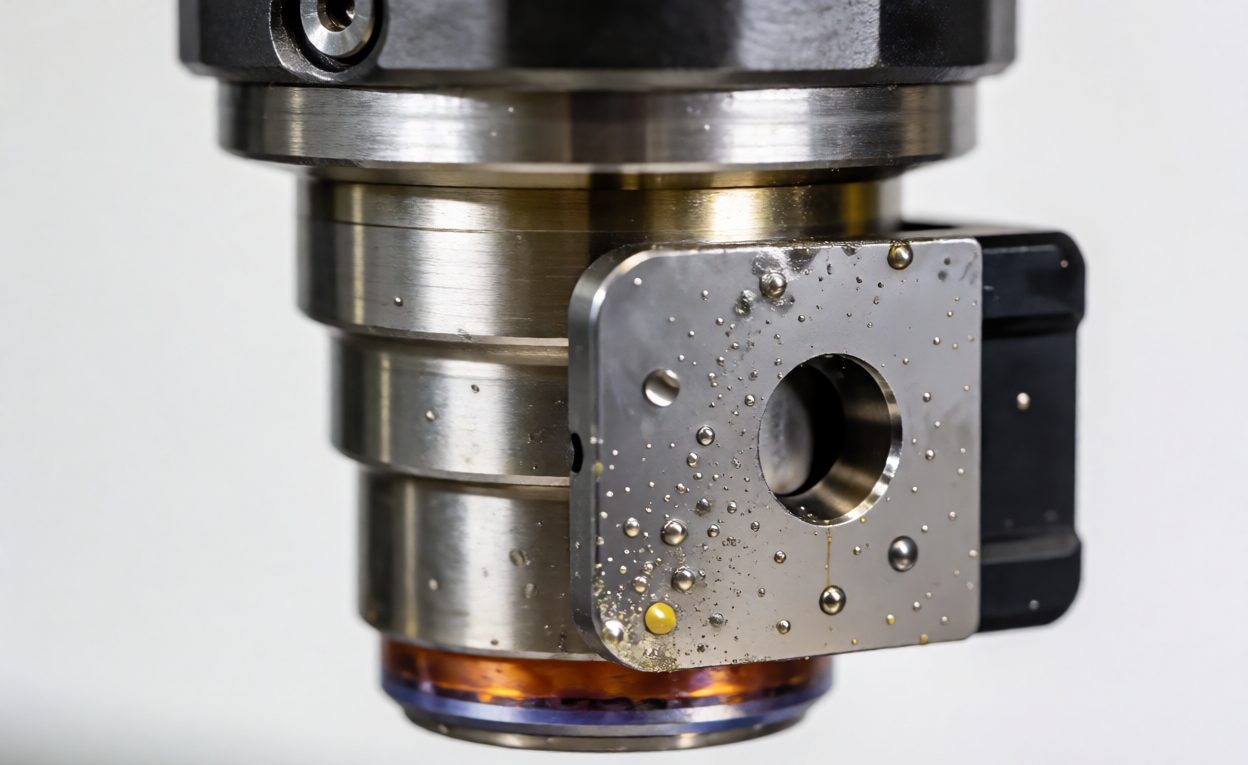
Spatter is molten or semi-molten material ejected from the keyhole. It damages optics, contaminates fixtures, and creates cleaning work that competes with production time. Five causes cover most of it.
- Keyhole instability: the vapour cavity collapses and ejects metal. Often the result of power density set too high or speed set too low for the material.
- Surface contamination: oil, oxide, coating or galvanising that vaporises explosively at the start of the weld.
- Power ramp: an abrupt start dumps energy into a cold surface and blows material out. A controlled ramp-in and ramp-out reduces start and end spatter substantially.
- Filler wire feeding: a wire that enters the pool at the wrong angle or speed generates droplets. Wire feed synchronisation is part of the spatter budget.
- Focal position: a focus set too high above the surface widens the keyhole mouth and increases ejection.
Spatter control is therefore mostly a parameter and preparation discipline, not a hardware purchase. The hardware exists to survive the spatter that remains.
Protecting Optics and Fixtures
Three protections matter, and they are consumables with a measurable cost per shift.
- Cover slide: a replaceable glass between the weld and the focusing optics. Its cost per shift is trivial compared with a damaged lens, and its condition should be checked on a fixed interval rather than when the weld quality drops.
- Cross-jet: a transverse air stream across the cover slide that deflects spatter and fume before they reach the glass. A cross-jet that is misaligned is worse than none, because it can draw fume toward the optics.
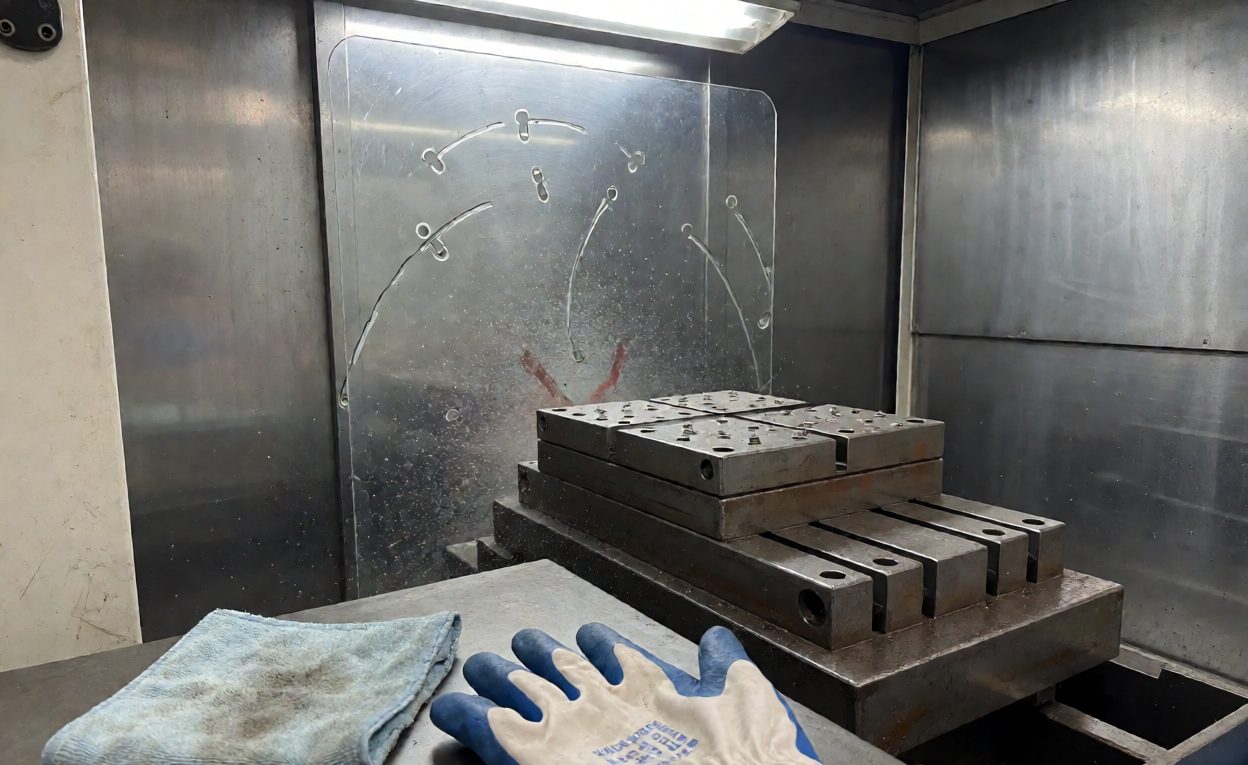
- Fixture shielding: sacrificial shields on fixture surfaces that see spatter, so cleaning is a swap rather than a re-qualification of the fixture geometry.
The welding robot and head configuration determines how accessible these consumables are. A head where the cover slide cannot be changed without removing the nozzle will be run past its service life, because production does not stop for a five-minute task that takes thirty.
Monitoring and Maintenance
Extraction performance degrades silently. A filter loads, airflow falls, capture velocity drops below the threshold, and the fume that was being captured starts escaping into the cell. Nothing alarms unless you instrument it.
- Differential pressure across the filter: the primary indicator of loading, and the trigger for replacement.
- Airflow or capture velocity check: a periodic measurement at the hood face, recorded and trended.
- Duct inspection: a scheduled check for settled dust, particularly at horizontal runs and elbows.
- Filter change record: date, pressure at change, and hours run, so the interval can be optimised rather than guessed.
Handheld and robotic configurations differ here: a handheld unit’s extraction travels with the operator and is often the weakest link, while a robotic cell can integrate extraction into the enclosure design properly. The trade-off between flexibility and control is real, and extraction is part of it.
Technical Background
Welding fume is a condensation aerosol: metal vaporised by the beam condenses into particles whose size distribution peaks well below a micron. That size matters because fine particles behave aerodynamically like a gas, staying airborne for hours and penetrating deep into the respiratory tract. A high-efficiency particulate air filter captures them, but only if the airflow actually reaches the filter rather than leaking past a seal.
The occupational side is governed by industrial hygiene practice: identify the species present, measure exposure in the breathing zone, and control to a limit. Extraction is one control in a hierarchy that also includes enclosure and process substitution. Because the beam itself is invisible and the hazard is not, laser safety programmes and fume control programmes are usually run by different people, which is exactly why they should be specified together.
A Cell Design Checklist
- List the materials to be welded and the metal species each emits, including coatings and galvanising.
- Specify capture velocity at the weld and the capture distance, not just a fan capacity in cubic metres per hour.
- Choose close capture or coaxial extraction before finalising the head and enclosure design.
- Size the filter for the fine fraction, with a pre-filter stage ahead of the high-efficiency stage.
- Include cover slide, cross-jet and fixture shields as specified consumables with a change interval.
- Specify a ramp-in and ramp-out profile to reduce start and end spatter.
- Instrument differential pressure and record filter changes with hours run.
- Plan access so the cover slide can be changed in minutes without removing the head.
Нужно ли извлечение, если ячейка полностью закрыта?
Yes. An enclosure contains the beam, not the fume. Opening the cell for loading releases whatever has accumulated, and the fine fraction stays airborne. Enclosure plus extraction is the workable combination.
Что такое скорость захвата и почему это важно?
It is the air speed at the fume source needed to entrain the plume. It falls sharply with distance, so a hood moved twice as far away needs far more airflow to do the same job.
Why does the filter clog so quickly?
Usually because there is no pre-filter stage for coarse spatter and condensate, or because the extraction is pulling in large amounts of room air. Both are design issues rather than filter quality issues.
What causes spatter in laser welding?
Keyhole instability, surface contamination, abrupt power ramps, filler feed mismatch and focal position. Most spatter is a parameter and preparation problem, not a hardware problem.
How often should the cover slide be changed?
On a fixed interval based on measured degradation, not when weld quality drops. Checking it only when quality falls means production has already been running with a compromised optic.
Is galvanised steel a special case for fume?
Yes. Zinc coating produces zinc oxide fume at a much higher rate than bare steel, and it also causes spatter at the start of the weld. Both extraction capacity and surface preparation need to account for it.
Can extraction be retrofitted to an existing cell?
It can, but it is expensive: ducting routes, enclosure penetrations and airflow re-validation all have to be redone. Including extraction in the original cell layout is far cheaper.