
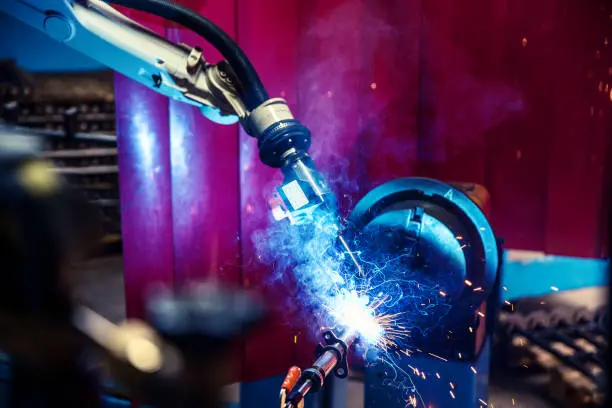
Robotic Laser Welding System: Solving Complex Thermal Distortion and Cycle-Time Bottlenecks in Modern Factories
High-precision manufacturing now demands more than simple metal joining. Today, a Robotic Laser Welding System is the only way to balance extreme speed with metallurgical integrity. At TrueSyn Intelligent Equipment, we see factory managers struggling with traditional arc welding limitations every day. These legacy methods create massive heat-affected zones and require extensive post-weld grinding.
Our integrated solutions combine high-power fiber laser sources with advanced robotics. This combination allows for a Robotic Laser Welding System that operates at speeds ten times faster than manual TIG welding. By concentrating energy into a microscopic focal point, we minimize thermal input. This prevents the warping of thin-gauge stainless steel and high-strength aluminum alloys used in modern EVs.
The Engineering Theory: Energy Density and the Keyhole Effect
To master precision welding, an engineer must first understand the physics of the fiber laser source. Unlike traditional heat sources, a fiber laser generates a high-intensity Continuous Wave (CW) beam. This beam creates a vapor cavity, commonly known as the “keyhole,” which allows for deep penetration with a very narrow weld bead. If you want to dive deeper into the physics of beam quality and M2 factors, you should know about laser principles through our educational technical resources.
A Robotic Laser Welding System utilizes this energy density to achieve high-speed processing. The fiber laser source delivers light via a flexible cable directly to the robotic wrist. This eliminates the need for complex mirrors. It also ensures that power remains consistent regardless of the robot’s orientation or reach. This consistency is vital for maintaining uniform penetration depth across long structural seams.
First-Hand Experience: How TrueSyn Solves Real-World Production Failures
Since our founding in 2013, TrueSyn has deployed over 5,000 laser units globally. You can read more about our 30+ global offices and our commitment to E-E-A-T standards on our about us page. Our strength lies in our dual expertise: we manufacture both the laser source and the robotic integration software.
In our experience deploying over 3,000 laser welding sets, we often see clients fail because of poor part fit-up. In one case, a kitchenware manufacturer struggled with gaps in their assembly. We integrated a TrueSyn laser welding robot ABB series combined with a high-precision floor track for extended reach. By adding vision-guided seam tracking, the robot could adjust its path in real-time. This reduced their scrap rate from 12% to nearly 0% within the first month.
We have also mastered the science of part positioning. For heavy structural components, we often recommend a workholding fixtures in robotic welding cells approach. This ensures the workpiece remains perfectly aligned with the laser’s focal point. Without these specialized fixtures, even the most expensive Robotic Laser Welding System will fail to deliver consistent results.
Key Equipment & Technical Specifications
The following table compares the performance of our Robotic Laser Welding System against traditional automated MIG welding for 5mm stainless steel components.
| Performance Metric | Automated MIG Welding | TrueSyn Robotic Laser System |
|---|---|---|
| Welding Speed (m/min) | 0.4 – 0.6 | 2.0 – 5.0 |
| Heat-Affected Zone (HAZ) | Extensive (5.0mm+) | Minimal (0.2mm – 0.8mm) |
| Post-Weld Grinding | Required (Labor Intensive) | None (Aesthetic Finish) |
| Repeatability | ±0.5mm | ±0.05mm |
Our full product catalog features a wide range of powers, from 1500W to 6000W. Each system is customized based on the material thickness and the required penetration depth of the customer’s specific application.
Industry Applications: Automotive, 5G, and Aerospace
The flexibility of a Robotic Laser Welding System makes it indispensable across multiple industry applications. In the automotive sector, we use these systems for welding high-strength steel door frames and EV battery trays. These parts require maximum structural integrity with minimum weight.
- Aerospace: Welding titanium engine components where zero oxidation and deep penetration are critical.
- 5G Infrastructure: Hermetic sealing of aluminum enclosures for outdoor telecommunications base stations.
- Medical Equipment: Creating high-purity welds for surgical instruments that must withstand rigorous sterilization.
- Electric Vehicles: Joining busbars and battery modules with high electrical conductivity and low resistance.
In each of these sectors, the Robotic Laser Welding System serves as a force multiplier. It allows a single operator to manage a cell that outputs the work of five manual welders. This shift is essential for factories looking to scale operations while facing a global shortage of skilled manual labor.
Frequently Asked Questions (FAQ)
What is the maximum penetration depth of your Robotic Laser Welding System?
Our standard 3000W systems can achieve a single-pass penetration of up to 5mm in stainless steel. For thicker materials, our 6000W high-power fiber laser systems can penetrate up to 10mm or more depending on the welding speed and material type.
How long does it take to program a new part for the robot?
With TrueSyn’s intuitive software and offline programming tools, a complex welding path can be generated in just a few hours. For high-volume production, we also offer seam-tracking sensors that automatically correct the robot’s path for any minor variations in part placement.
What maintenance does a fiber laser welding source require?
Fiber lasers are largely maintenance-free compared to CO2 lasers. The primary tasks involve checking the water-cooling chiller levels and inspecting the protective lens in the welding head. Most of our systems run for over 100,000 hours before the laser source requires a major service.
Is laser welding safe for an open factory floor?
Safety is our top priority. Every Robotic Laser Welding System we sell is enclosed in a Class 4 safety booth. These booths feature interlocked doors and laser-rated viewing glass to protect the eyes of nearby personnel from the 1064nm infrared radiation.
Are you ready to automate your welding department? TrueSyn’s engineering team is ready to analyze your parts and provide a custom ROI calculation. Stop fighting thermal distortion and start delivering precision.
Contact our engineering experts today: Contact TrueSyn Intelligent Equipment.