
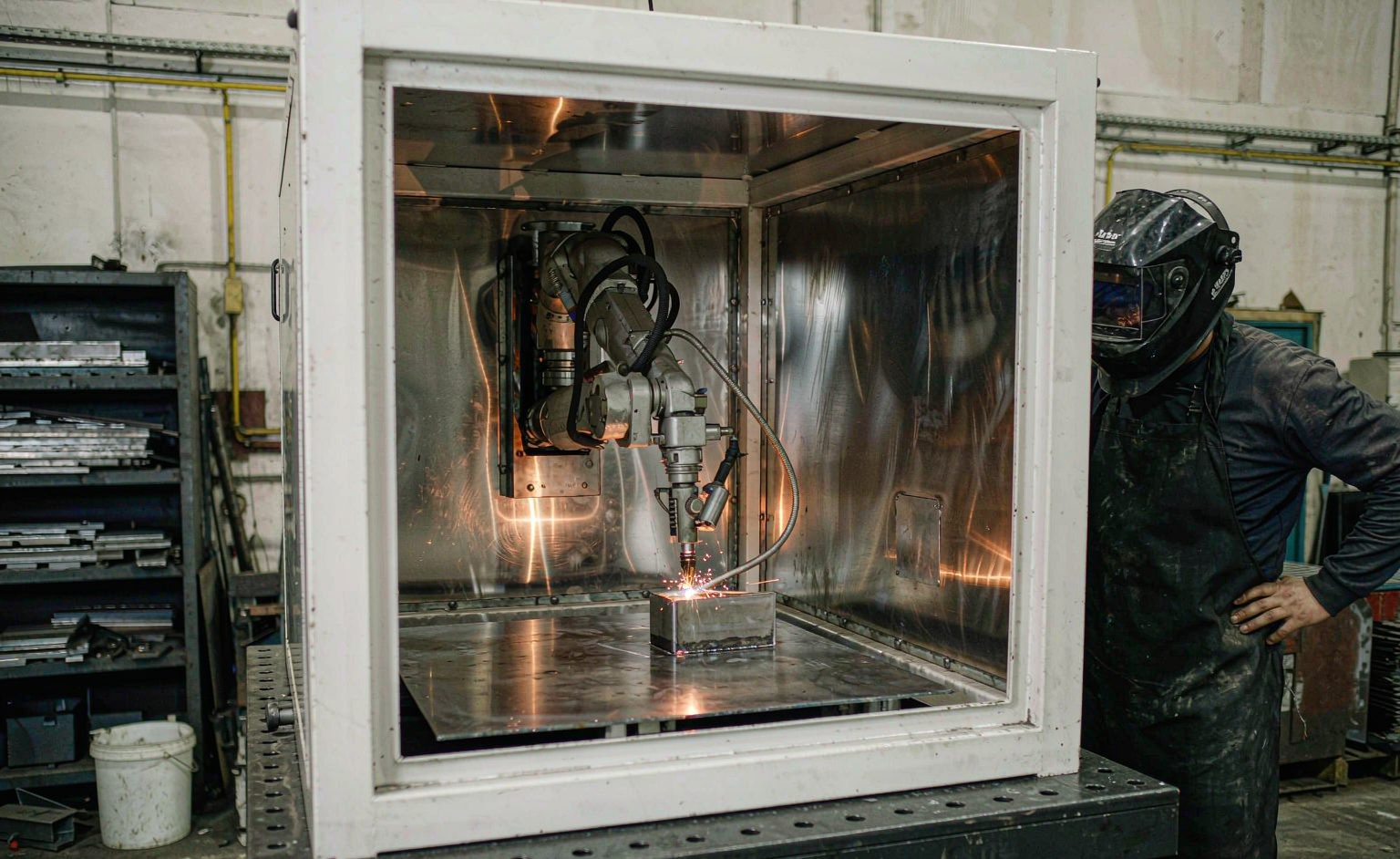
How to Choose a Laser Welding Machine Manufacturer in China: Factory, Laser Source and Support
Two laser welding machines with the same wattage, the same appearance and the same quoted price can be entirely different purchases. The difference sits in the laser source, the assembly quality behind the enclosure, and the support the supplier can actually deliver in your market. Buyers who screen on specification sheets alone discover the gap after installation, when a source fails and there is no local service. This guide covers the dimensions that decide whether the purchase works.
Key Takeaways
- The laser source is the component that determines output quality and lifetime; ask which source, which power class, and what the warranty covers.
- Machine type (handheld vs robotic) is a throughput and application decision, not a price decision.
- Factory capability is verifiable: ask for process capability, weld samples on your material, and the test reports they produce.
- Service network and spare-parts availability in your region matter more than the headline warranty period.
- Installation requirements (power, gas, chiller, floor space) must be confirmed before the machine ships.
Start With the Application, Not the Machine
Before comparing suppliers, define what the machine must do. The application decides the machine class, and the machine class decides which suppliers are relevant at all.
| Application factor | What it drives |
|---|---|
| Material and thickness | Required power class and beam delivery |
| Joint type and access | Handheld gun vs robotic path vs fixed optics |
| Throughput per shift | Manual operation vs automation and fixturing |
| Weld quality requirement | Penetration control, spatter and post-processing |
| Operator skill available | Parameter presets and process stability needs |
The machine-type decision is developed in our handheld vs robotic laser welding comparison, which covers the cost, throughput and application boundaries of each. Screening suppliers before that decision is made wastes everyone’s time.
The Laser Source: The Component That Matters Most
The laser source is the heart of the machine and the component most likely to determine whether the purchase holds up. It is also the one buyers ask about least.
| Source consideration | Why it matters | What to ask |
|---|---|---|
| Source brand and origin | Determines beam quality, stability and support ecosystem | Which source, which model, and is it genuine? |
| Power class vs rated output | Rated power and delivered power are not always the same | What is the guaranteed output at the workpiece? |
| Warranty scope | Source replacement is the largest single service cost | What is covered, for how long, and who performs it? |
| Lead time for replacement | Determines downtime when a source fails | How long to source a replacement, and is stock held locally? |
Ask the source question directly and in writing. A supplier who names the source, its model and its warranty is a supplier with a supply chain. One who says only “fiber laser, 1500W” is describing a specification, not a product. The underlying technology is explained in our laser welder maintenance guide, which also covers the cooling system that protects the source.
Verifying the Factory
Factory capability is verifiable without a visit, and the verification is mostly about evidence rather than claims.
| Verification | What good evidence looks like |
|---|---|
| Weld samples on your material | Samples in your actual thickness and joint, with process parameters recorded |
| Process documentation | Written parameter sets, not a technician’s memory |
| Test reports | Continuity, output power and safety checks delivered with the machine |
| Assembly and QC | Documented incoming inspection on source and optics |
| Reference installations | Contactable references in a comparable application |
The weld sample is the single most informative request. Ask for a sample in your material, your thickness and your joint configuration, with the parameters used recorded. A factory that can produce a repeatable sample on your material has demonstrated the process; one that sends a generic stainless demo has demonstrated marketing. Weld acceptance criteria are covered in our laser welding safety guide, which also addresses the enclosure and safety regime the machine must meet.
Service Network and Spare Parts
The support commitment is where the real difference between suppliers shows up, and it is the dimension most often reduced to a number of warranty months.
| Support factor | Question to ask | Why it decides the purchase |
|---|---|---|
| Regional service presence | Is there a technician within a day’s travel of my site? | Determines actual downtime, not warranty length |
| Spare-parts stock location | Which parts are held locally vs shipped from China? | Shipping a nozzle is fine; shipping a source is not |
| Response commitment | What is the contracted response and resolution time? | Converts support from a promise to a term |
| Training included | Is operator and maintenance training part of delivery? | Determines whether the machine reaches rated output |
A two-year warranty with no local service is worth less than a one-year warranty with a technician in your region and a stocked spares kit. Ask for the service commitment in writing, including response times and which parts are held where. If the answer is vague, the support is vague.
Confirming Installation Requirements Before Shipping
Four installation requirements decide whether the machine can be commissioned on arrival, and all four are cheaper to confirm before shipping than after.
| Requirement | What to confirm |
|---|---|
| Electrical supply | Voltage, phase and available amperage at the site |
| Shielding gas | Gas type, purity and supply or cylinder logistics |
| Cooling | Chiller capacity, water quality and ambient limits |
| Floor space and access | Machine footprint plus gun/cable reach and service clearance |
Send your site conditions to the supplier and ask them to confirm the machine against them in writing. This one step prevents the most common commissioning failure: a machine that arrives and cannot be powered, cooled or safely operated in the space available.
Frequently Asked Questions
How do I choose a laser welding machine manufacturer in China?
Screen on the laser source (brand, model, warranty), factory capability evidenced by weld samples on your material, service presence in your region, and spare-parts availability. Specification sheets alone do not separate suppliers.
Which laser source should I specify?
Name the brand, model and power class, and ask for the guaranteed output at the workpiece rather than the rated figure. The source warranty and replacement lead time matter more than the source name.
What should I ask a supplier to demonstrate?
A weld sample in your actual material, thickness and joint configuration, with the process parameters recorded. This is the most informative single request you can make.
How important is local service for a laser welder?
Decisive. A technician within a day’s travel and locally stocked consumables determine real downtime. A long warranty with no regional service is worth less than a shorter one with coverage nearby.
What installation requirements should I confirm before shipping?
Electrical supply (voltage, phase, amperage), shielding gas type and logistics, chiller capacity and water quality, and floor space including service clearance.
Handheld or robotic laser welding?
Handheld suits flexible, lower-throughput work and shorter runs; robotic suits repeatable high-throughput production with fixturing. The choice follows from your application, covered in our handheld vs robotic comparison.
What documents should come with the machine?
Test reports (output power, continuity, safety), the parameter sets used for your sample welds, the source warranty documentation and the spare-parts list with part numbers.
Technical background: laser beam welding, fiber laser technology and laser safety classes explain the process and safety framework referenced above.