
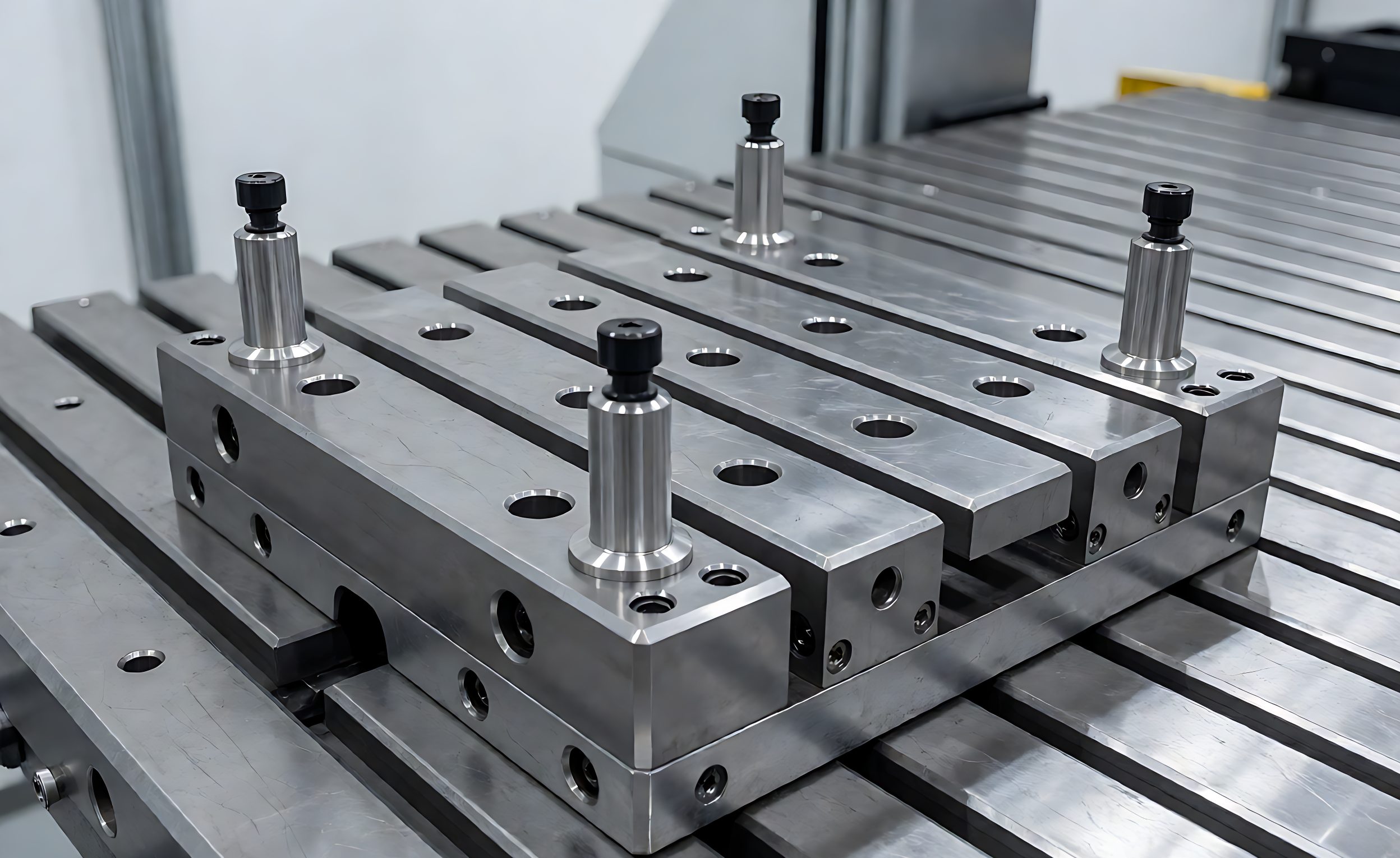
Быстро переставляемые приспособления и палеточные системы для сварочных ячеек
A cell that welds one part all week has no changeover problem; most cells are not that lucky. A job-shop cell may see a dozen part families a week, and every change costs the same hidden tax: the fixture is unbolted, the datum is lost, the program is re-verified, and the first part off the new setup is inspected with suspicion. An hour at a time, this tax quietly removes a full shift from every week.
Quick-change fixtures and pallet systems attack that tax directly. The principle is simple: perform everything slow and precision-critical once, off the machine, and make the on-machine change purely mechanical. The result is a cell that changes parts in minutes, without depending on the skill of whoever is on shift.
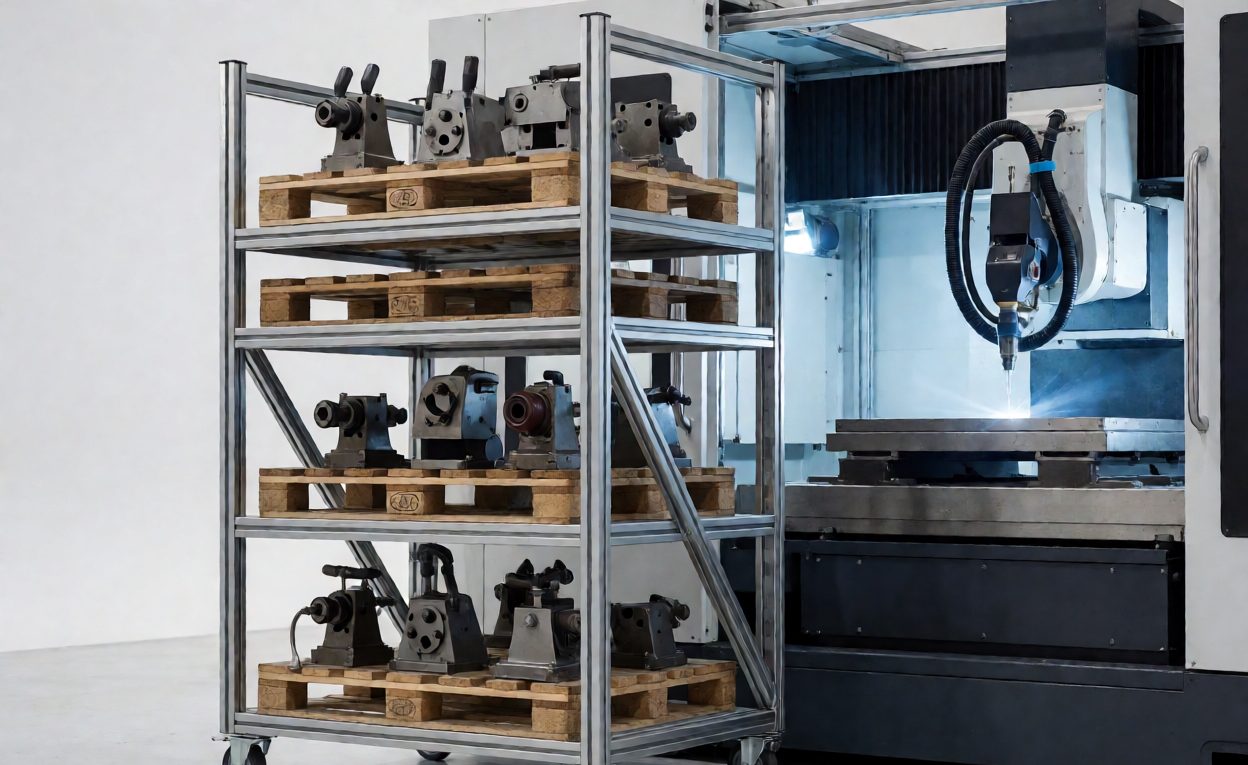
Where Changeover Time Actually Goes
Reducing changeover starts with knowing where the time goes; the biggest share is rarely the bolting itself.
- Fixture rebuild and alignment: locating surfaces re-established from scratch, shims adjusted until the part sits where it did last time.
- Program recall and verification: the program is loaded, dry-run at reduced speed, and watched for signs the part is not where the program expects.
- First-part inspection: dimensional checks and weld trials because nobody trusts the setup yet.
- Recovery: small crashes caused by proceeding before confidence was established.
A pallet system eliminates the first two categories almost entirely and makes the second two trivial. Because the fixture returns to the same physically constrained location every time, the part returns to the same place, and last week’s correct program is still correct. The fixture design considerations do not change; what changes is that they are settled once on the pallet instead of re-negotiated at every changeover.
What Zero-Point Clamping Adds
The enabling hardware is the zero-point clamping grid: standardized receiver pins set into the cell table, each pulling a mating pallet to a repeatable reference position with one clamping action. Repeatability is measured in hundredths of a millimetre, comfortably tighter than the process needs and far tighter than manual re-alignment achieves.
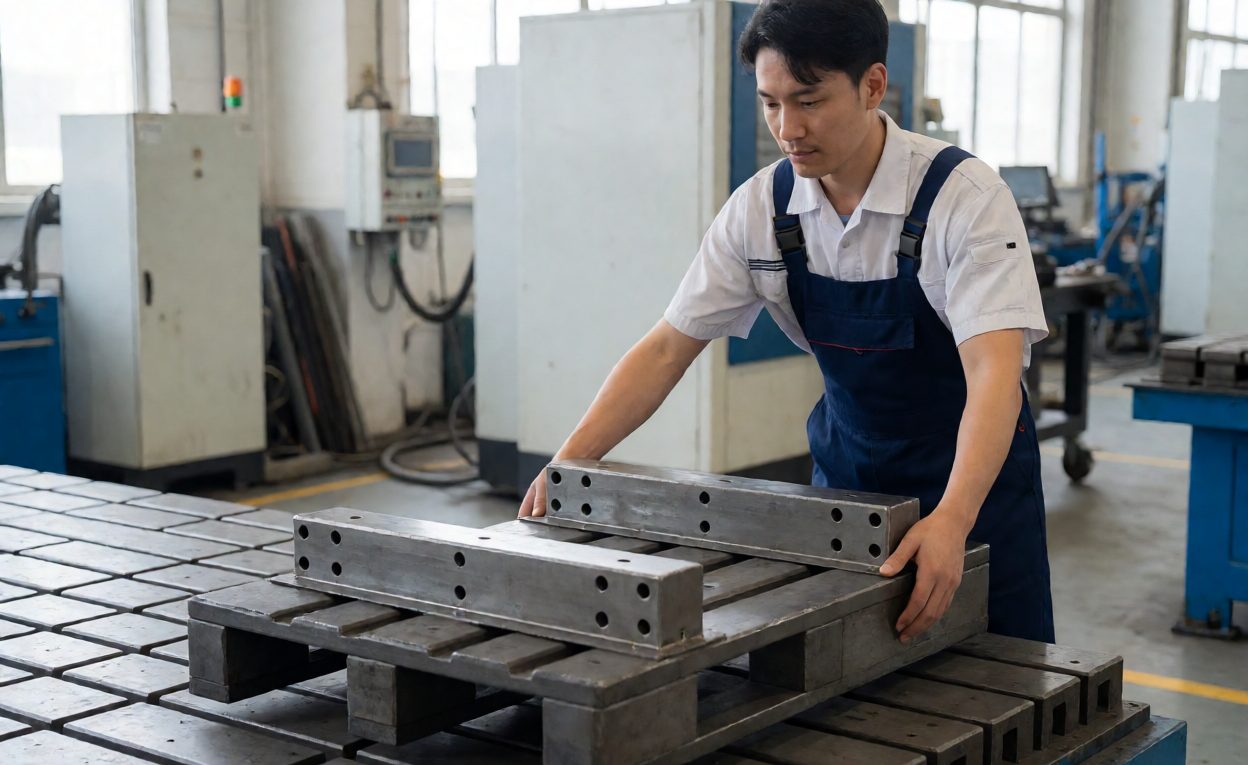
- Off-line fixturing: fixtures are built and parts loaded on pallets at a bench while the cell keeps welding; the changeover becomes a pallet swap measured in minutes.
- Multiple pallets per cell: a small fleet lets the next part be prepared during the current run, so setup disappears from the critical path.
- Shared standard across cells: any fixture fits any machine with the same grid, turning isolated cells into a flexible pool.
- Documented datum: the pallet carries the datum relationship permanently, so drift becomes a scheduled maintenance item, not a daily hunt.
This pays off most when specified before the fixture order, not retrofitted after. Where the tooling scope and ownership conversation is happening anyway, the pallet standard belongs in it: grid pitch, pallet sizes, receiver specification and who supplies what. Retrofitting a grid to fixtures designed without one is possible but wasteful.
Designing Fixtures for the Pallet, Not Just the Part
A fixture designed for a pallet differs from a fixture designed for a table. The datum relationship between part and pallet must survive handling, washing and storage, which pushes designers toward harder wear surfaces and protected locating features. Weight limits matter: how pallets are moved sets the practical ceiling. And every pallet needs an unambiguous identity – a hard tag, an RF chip or a machined code – because a fleet of look-alike pallets is how the wrong program gets run on the right part.
Repeatability should be verified, not assumed: a monthly dial-indicator check of the locating pins detects wear before it becomes a quality escape.

Program Handling and Part Identification
The mechanical side is the easy half; the program side decides whether the promised minutes are real. The cleanest arrangement ties program selection to pallet identity automatically: the cell reads the tag, calls the matching program and parameters, and refuses to run otherwise. Where that is not possible, selection must be a deliberate, confirmed operator action, and the programming and teaching approach should include a standard first-part verification routine so every changeover follows the same short, trusted sequence.
Cells with automated loading benefit doubly. An integrated loading and positioning system combined with palletized fixtures turns changeover into a material-handling move rather than a production stop.
Justifying the Investment
A zero-point grid, a pallet fleet and compatible fixtures add real cost – often ten to twenty percent of the tooling budget. The payback arithmetic is worth writing down: changeovers per week, hours saved per change, machine-hour rate, plus softer gains from reduced first-part scrap. In most multi-part shops the system pays back in months; in single-part cells it usually does not.
The concept is not new. Single-minute exchange of die formalized the same logic for press shops decades ago: separate internal setup from external setup, and convert the first into the second – exactly what pallet systems do for welding cells. Interchangeable parts thinking applies at the fixture level too: standardized receivers, clamp interfaces and pallet sizes are what let one cell accept ten fixtures. And modular design is the frame for a growing part family: a base pallet with swappable sub-fixtures absorbs new variants far cheaper than new full fixtures, provided the datum strategy was planned for it. Shops weighing whether a cell justifies this at all can start from the robotic welding cell overview and work outward.
Часто задаваемые вопросы
What is a zero-point clamping system?
A standardized grid of receiver pins that pulls mating pallets to a repeatable reference position with one clamping action, holding repeatability in the hundredths of a millimetre.
How much changeover time can a pallet system save?
Multi-part cells commonly cut changeovers from one to two hours to fifteen minutes or less, because alignment and program verification are eliminated, not accelerated.
Do programs need re-teaching after a quick change?
No. The pallet returns to the same constrained position, so the existing program remains valid, subject to a short first-part verification routine.
How many pallets should a cell have?
Enough to stage the next part during the current run – usually two to four per cell, sized by part mix and loading method.
Can existing fixtures be retrofitted to a pallet system?
Often, using adapter plates. It works, but designing fixtures to the pallet standard from the start avoids duplicated machining.
What accuracy do quick-change systems hold?
A few hundredths of a millimetre at the receiver, well inside what any welding process requires.
Is a pallet system worth it for low-volume work?
Usually not for a true single-part cell, but job shops with many small batches benefit most, since savings scale with the number of changes.