
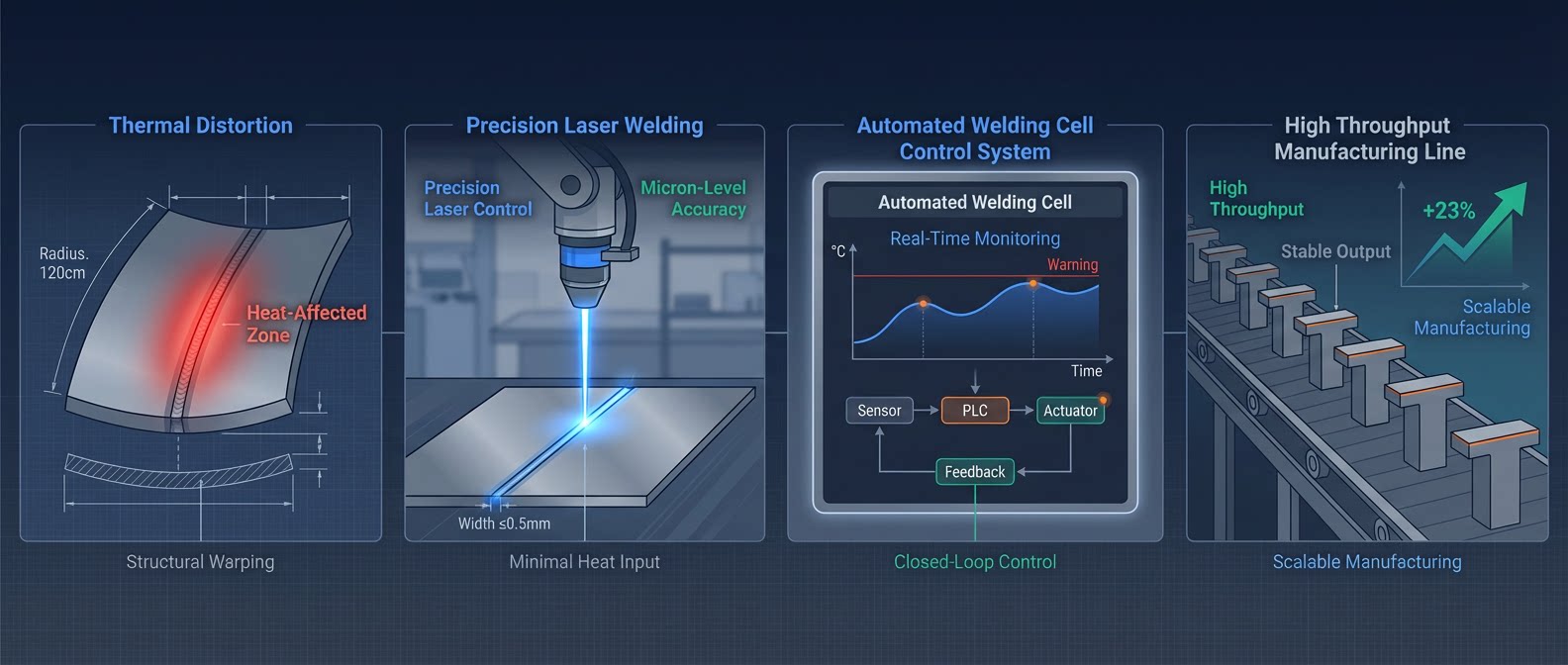
Precision Laser Welding Automation: Overcoming Thermal Distortion and Throughput Barriers in High-Volume Manufacturing
In the current landscape of industrial manufacturing, the demand for higher strength-to-weight ratios has made traditional joining methods obsolete. For factory engineers managing high-volume production lines, Precision Laser Welding Automation has transitioned from a niche luxury to a core structural requirement. The challenge on the factory floor is no longer just “making a weld,” but maintaining metallurgical integrity while achieving cycle times that manual operations simply cannot match.
At TrueSyn Intelligent Equipment, we specialize in high-power fiber laser systems integrated with multi-axis robotics. By mastering both the laser source physics and the kinematic precision of the robotic arm, we provide solutions that eliminate common failure points such as excessive Heat-Affected Zones (HAZ) and inconsistent penetration depth. Our systems are engineered for executives who require 24/7 operational stability and a clear path to ROI through reduced scrap rates and zero post-weld processing.
The Technical Foundation: Controlling the Heat-Affected Zone (HAZ)
The primary advantage of Precision Laser Welding Automation is the high energy density of the fiber laser. Traditional arc welding (MIG/TIG) relies on a broad heat source that conducts energy slowly into the material, often leading to macro-deformation and “warping” in thin-gauge metals. In contrast, a fiber laser focuses kilowatts of power into a focal spot as small as 0.1mm.
This creates the “Keyhole Effect,” where the metal vaporizes to form a narrow capillary, allowing the energy to reach the root of the joint instantly. For a deep technical analysis of how beam quality impacts weld pool stability, we encourage engineers to know about laser principles on our technical theory page. This concentrated energy input results in a weld bead that is significantly narrower and deeper than conventional welds, effectively minimizing the HAZ and preserving the material’s original mechanical properties.
- Reduced Distortion: Lower total heat input means parts remain within tolerance without expensive straightening fixtures.
- Superior Strength: Deep penetration ensures structural integrity in safety-critical automotive and aerospace components.
- High Velocity: Continuous Wave (CW) lasers allow for welding speeds exceeding 3 meters per minute on standard stainless steel.
First-Hand Experience: Lessons from 3,000+ Robotic Deployments
Since 2013, TrueSyn has been at the forefront of the automation revolution. With over 5,000 laser equipments sold and 30+ global offices, our engineering team has seen the evolution of the factory floor first-hand. You can learn more about our manufacturing heritage about us and our commitment to E-E-A-T (Experience, Expertise, Authoritativeness, and Trustworthiness).
In our experience deploying over 3,000 laser welding sets, we have found that the most common bottleneck isn’t the laser source—it’s the part positioning. In a recent automotive project involving EV battery trays, the client struggled with 3D path consistency. We implemented the TrueSyn laser welding robot Yaskawa series paired with a 3-axis flip positioner. This setup allowed the robot to maintain a perfectly perpendicular angle to the weld seam at all times, ensuring 100% penetration consistency across complex curved surfaces. By automating the orientation of the workpiece, we reduced their cycle time by 45% compared to their previous stationary laser setup.
Furthermore, safety is often an afterthought in poorly integrated shops. A high-power Precision Laser Welding Automation cell generates significant infrared radiation. We integrate custom-designed laser protective enclosures into every robotic cell, ensuring that the 1064nm wavelength is fully contained, allowing nearby operators to work safely without specialized PPE.
Strategic Equipment Selection: Robotic vs. Manual ROI
For manufacturers deciding whether to invest in full Precision Laser Welding Automation, the following data table compares the operational metrics of manual laser welding versus a fully integrated TrueSyn robotic cell.
| Metric | Manual Handheld Laser | TrueSyn Robotic Automation |
|---|---|---|
| Repeatability | Variable (Human Factor) | ±0.05 mm |
| Duty Cycle | 40% – 60% | 95% – 100% (24/7) |
| Safety Profile | High Operator Risk | Fully Enclosed (Class 1) |
| Post-Processing | Minimal | Zero (Clean Finish) |
Our complete product catalog showcases systems ranging from 1.5kW to 20kW. For most precision sheet metal applications, a 2kW or 3kW system provides the optimal balance of penetration depth and energy efficiency.
Multi-Sector Industry Applications
The flexibility of Precision Laser Welding Automation has allowed it to penetrate sectors where traditional welding was previously the only option. We provide specialized industry applications across several high-growth fields:
- Automotive & EV: Hermetic sealing of aluminum battery housings and busbar welding for high-voltage systems.
- Aerospace & Defense: Precision joining of titanium and Inconel alloys for jet engine components.
- Renewable Energy: Mass production of solar thermal collectors and wind turbine structural elements.
- Medical Device: Micro-welding of stainless steel surgical instruments where zero contamination is mandatory.
In the transition to electric vehicles (EVs), the ability to weld copper-to-aluminum joints is a game-changer. Our Precision Laser Welding Automation systems utilize specialized beam modulation to control the formation of intermetallic layers, ensuring high electrical conductivity and vibration resistance in the harshest environments.
Frequently Asked Questions (FAQ)
What is the maximum penetration depth for a 3000W laser system?
In standard stainless steel (304/316), a 3000W Precision Laser Welding Automation system can achieve single-sided penetration of up to 6mm at a travel speed of approximately 1.2m/min. Using a dual-pass or oscillation (wobble) technique, this can be extended for structural applications.
How does TrueSyn handle welding path programming for complex 3D parts?
We utilize advanced offline programming (OLP) software that allows engineers to import CAD models directly. This software generates the robotic path and laser firing sequences automatically, significantly reducing the downtime typically required for manual “teaching” of the robotic arm.
What are the maintenance requirements for a fiber laser source?
Fiber lasers are solid-state and virtually maintenance-free for up to 100,000 hours of operation. The primary maintenance tasks for the system include cleaning the external optics, checking the water chiller’s conductivity, and ensuring the shielding gas filters are replaced regularly.
Is it possible to weld dissimilar metals with your robotic systems?
Yes. Our systems are frequently used to join dissimilar metals like Copper to Stainless Steel. The key is the precise control of power density and pulse duration, which prevents the excessive mixing of the two metals and reduces the risk of brittle fracture at the joint.
Are you ready to modernize your production facility? TrueSyn Intelligent Equipment offers complete turnkey Precision Laser Welding Automation solutions, from initial sample testing to global on-site installation. Our engineers are ready to help you solve your most difficult joining challenges.
Contact our Chief Engineer today for a feasibility study: Contact TrueSyn Engineering.