
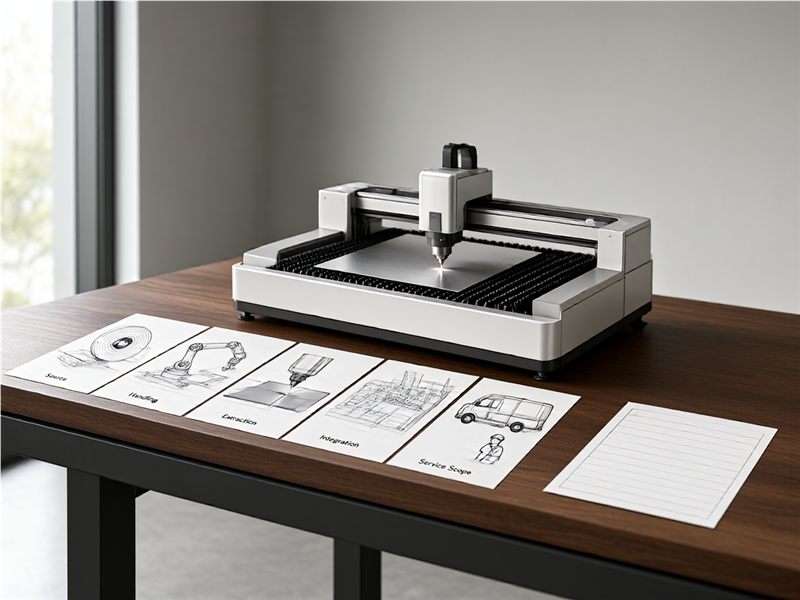
Laser Cutting Cost: Machine, Automation, Integration
Laser cutting quotes are difficult to compare because they rarely cover the same scope. One quote may include the machine and the chiller; another may include the robot, the fixture, the extraction and the commissioning. The number at the bottom can look similar while the delivered scope is completely different. This article separates the cost into the parts that should be compared line by line.
Machine scope
The machine scope includes the laser source, the cutting head, the motion system, the chiller and the control. Check the source power at the required duty, the head configuration and the working envelope. A lower-power machine with a larger envelope may be cheaper than a higher-power machine with a smaller envelope, but it may not cut the thickest part in the family. Specify the thickness and the material range first, then compare the machines that meet it.
Automation and handling
Automation includes the robot or the gantry, the loading and unloading, the fixture and the part transfer. It is often the largest cost difference between two quotes. A manual load station is cheaper to buy and more expensive to run at high volume; a robotic cell is the reverse. The decision should be based on the volume, the part weight and the labour availability, not on the headline machine price.
If the cell will run high mix, the changeover time is a cost even when it does not appear in the quote. A fixture that takes an hour to change can erase the savings of a faster machine.
Integration and site work
Integration covers the safety enclosure, the extraction, the electrical work, the foundation, the compressed air and the network connection. These items are often excluded from the machine quote and appear later as site costs. Ask for a site requirements list before the order, and check whether the supplier’s scope includes the installation and the commissioning.
Consumables and running cost
Consumables include the nozzle, the protective optics, the assist gas and the electricity. The gas cost can be significant for thick stainless cut with nitrogen; the optics cost depends on the power and the cleanliness of the process. Ask for the expected consumable life at the production duty, not the laboratory value.
Commissioning and ramp-up
The cost of a cell does not end at shipment. Commissioning, training, the first-part inspection and the ramp-up to full production all take time. A quote that includes a structured acceptance test and operator training is usually better value than a lower quote that leaves the ramp-up to the buyer.
Whole-life cost
Add the maintenance, the spare parts, the energy and the floor space to the purchase price. A machine with a long optic life and a simple maintenance routine can be cheaper over five years than a cheaper machine with a fragile optical path. The laser cutting overview covers the process and the cell types, and the laser cutting robot page describes the robotic configuration.
Send the part drawing, the annual volume and the site constraints, and the quote can be compared on the same scope instead of the same headline number.