알루미늄 레이저 용접: 균열, 기공 및 파라미터 윈도우
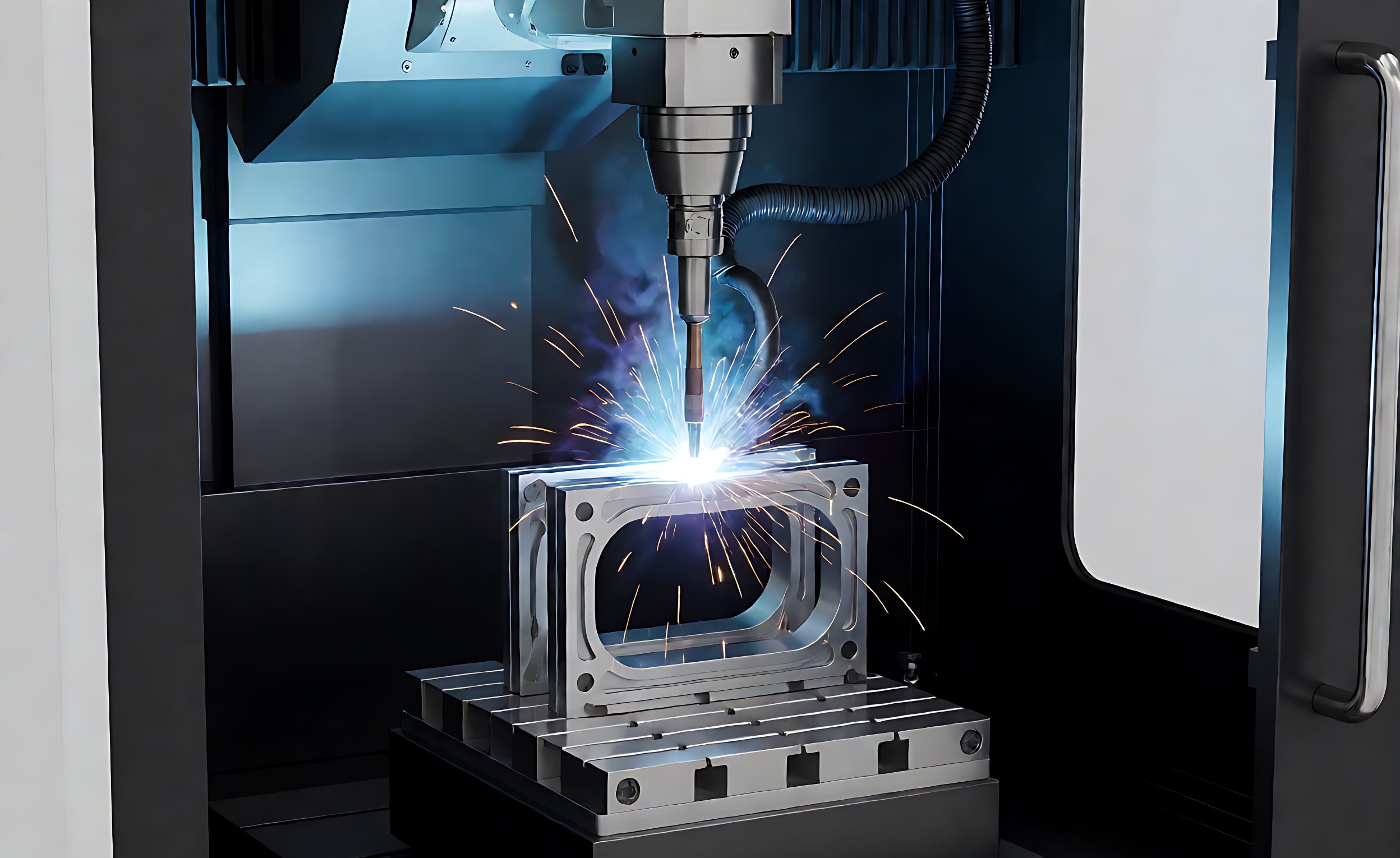
Aluminum is the material that most often converts a working laser welding cell into a debugging project. The same machine that runs steel at production rate will produce porosity, cracking and inconsistent penetration on an aluminum assembly, and the operator will spend weeks adjusting parameters that were never the real problem.
Four physical properties explain nearly every aluminum failure: high reflectivity at the laser wavelength, very high thermal conductivity, a refractory oxide layer, and a large change in hydrogen solubility on solidification. Each has a process answer, and none of them is solved by turning the power up. This guide covers the mechanisms, the parameter window, the filler strategy, and how to verify that a process is actually stable rather than lucky.
Why Aluminum Behaves Differently
Reflectivity. At the near-infrared wavelengths used by fiber lasers, polished aluminum reflects the majority of incident energy. A cold aluminum surface is a poor absorber, which makes starting the weld difficult; once a keyhole forms, absorption rises sharply and the process becomes much more efficient. That transition is why aluminum welds are sensitive to the first few milliseconds and to surface condition.
Thermal conductivity. Aluminum conducts heat away from the weld zone several times faster than steel. The consequence is a narrow process window: too little energy and you get lack of fusion, too much and you get a keyhole that collapses or a part that distorts. Heat is also lost into the fixture, which is why the same parameters can behave differently on a fixture with a different contact pattern.
Oxide layer. Aluminum oxide melts at a temperature far above the metal beneath it, and it is stable and electrically insulating. Welding through an oxide layer produces inconsistent wetting and entrapped oxide, which appears as lack of fusion or as irregular porosity along the fusion line.
Hydrogen solubility. Molten aluminum dissolves far more hydrogen than solid aluminum. As the pool solidifies, the excess hydrogen has to go somewhere, and it forms bubbles. This single mechanism accounts for most porosity in aluminum laser welding, and it is why cleanliness is not a housekeeping issue but a process parameter.
Cracking: Hot Cracking and How to Avoid It
Hot cracking happens while the weld is solidifying. The grain boundaries are still liquid while the bulk has become solid, and the shrinkage strain tears those liquid films apart. Aluminum alloys with a wide solidification range and a sensitive composition are prone to it, and the 6xxx family includes some of the most commonly welded structural alloys.
Three levers reduce hot cracking. The first is filler selection: a filler that promotes a fine, divorced eutectic or modifies the grain structure widens the safe window considerably. The second is dilution control, because the weld metal composition is a mix of filler and parent metal, and a joint that is mostly parent metal behaves like the parent metal. The third is restraint, because cracking needs strain; a joint design that allows slight movement relieves the stress that causes the tear.
The filler strategy decision is therefore not just a metallurgical preference. An autogenous weld on a crack-sensitive alloy may be perfectly sound on a coupon and fail on a restrained production part, because the coupon was free to move.
Porosity: Hydrogen, Contamination and Keyhole Instability
Porosity in aluminum has three distinct sources, and they need different fixes.
- Hydrogen porosity: gas that was dissolved in the melt and released on solidification. It appears as rounded pores distributed through the weld, and its severity tracks surface cleanliness, filler cleanliness and atmospheric humidity.
- Keyhole-induced porosity: the vapor cavity collapses and traps a bubble. It appears as larger, often irregular pores near the root, and it tracks power density, welding speed and focal position.
- Oxide and contamination porosity: entrapped oxide film or hydrocarbon residue creates irregular voids along the fusion boundary.
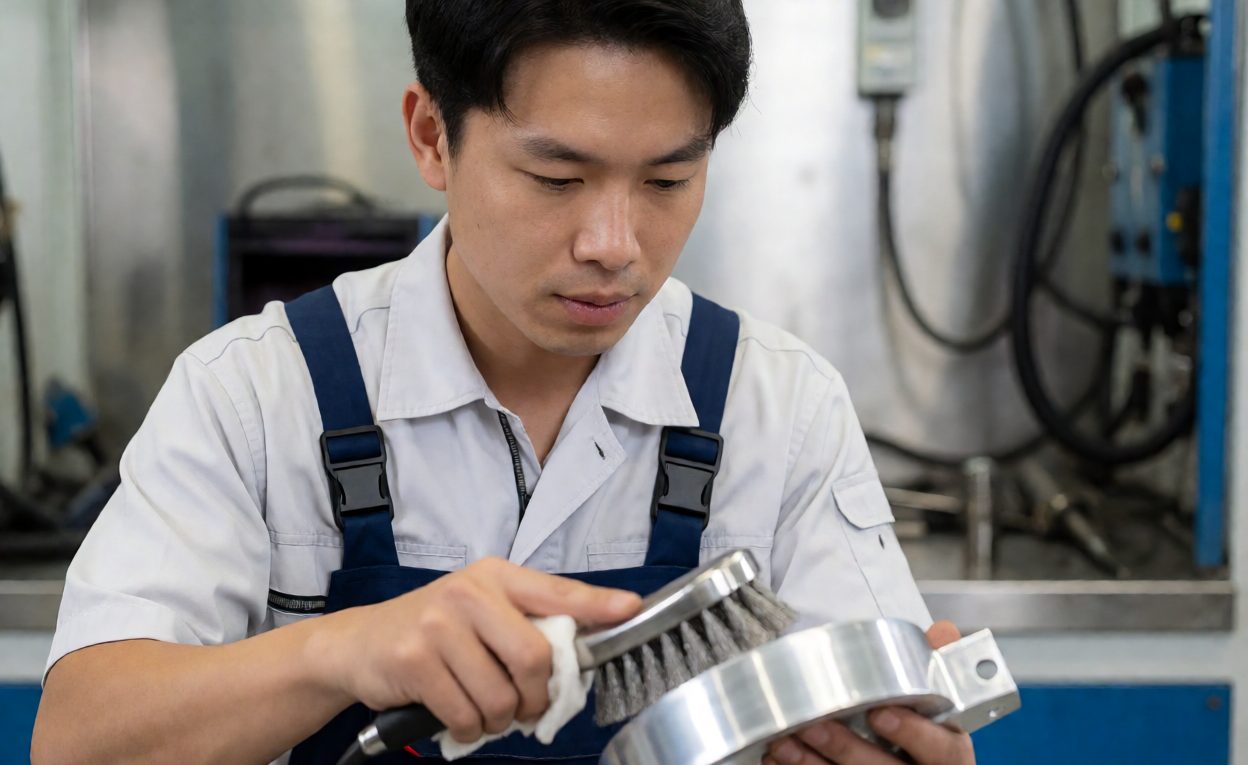
The practical hierarchy is cleanliness first, then shielding, then parameters. Degrease and mechanically remove oxide immediately before welding, because aluminum re-oxidises within hours in normal shop air. Use adequate argon coverage with a nozzle designed for the joint, and consider trailing shielding for high-speed seams. Filler wire and its storage matter as much as the parent metal: wire that has absorbed moisture introduces hydrogen directly into the pool.
The Parameter Window
Aluminum laser welding rarely has a wide window, so it helps to know which parameter moves which defect.
- Power density: must be high enough to establish a keyhole, because conduction-mode welding is unstable on aluminum. Too high and the keyhole becomes unstable, generating spatter and root porosity.
- Welding speed: faster reduces heat input and distortion but narrows the window and increases the risk of lack of fusion at the root.
- Focal position: small changes shift the energy distribution significantly. Most aluminum processes are set slightly below the surface to improve root penetration and reduce spatter.
- Beam oscillation: small-amplitude wobble widens the keyhole, improves gap tolerance and reduces porosity, at the cost of some speed.
- Gap tolerance: aluminum is far less forgiving than steel. A gap that a steel weld bridges will produce a burn-through or an unfused root on aluminum.
Joint design and fit-up tolerance determine whether the parameter window is workable at all. A designer who specifies a butt joint with a loose tolerance has specified a process that will be debugged in production rather than in design.
Fixturing and Distortion
Aluminum’s thermal expansion is high and its stiffness is low, so it moves. A fixture that holds the part rigidly will resist the shrinkage and convert it into residual stress, which either distorts after unclamping or cracks during cooling. A fixture that locates rather than clamps, with controlled clamping force and a defined sequence, behaves better.
Heat sinking is a double-edged tool. A copper or steel backing bar pulls heat out and reduces distortion, but it also changes the cooling rate, which changes the solidification structure and can promote cracking in sensitive alloys. If a backing bar is used, the process should be qualified with it in place, not developed without it.
Verifying That the Process Is Stable
A single good weld proves very little. Four checks establish stability.
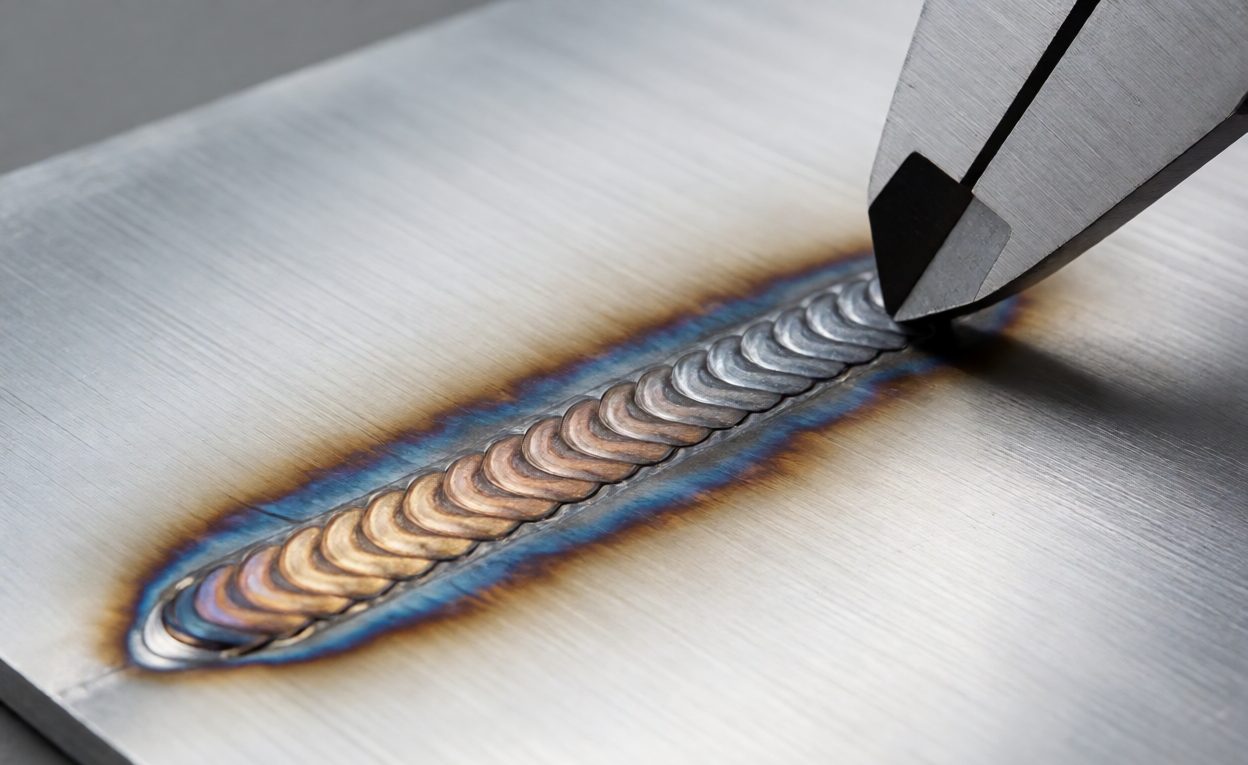
- Macro section: cut, mount, polish and etch a sample from the start, middle and end of a production run, and measure penetration depth and fusion width. Variation across the run indicates a drifting process.
- Radiography or CT: for porosity-sensitive parts, image a sample and count pores by size class rather than simply pass or fail.
- Penetrant testing: fast and effective for surface-breaking cracks along the toe of the weld.
- Tensile or peel test: for critical joints, mechanical testing confirms that the fusion is real rather than apparent.
The verification methods themselves have to be matched to the failure mode. Radiography finds porosity; it is poor at finding lack of fusion in a lap joint. Penetrant finds surface cracks; it finds nothing internal. A test plan built around one method will miss the defect class that method cannot see.
Technical Background
The physics starts with the surface. Aluminium forms a thin, self-healing oxide layer within minutes of exposure to air, and that layer’s melting point is roughly twice that of the metal, so a weld pool can form under an oxide skin that never breaks. Removing it mechanically, and welding before it re-forms, is the only reliable answer.
Once a keyhole forms, the process is a balance between energy input and heat loss, and welding metallurgy explains the rest. The solubility of hydrogen in liquid aluminum is far higher than in the solid, so the excess must precipitate during solidification, producing the porosity that dominates aluminum weld defects. Cooling rate controls pore size: fast cooling traps smaller pores, slow cooling lets them grow and rise.
An Aluminum Process Checklist
- Name the alloy and temper, and check its crack sensitivity before choosing a joint design.
- Choose the filler for crack resistance, not just for strength match.
- Degrease and mechanically remove oxide within the same shift as welding.
- Control filler wire storage and humidity exposure.
- Set focal position and power density to establish a stable keyhole, then tune speed for the root.
- Qualify the process with the production fixture and backing bar in place.
- Cut macro sections from start, middle and end of the run, not just one sample.
- Use at least two inspection methods matched to the two dominant defect classes.
알루미늄은 강철보다 레이저 용접이 더 어려운 이유는 무엇입니까?
High reflectivity at the laser wavelength, high thermal conductivity that narrows the process window, a refractory oxide layer, and hydrogen porosity on solidification. Each needs a separate process answer.
Can aluminum be laser welded without filler wire?
On some alloys and joint types, yes. On crack-sensitive alloys under restraint, autogenous welding is risky, and a filler chosen for crack resistance is usually the more stable production process.
알루미늄 레이저 용접의 기공 현상은 어떤 원인으로 발생합니까?
Mainly hydrogen released during solidification, plus keyhole collapse and entrapped oxide. Cleanliness, shielding and keyhole stability address the three sources respectively.
How do I stop hot cracking?
Use a filler that modifies the solidification structure, control dilution so the weld metal is not dominated by parent metal, and design the joint to allow slight movement rather than full restraint.
방진동(빔 진동)이 도움이 될까요?
Yes. Small-amplitude wobble widens the keyhole, improves gap tolerance and reduces porosity, at some cost in welding speed.
How tight should the fit-up be?
Tighter than for steel. Aluminum does not bridge gaps well, so a joint that relies on the weld filling a gap will produce burn-through or an unfused root.
Which inspection method finds lack of fusion?
Macro sectioning and, for production, ultrasonic or CT methods. Radiography is good at porosity but poor at detecting lack of fusion in lap joints.