
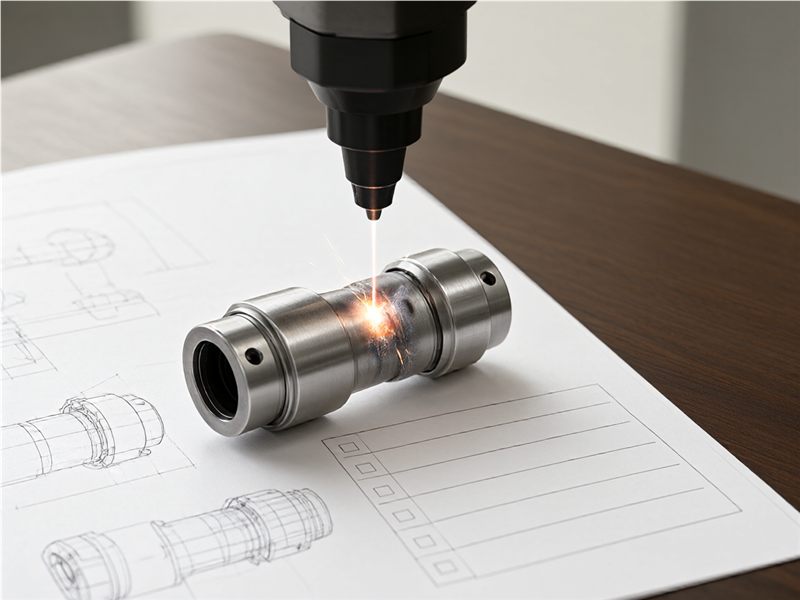
Automotive Laser Applications: Joint, Surface and Production Cycle
Automotive production is where laser processing earns its place: high volume, tight tolerances and a need for consistent quality. But the automotive requirement is not a single process; it is a set of applications with different joints, surfaces and cycle times. This article looks at four common areas and what each one demands from the laser step.
Body-in-white and frame joints
Body joints are usually thin sheet, lap or fillet, and the priority is stiffness and dimensional accuracy. Laser welding gives a narrow heat-affected zone and low distortion, which helps with the fit of adjacent panels. The process needs a fixture that holds the joint line and a program that follows the seam through the curved geometry. The acceptance check is usually a combination of cross-section, peel test and dimensional measurement.
Battery and powertrain parts
Battery housings, busbars and powertrain components often involve aluminium or copper, dissimilar joints and leak-tightness requirements. The reflective materials need higher power density and a stable beam delivery; the leak test needs a continuous, defect-free seam. Cleanliness is also critical: particles from the welding process can contaminate the cell, so extraction and part handling are part of the process design.
Sensors, connectors and small parts
Small parts are where the spot size and the positioning accuracy matter most. The weld may be a few tenths of a millimetre wide, and the heat input must not damage the surrounding polymer or electronics. A pulsed source or a low-power continuous source with a small spot is common. The fixture must locate the part precisely and the inspection must be able to see the weld, which may mean a camera or a vision system rather than a manual check.
Surface requirements
Automotive parts often have a visible surface or a coating step after welding. A weld that will be painted needs a clean, consistent surface and no spatter; a weld on a visible stainless or aluminium part may need a brushed or polished finish. The heat tint and the spatter are process outputs, not cosmetic afterthoughts. If the part is coated, the coating system may specify a surface profile that the weld and the cleaning step must preserve.
Cycle time
In automotive, the cycle time is fixed by the line, not by the process. The laser step must fit within the takt time, including load, clamp, weld, inspect and unload. A process that is technically sound but takes longer than the takt time will not be accepted. The trial should measure the full cycle on the production fixture, not only the weld length divided by the speed.
The automotive laser welding application page describes the common cell configurations, and the laser welding robot range covers the robotic platform. For cutting applications in the same sector, see the laser cutting robot page.
Coatings and mixed-material stacks
Automotive parts often arrive coated, lubricated or stacked with an adhesive. Zinc-coated steel outgasses during welding and can leave porosity; aluminium-to-steel joints form brittle phases; adhesive layers can contaminate the weld zone and the extraction system. The process has to be specified for the stack, not for the base metal alone.
Decide whether the coating is removed before welding, displaced by the process or left in place. If it is removed, the removal step and the cleaning step must be part of the cell design. If it is left, the trial should include the coating thickness and the worst coating condition, because a heavier coating changes the fume, the arc stability and the weld appearance. The same rule applies to the surface finish after welding: a part that will be painted needs a profile the coating can adhere to, and that profile is set by the weld and the cleaning step together.
Send the joint drawing, the material stack and the takt time, and the process can be evaluated against the line constraint rather than a standalone weld sample.