
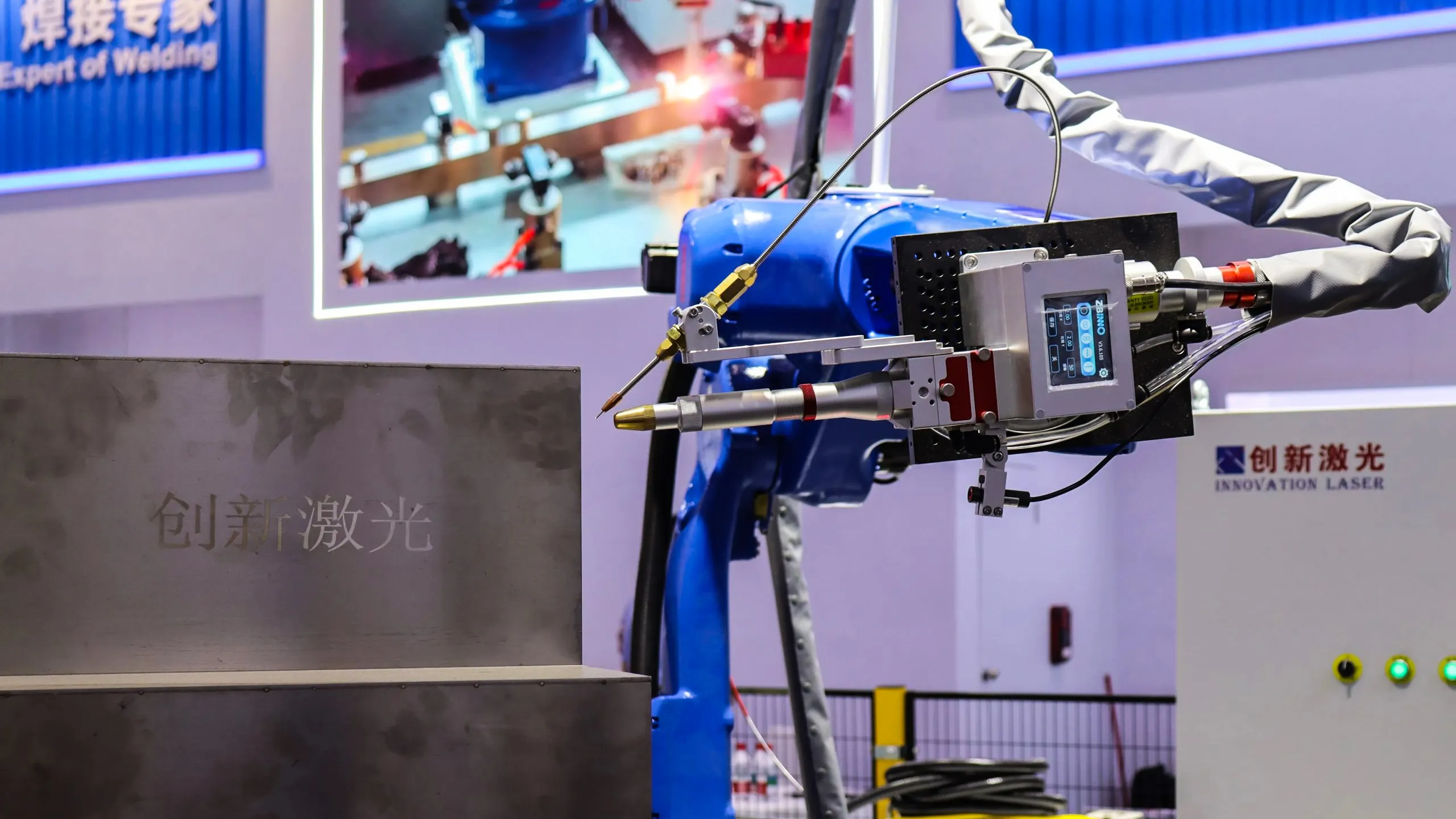
3000W Fiber Laser Welding Machine: Maximizing Penetration and Minimizing Thermal Distortion in Heavy-Duty Manufacturing
The global manufacturing shift toward high-strength alloys and thicker structural components has pushed traditional TIG and MIG welding to their physical limits. In modern production environments, the Fiber Laser Welding Machine has emerged as the definitive solution for high-speed, high-precision joining. At TrueSyn Intelligent Equipment, we specialize in high-power 3000W systems designed to achieve deep penetration while maintaining a negligible Heat-Affected Zone (HAZ).
For factory engineers, the challenge isn’t just about melting metal; it is about controlling the energy density to prevent macro-deformation in structural frames. Our 3000W systems provide the necessary power density to weld stainless steel and carbon steel up to 8mm with full penetration, effectively replacing multi-pass arc welding with a single, high-speed laser pass.
The Core Challenge: Balancing Penetration Depth and Material Integrity
When welding thick plates for automotive chassis or pressure vessels, traditional arc welding methods face three critical failures: excessive heat input, slow travel speeds, and significant post-weld grinding requirements. A Fiber Laser Welding Machine solves these issues by utilizing a concentrated Continuous Wave (CW) beam.
- Thermal Deformation: Traditional welding spreads heat across a wide area, causing thin and medium plates to warp or buckle.
- Cycle Time Bottlenecks: MIG welding requires multiple passes for thick sections, whereas a 3000W fiber laser can complete the joint in a single pass at speeds exceeding 1.5 meters per minute.
- Joint Consistency: Manual welding is subject to human error, leading to variations in penetration depth and weld bead aesthetics.
Why Traditional Methods Fail in High-Precision Environments
In high-precision sectors, the “Keyhole Effect” of laser welding is irreplaceable. Unlike the surface-melting approach of TIG, the high-intensity beam of a 3000W fiber laser creates a vapor cavity (the keyhole) that allows energy to reach the root of the joint instantly. This results in a depth-to-width ratio often exceeding 10:1, which is impossible with conventional arc processes.
First-Hand Experience: How TrueSyn Laser Equipment Solves Industrial Challenges
With over 3,000 sets of precision laser welding equipment running globally, our engineering team has encountered every possible metallurgical challenge. In a recent deployment for an automotive tier-1 supplier, we integrated a 3000W longitudinal seam laser welder to replace a traditional plasma welding line for exhaust components.
In our experience deploying 3000W fiber laser welding systems for automotive clients, we minimized the Heat-Affected Zone (HAZ) by optimizing the shielding gas flow dynamics and focal position. By switching to a high-speed robotic integration using the FANUC series robotic laser welding system, we reduced the cycle time per part by 65%. The client reported a 90% reduction in post-weld straightening processes because the laser’s concentrated energy input kept the surrounding material well below its critical deformation temperature.
Furthermore, we found that for materials like 6000-series aluminum, the use of a dual-pulse modulation on our 3000W sources significantly reduced porosity. By fine-tuning the frequency and duty cycle, the weld pool remains stable even at high transit speeds, ensuring the structural integrity required for EV battery trays.
Technical Specifications: 3000W Fiber Laser vs. Traditional Methods
The following table illustrates the performance leap when upgrading to a high-power Fiber Laser Welding Machine for 6mm stainless steel plates.
| Feature | TIG Welding | 3000W Fiber Laser |
|---|---|---|
| Welding Speed (6mm SS) | 0.15 m/min | 1.8 – 2.5 m/min |
| Heat-Affected Zone (HAZ) | Large (5mm – 8mm) | Minimal (0.5mm – 1.2mm) |
| Post-Processing Need | Heavy Grinding/Polishing | Virtually None |
| Penetration Control | Inconsistent/Manual | Precision CNC/Robotic Control |
| Annual Consumables Cost | High (Electrodes, Gas, Wire) | Low (Protective Lenses, Gas) |
Advanced Applications in Modern Industry
TrueSyn’s integrated solutions extend beyond simple welding. We combine our laser sources with sophisticated automation to handle complex geometries. For example, our 5-axis laser welding machine is frequently used in the aerospace sector for complex curved surfaces where maintaining a perpendicular beam-to-workpiece angle is critical for penetration consistency.
Automotive and EV Battery Production
In the transition to electric vehicles, laser welding applications in the automotive industry have become the standard for battery pack assembly. The 3000W fiber laser allows for the high-speed busbar welding required to connect thousands of battery cells with minimal electrical resistance and high thermal stability.
Heavy Machinery and Metal Fabrication
For large-scale enclosures and structural frames, the use of a handheld fiber laser welding machine with water-cooling technology provides the flexibility of manual operation with the power of a stationary industrial laser. This is particularly effective for tack welding large assemblies before they are moved to a fully automated robotic cell.
Frequently Asked Questions (FAQ)
What is the maximum penetration depth of a 3000W Fiber Laser Welding Machine?
For stainless steel and carbon steel, a 3000W fiber laser can typically achieve a single-sided penetration depth of 6mm to 8mm depending on the welding speed and focal settings. When using a double-sided welding approach, this can effectively join plates up to 14mm thick with high structural integrity.
Can a Fiber Laser Welding Machine weld dissimilar metals?
Yes, one of the primary advantages of fiber laser technology is its ability to join dissimilar metals, such as copper to aluminum or stainless steel to carbon steel. This is achieved through precise control of the heat input, which minimizes the formation of brittle intermetallic compounds at the joint interface.
How does laser welding affect the corrosion resistance of stainless steel?
Because the Fiber Laser Welding Machine produces a very narrow HAZ and operates at high speeds, the chromium depletion (sensitization) that typically occurs in TIG welding is largely avoided. This helps maintain the original corrosion resistance of the stainless steel alloy within the weld zone.
What maintenance is required for a 3000W fiber laser system?
Unlike CO2 lasers, fiber lasers are solid-state and require very little maintenance. The primary maintenance tasks include regular inspection and replacement of the protective lens, ensuring the water-cooling chiller is functioning correctly, and keeping the fiber delivery cable free from tight bends or physical damage.
Are you looking to eliminate welding bottlenecks in your production line? Contact the TrueSyn engineering team today. We provide full-scale sample testing, customized robotic integration, and the industry-leading 3000W Fiber Laser Welding Machine technology to take your manufacturing to the next level.