
What Is a Laser Cutting Machine? A Manufacturer’s Perspective
By Zhejiang TrueSyn Intelligent Equipment Co., Ltd. | Est. 2013
This guide goes beyond the textbook definition. We will share insights from our factory floor. We will explain how this technology works and why robotic automation is the future.
The Core Concept: Defining the Technology
At its simplest, a laser cutting machine is a fabrication tool. It uses a thin, focused beam of light to cut materials. However, the technology is complex.
Think of it like using a magnifying glass on a sunny day. You focus sunlight into a tiny point. That point gets very hot. Now, imagine that light is thousands of times more powerful. That is a laser.
The process involves three main steps:
- Generation: A laser source creates the beam.
- Transportation: Fiber optics or mirrors guide the beam.
- Focusing: A cutting head focuses the beam onto the material.
The heat is intense. It melts or vaporizes the material instantly. A gas assist (like oxygen or nitrogen) then blows the molten metal away. The result is a clean, precise cut.
Our Experience: The Shift to Fiber Lasers
When TrueSyn was founded in 2013, the market was different. CO2 lasers were common. However, we noticed a shift. Our clients wanted faster speeds and lower maintenance. This led us to focus on Fiber Laser technology.
Why do we prefer fiber lasers?
- Efficiency: They convert energy better than older models.
- Maintenance: There are no moving mirrors to align.
- Speed: For thin metals, fiber is significantly faster.
We now integrate these sources into advanced robotic systems. You can see examples in our FANUC Laser Cutting Robot series.
Types of Laser Cutting Machines
Not all machines are the same. In our industry, we categorize them by the laser source and the motion system.
1. Fiber Laser Cutters
These are the industry standard for metal. They use optical fibers doped with rare-earth elements. They are perfect for cutting steel, aluminum, and brass.
2. CO2 Laser Cutters
These use a gas mixture. They are excellent for non-metals like wood or acrylic. However, they are less efficient for heavy industrial metalwork.
3. Robotic Laser Cutters (3D Cutting)
This is where TrueSyn specializes. Standard machines cut flat sheets (2D). But real parts are complex. They are curved. They are three-dimensional.
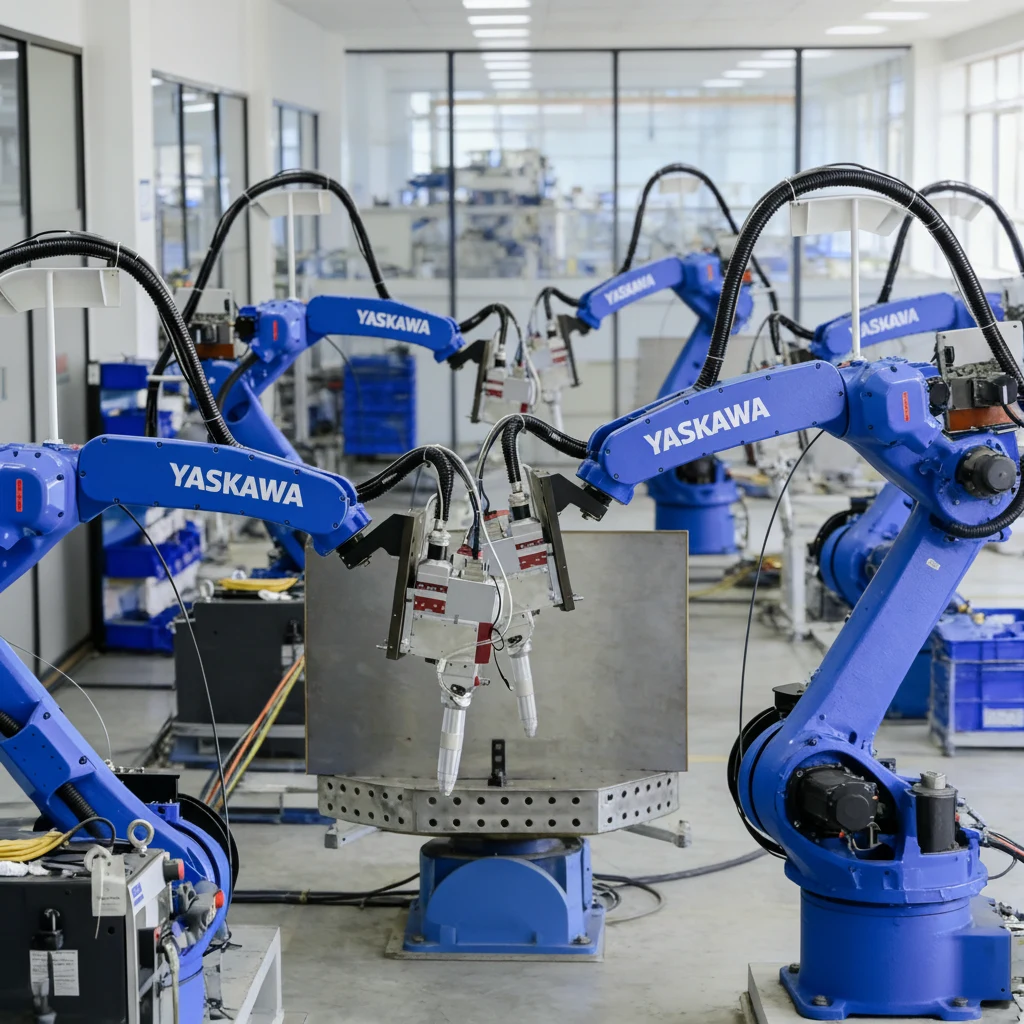
We mount the laser head onto a robotic arm. This allows for 6-axis movement. It is crucial for industries like automotive manufacturing. For instance, our Yaskawa Laser Cutting Robot can trim stamped parts at any angle.
The Role of Automation in Laser Cutting
Knowing what a laser cutting machine is serves only as the first step. The real value comes from automation. A standalone machine requires manual loading. This is slow. It is also dangerous.
We evolved from a laser equipment manufacturer to a robotic solution provider. Why? Because our clients needed consistency.
Integration Benefits
We combine laser cutters with external axes and positioners. This includes:
- Floor Tracks: These extend the robot’s reach. See our Floor Track solutions.
- Positioners: These rotate the workpiece. Check out our Single Axis Rotary Positioners.
By automating the process, one operator can manage multiple cells. This reduces labor costs significantly.
Real-World Application: A Case Study
To demonstrate E-E-A-T (Experience, Expertise, Authoritativeness, and Trustworthiness), let us share a real scenario.
A client in the automotive sector approached us. They were cutting chassis parts manually. The edges were rough. They needed secondary grinding. This wasted time.
The Solution: We installed a robotic fiber cutting cell. We used a robot from our ABB series adapted for cutting.
The Result:
1. Production speed increased by 40%.
2. The cuts were clean. No grinding was needed.
3. Safety improved as workers were removed from the immediate cutting zone.
This is the power of understanding the technology deeply. For more on automotive use cases, read our Introduction to Automotive Applications.
Key Components of a Laser System
When you buy a laser cutting machine, you are buying a system. Here is what is inside the box:
The Laser Source
This is the engine. It determines the cutting thickness. Higher wattage means thicker cuts.
The Cutting Head
This contains the lenses. It must be kept clean. Dust is the enemy of laser optics.
The Chiller
Lasers generate heat. A water chiller keeps the source at a stable temperature. Without this, the laser would overheat and fail.
The Control Software
This is the brain. It translates CAD drawings into machine code (G-code). We often use systems that support “Programming-Free” operations for easier use. You can learn about our programming-free systems here.
Safety Considerations
Laser safety is non-negotiable. Fiber lasers use a wavelength that is dangerous to the human eye. It can pass through the cornea.
We always recommend fully enclosed cells. We provide Laser Protective Enclosures. These prevent scattered light from escaping. Operators must also wear specific safety glasses matched to the laser’s wavelength.
How to Choose the Right Machine
Are you considering an investment? Ask yourself these questions:
- What material are you cutting? If it is metal, go with Fiber.
- What is the shape? If it is flat sheet metal, a gantry system works. If it is a 3D part (like a tube or stamped part), you need a robot.
- What is your volume? High volume requires automated loading and unloading.
We also offer hybrid solutions. Sometimes you need to cut and mark. We have Fiber Laser Marking Machines that can be integrated into the same line.
Maintenance: Keeping Your Machine Running
A laser cutting machine is a precision instrument. It requires care. Based on our after-sales service data, here are the top maintenance tips:
- Check Optics Daily: Clean the protective lens. This is the most common failure point.
- Monitor Water Quality: Change the chiller water regularly to prevent algae or corrosion.
- Lubricate Axes: Robots and gantries need grease to move smoothly.
Conclusion
So, what is a laser cutting machine? It is more than a tool. It is a competitive advantage. It offers speed, precision, and the ability to create complex geometries.
At Zhejiang TrueSyn, we have evolved from simple welding to comprehensive robotic automation. We understand the machines because we build them. Whether you need a standard unit or a complex robotic cell, we are here to help.
Ready to modernize your production line? Contact our team today for a consultation.