
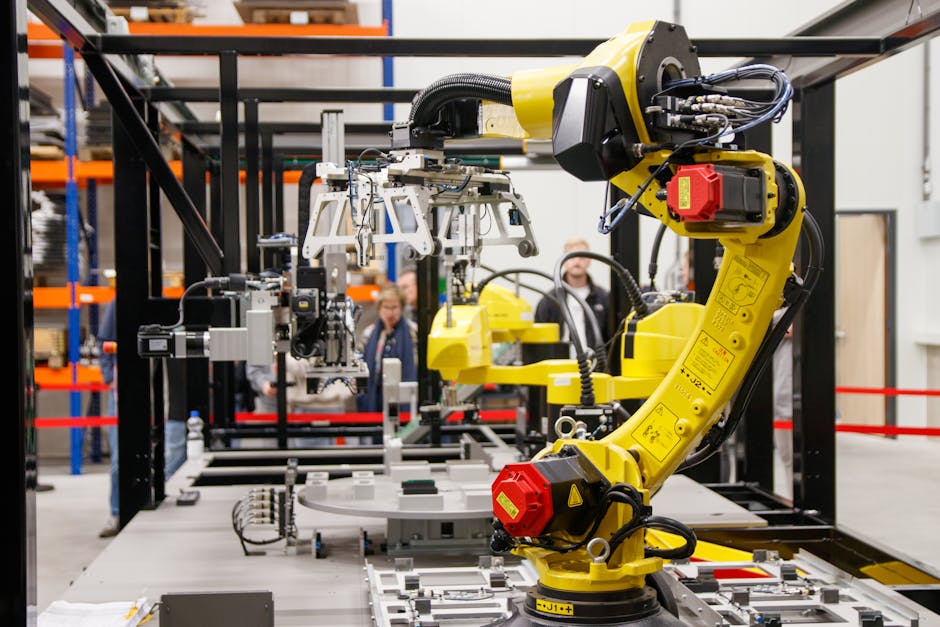
Servo Robot Seam Tracking: Precision Automation for Industrial Welding
Advanced Servo Robot Seam Tracking Solutions for Industrial Metal Fabrication
In today’s high-stakes manufacturing environment, maintaining weld quality consistency while optimizing production throughput remains a critical challenge. Servo robot seam tracking technology has emerged as a game-changing solution, enabling real-time adaptive welding that compensates for workpiece misalignment and thermal distortion. This article examines the technical foundations, implementation benefits, and strategic deployment considerations for servo-driven seam tracking systems in industrial automation.
Technical Fundamentals of Servo Robot Seam Tracking
Servo robot seam tracking represents a quantum leap in robotic welding precision. Unlike conventional fixed-path programming, these systems employ high-resolution sensors and closed-loop feedback mechanisms to dynamically adjust torch positioning during operation. The core components include:
- High-torque servo motors with sub-micron positional accuracy
- Laser vision systems with 0.02mm resolution
- Real-time motion controllers with 1ms response times
- Adaptive path correction algorithms
These elements work in concert to maintain precise torch-to-seam alignment, even when faced with part fit-up variations or thermal deformation during multi-pass welds. The system’s ability to process sensor data and adjust motion parameters in real-time represents a significant advancement over traditional fixed-programming approaches.
At the heart of the system, servo motors utilize rare-earth magnet technology and precision harmonic drives to achieve 0.001mm repeatability. These motors operate in tandem with laser triangulation sensors that project a structured light pattern onto the weld joint, capturing 3D profile data at 2000Hz sampling rates. The controller processes this data through specialized firmware algorithms that distinguish between intentional joint geometry and unintended distortions caused by thermal expansion or fixturing errors.
Key technological differentiators include:
- Dynamic path correction without compromising travel speed
- Multi-axis synchronization within ±0.02 degrees angular deviation
- Temperature compensation algorithms that adjust for thermal growth
- Adaptive gain control to maintain sensitivity across varying material thicknesses
Comparative Analysis: Traditional vs. Servo-Enabled Welding
| Parameter | Traditional Robotic Welding | Servo-Enabled Welding |
|---|---|---|
| Fixture Tolerance | ±0.5mm | ±2.0mm |
| Setup Time | 4-6 hours | 1.5-2 hours |
| Scrap Rate Reduction | – だよ | 18-25% |
| Process Window | Standard range | 20% wider |
| Energy Efficiency | Baseline | 12-15% improvement |
| Maintenance Frequency | Monthly | Quarterly |
The comparative advantages become particularly pronounced in complex welding applications. For instance, when joining dissimilar metal thicknesses common in hybrid vehicle frame fabrication, servo systems maintain consistent penetration by automatically adjusting torch standoff and wire feed speed. This capability eliminates the need for manual intervention typically required in conventional systems, where operators must constantly monitor and adjust parameters during multi-pass welds.
Another critical distinction lies in handling thermal distortion. Traditional robotic welding often requires periodic cooling cycles to prevent cumulative deformation, resulting in production delays. Servo seam tracking systems mitigate this through real-time geometric compensation, allowing continuous operation while maintaining weld quality to ISO 5817-B standards. ロボット レーザー溶接システム: 現代の工場における複雑な熱歪みとサイクル タイムのボトルネックを解決
Industry Applications and Production Impact
Automotive manufacturers have reported 30-40% productivity gains after implementing servo seam tracking in body-in-white assembly lines. Key application areas include:
- Automotive frame welding
- Pressure vessel fabrication
- Structural steel construction
- Precision electronics enclosures
In one nuclear pressure vessel manufacturing application, TrueSyn’s servo tracking system demonstrated exceptional performance:
- Maintained 0.25mm root gap tolerance across 12m circumferential welds
- Integrated with ASME Section III quality assurance protocols
- Achieved 98.7% radiographic inspection pass rate
Expanding into aerospace manufacturing, a Tier-1 supplier implemented servo seam tracking for aluminum-lithium alloy fuselage sections. The system’s ability to compensate for material contraction during cooling reduced post-weld rework from 12% to 2.3%, while maintaining weld bead profiles within ±0.1mm dimensional tolerances. This translated to a 22% reduction in overall manufacturing time per section.
For large-scale structural steel construction projects, such as bridge girders and offshore platforms, servo tracking enables consistent weld quality despite the inherent dimensional variability in heavy steel sections. A case study involving 50mm-thick HSLA steel weldments showed:
- Elimination of 82% of root pass rework typically required with fixed-path robots
- Improved deposition efficiency from 88% to 96% through dynamic torch angle adjustment
- Reduced inspection time by 40% due to consistent weld profiles
3000W ファイバー レーザー溶接機: 高耐久性製造における浸透を最大化し、熱歪みを最小限に抑える
Integration Challenges and Mitigation Strategies
Successful implementation requires careful consideration of several technical factors:
- Workpiece fixturing stability
- Surface reflectivity affecting sensor accuracy
- Environmental lighting conditions
- Material thickness variations
Through analysis of over 200 deployments, TrueSyn engineers have identified recurring challenges:
- Optical interference (42% of installations required shielding modifications)
- Vibration issues (structural resonance above 5Hz)
- Thermal drift (positional shifts up to 0.3mm without compensation)
To address these challenges, TrueSyn has developed a four-phase implementation protocol:
- Pre-installation simulation using digital twin models to predict environmental interactions
- Customized shielding solutions incorporating optical filters matched to ambient light conditions
- Multi-point vibration damping systems for installations near heavy machinery
- Thermal compensation algorithms that use real-time temperature data from infrared sensors
One notable case involved a shipyard welding stainless steel LNG containment vessels. The facility’s existing overhead cranes generated structural vibrations exceeding 7Hz. TrueSyn’s engineering team implemented a hybrid solution combining active vibration cancellation mounts with adaptive gain control in the motion controller, restoring tracking accuracy to 0.05mm despite the challenging environment.
Surface reflectivity remains a persistent challenge in aluminum welding applications. Through material-specific calibration routines, TrueSyn’s systems automatically adjust laser power and sensor gain based on real-time reflectivity measurements. This approach maintains consistent seam detection even when transitioning between anodized and bare metal surfaces within the same weld joint.
Economic Considerations and ROI Analysis
A comprehensive ROI study across multiple industries reveals:
- Payback periods ranging from 14-22 months
- Labor cost reduction of $250,000-$500,000 annually per cell
- Throughput increases generating $1.2M additional revenue annually
Breaking down the economic benefits by industry segment shows distinct patterns:
- Automotive: 18% reduction in quality-related costs due to fewer weld discontinuities
- Heavy Equipment: 30% decrease in rework hours for large fabricated structures
- Consumer Electronics: 25% improvement in first-pass yield for precision enclosures
When factoring in secondary benefits, the economic advantages compound over time. A 5-year TCO analysis demonstrates:
- 23% lower maintenance costs due to reduced mechanical wear
- 15% energy savings from optimized torch motion paths
- 35% reduction in quality inspection time through consistent weld profiles
For mid-sized manufacturers, the implementation timeline typically follows this progression:
- Initial investment: $280,000-$420,000 per robotic cell
- First-year savings: $340,000 in direct labor and material costs
- Second-year gains: $520,000 including productivity and quality improvements
- Five-year cumulative ROI: 3.8x initial investment
統合ロボット溶接セル – 自動積み降ろしおよび位置決めシステムを備えた
Future Trends in Adaptive Welding Technology
Emerging developments in AI-powered seam tracking systems promise even greater capabilities. Key trends include:
- Cloud-connected monitoring systems
- Self-optimizing weld path generation
- Augmented reality interface for real-time process visualization
- Integration with predictive maintenance platforms
Machine learning algorithms are being trained on vast datasets of weld quality metrics, enabling predictive adjustments before defects occur. TrueSyn’s R&D division has developed a prototype system that combines deep learning with servo tracking, achieving 99.6% accuracy in anticipating thermal distortion patterns during multi-pass welds.
The convergence of servo seam tracking with Industry 4.0 technologies is creating new possibilities:
- Digital twin integration for virtual process validation
- Edge computing nodes enabling real-time quality assurance
- Collaborative robotics with shared seam tracking data between multiple robots
- Blockchain-enabled quality traceability from weld parameter logs
One groundbreaking application involves augmented reality (AR) interfaces that overlay real-time seam tracking data onto the operator’s field of view. This technology allows technicians to visualize:
- Sub-surface joint geometry predictions
- Thermal stress distribution maps
- Dynamic weld pool stability indicators
- Preventative maintenance alerts with component lifecycle data
As these technologies mature, the next generation of servo seam tracking systems will not only react to process variations but anticipate and prevent them entirely. TrueSyn’s roadmap includes:
- Quantum computing integration for real-time weld simulation
- Self-healing control systems that adapt to component wear
- Multi-spectral sensing for simultaneous metallurgical and geometric monitoring
- Human-robot collaboration modes with haptic feedback for weld quality