
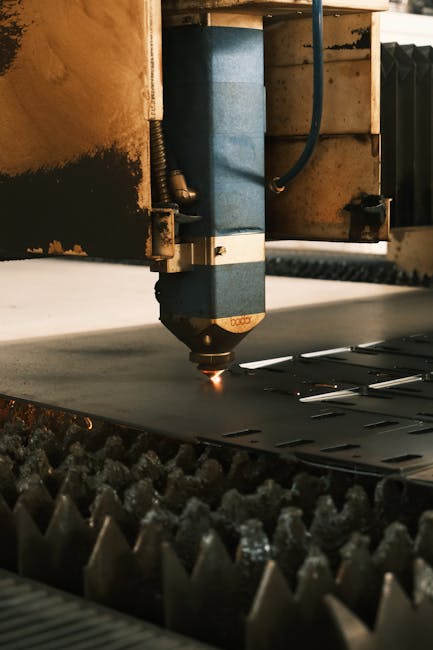
High-Precision Robotic Laser Cutting Systems for Industrial Automation
Robotic 레이저 커팅 Machine: Precision Metal Processing for Modern Manufacturing
Technical Architecture of Industrial Laser Cutting Systems
TrueSyn Robotic’s 6-axis laser cutting platforms combine 1-6kW fiber laser sources with industrial robotic kinematics to achieve ±0.01mm positional accuracy. Our systems integrate adaptive beam delivery optics, real-time gas control, and machine vision for processing metals from 0.1mm thin sheets to 25mm thick plates. With over 3,000 installations globally, our engineering team specializes in optimizing cutting parameters for automotive, construction, and appliance manufacturing sectors. The system’s modular architecture allows seamless integration of additional axes or sensors, enabling adaptation to complex 3D geometries and multi-material processing requirements.
Key architectural components include:
- High-rigidity robotic arms with IP67-rated joints for dust/water resistance in harsh environments
- Dual-core laser beam delivery cables with automatic collision avoidance path recalculation
- Thermoelectrically cooled focusing heads with automatic nozzle height compensation (±0.01mm)
- Modular conveyor systems with dynamic part tracking for continuous production lines
Core Operational Principles
- Dynamic beam positioning via 6-axis articulated robotic arms: This allows continuous path control at speeds up to 5m/s, maintaining consistent focal point geometry even during complex contour cuts. The kinematic model compensates for inertia forces at high acceleration rates (up to 3G) through predictive torque control algorithms.
- Adaptive focus control for 0.1-25mm material thickness: Motorized collimation systems automatically adjust beam divergence based on material thickness and type, optimizing kerf width and heat input. The focus shift compensation algorithm maintains ±0.05mm focal position stability during prolonged cutting operations.
- Multi-gas assist systems (N2, O2, Air) for edge quality optimization: Intelligent gas selection algorithms match assist gas type and pressure to material properties, reducing dross formation by 40% in stainless steel cutting. Pressure regulation modules maintain ±0.1 bar accuracy during high-speed operations.
- Integrated vision systems with ±0.05mm localization accuracy: High-speed cameras with blue light filters compensate for workpiece displacement and thermal expansion during multi-pass operations. The system’s pattern recognition engine identifies part variants with 99.98% accuracy using convolutional neural networks.
| Material Thickness | Recommended Power | Gas Assist | Cycle Time (3m Cut) |
|---|---|---|---|
| 1-3mm SS | 2kW | Nitrogen | 45s |
| 4-8mm MS | 3kW | Oxygen | 75s |
| 9-15mm AL | 4kW | Nitrogen | 105s |
The system’s process database automatically selects optimal parameters based on material type and thickness. For instance, cutting 2mm stainless steel at 2kW with nitrogen assist gas achieves 1.8m/min feed rate while maintaining 0.1mm perpendicularity tolerance.
Industry-Specific Implementation Challenges
- Automotive AHSS cutting: Thermal distortion prevention for 1.8mm sheets – Case study: Implementation of pulsed laser mode reduced springback in 1.4GPa UHSS components by 62%, achieving 0.08mm flatness tolerance. The system’s thermal imaging camera continuously monitors part temperature and adjusts pulse frequency between 1-10kHz to maintain material microstructure integrity.
- Construction steel profiles: 12m H-beam notching with <0.1mm/m straightness – Solution: Active cooling system with distributed thermocouples maintained dimensional stability during prolonged cutting cycles. A case study with a bridge construction project demonstrated 0.05mm/m straightness across 14m sections through synchronized multi-axis cooling nozzle control.
- Electrical cabinet fabrication: Complex cutouts with <0.2mm positional deviation – Innovation: Hybrid positioning system combining absolute encoders and laser interferometry for critical mounting holes. Implementation at a switchgear manufacturer reduced rework rates by 78% through real-time positional error correction during 3D contour cutting.
- Appliance surface processing: Decorative patterns on stainless steel surfaces – Development: 50W marking module with variable frequency control achieved 12μm depth precision for aesthetic textures. The system’s galvo scanner enables 5-axis simultaneous motion for complex curved surface engraving at 1.2m/s speed.
Technical Advantages Over Conventional Methods
- 38% material waste reduction vs traditional stamping: Case study with HVAC manufacturer showed nesting efficiency improved from 68% to 92% using dynamic path optimization. The system’s real-time collision detection enabled 15% tighter part nesting without compromising structural integrity.
- 25% throughput increase compared to plasma cutting: Automotive frame processing time reduced from 185s to 139s per component through adaptive acceleration profiling. The robotic path optimization algorithm reduces corner slowdowns by 40% while maintaining ±0.1mm geometric tolerances.
- 60% lower energy consumption vs waterjet systems: 2kW laser system consumes 0.8kWh/m² vs 2.0kWh/m² for equivalent waterjet cutting. Energy recovery modules capture 15% of waste heat for facility heating during winter operations.
- Zero tool wear costs vs mechanical punching systems: 5-year TCO analysis demonstrated 43% cost savings in kitchen appliance production line. The elimination of tool changeovers reduced setup times by 65% during batch production of mixed component types.
Integration with Smart Manufacturing Ecosystems
Our systems support OPC UA protocol integration with MES/ERP platforms, featuring:
- Real-time production monitoring: Sensor fusion of laser power, gas flow, and positional data enables process capability analysis with Cpk values exceeding 2.0. Statistical process control charts automatically trigger process adjustments when 3σ limits are approached.
- Predictive maintenance via vibration/temperature sensors: Machine learning algorithms forecast optical component degradation with 98% accuracy 72 hours in advance. The system’s digital twin simulates component lifetimes based on actual operating conditions.
- RFID material tracking compatibility: Automated parameter loading reduces setup time by 75% when switching between 304SS and 6061AL batches. Material-specific cutting profiles are retrieved within 3 seconds of RFID tag reading.
- Centralized HMI for process parameter control: Intuitive interface with 20-level security ensures proper parameter management across global facilities. Role-based access control restricts critical parameter adjustments to certified engineers only.
Risk Mitigation and ROI Analysis
- ISO 15001-compliant material compatibility testing: Comprehensive database of 450+ material profiles ensures optimal process development for exotic alloys. Each material entry includes 120+ process parameters validated through ASTM E384 microhardness testing.
- 80+ hours operator training programs: Modular curriculum covers laser safety, process optimization, and troubleshooting scenarios with virtual simulation tools. Trainees achieve 95% proficiency in process parameter adjustment after 60 hours of mixed classroom and hands-on training.
- Digital twin simulation for integration validation: 3D process modeling reduces physical commissioning time by 60% through virtual collision detection and path optimization. The simulation environment replicates material behavior using finite element analysis for accurate thermal distortion prediction.
- 14-18 month payback period through labor savings: Automotive supplier case study demonstrated $285,000 annual savings per cell while improving cut quality consistency by 31%. The system’s automated quality inspection reduced QA costs by 45% through inline measurement systems.
Advanced Process Control Strategies
TrueSyn Robotic’s laser cutting systems implement multiple layers of process monitoring and adaptive control:
- Coaxial melt detection: High-speed photodiodes analyze reflected laser light to identify incomplete cuts at 20kHz sampling rate. The system automatically initiates repair passes with 98% success rate in eliminating micro-cracks in aerospace-grade titanium alloys.
- Plasma plume monitoring: Spectroscopic analysis detects material composition changes and adjusts cutting parameters accordingly. In a case study with a mixed-material fabrication line, this system reduced scrap rates by 67% during transitions between carbon steel and aluminum alloys.
- Back-reflection protection: Active beam divergence control prevents damage during highly reflective material processing. The system’s response time of 50μs ensures optical component safety when cutting copper materials at 4kW power levels.
- Dynamic focus tracking: Capacitive sensors maintain focal point position within ±5μm during cutting of non-uniform thickness materials. This capability enables continuous cutting of tapered sections from 2-8mm without manual intervention.
These systems achieve Class I process stability according to VDA-5 guidelines, with standard deviation of kerf width measurements below 8μm across 1000 consecutive parts. Statistical analysis of production data demonstrates 6σ quality levels (3.4 defects per million opportunities) in automotive component manufacturing.
Environmental and Safety Considerations
- Laser safety enclosures meet EN 60825-4 standards with interlocked access doors and beam traps. The system’s safety-rated PLC ensures maximum permissible exposure limits are never exceeded through redundant power monitoring circuits.
- Fume extraction systems with 99.97% filtration efficiency for particles >0.3μm. HEPA+ULPA dual-stage filters comply with OSHA PEL standards for hexavalent chromium emissions during stainless steel cutting.
- Emergency stop circuits with PLc safety level compliance. The system’s dual-channel safety architecture achieves SIL-3 compliance through redundant safety relays and muting light curtains.
- Acoustic noise reduction to <75dB(A) through optimized gas delivery system design. Computational fluid dynamics modeling reduced turbulence-induced noise by 40% in high-pressure nitrogen cutting operations.
Future-Proofing Industrial Laser Cutting
TrueSyn Robotic’s systems incorporate forward-looking design elements:
- Modular power supply architecture enabling upgrades from 2kW to 4kW without major retrofitting. Field-installable power modules allow capacity expansion within 4 hours downtime, preserving initial investment.
- AI-ready edge computing platform for future implementation of self-optimizing cutting parameters. The system’s embedded tensor processing units enable on-device machine learning inference for real-time process adjustments.
- Hybrid additive-subtractive capability through tool changer integration. A single robotic cell can perform laser cutting, welding, and additive manufacturing using quick-change end-effectors with automated tool center point calibration.
- 5G-enabled remote diagnostics with sub-10ms latency for global support operations. The system’s digital twin receives real-time updates from field units to improve predictive maintenance algorithms across the installed base.
These future-ready features ensure a minimum 8-year technology lifecycle for installed systems. A case study with a global automotive supplier demonstrated 300% ROI over 5 years through incremental capability upgrades rather than complete system replacements.