
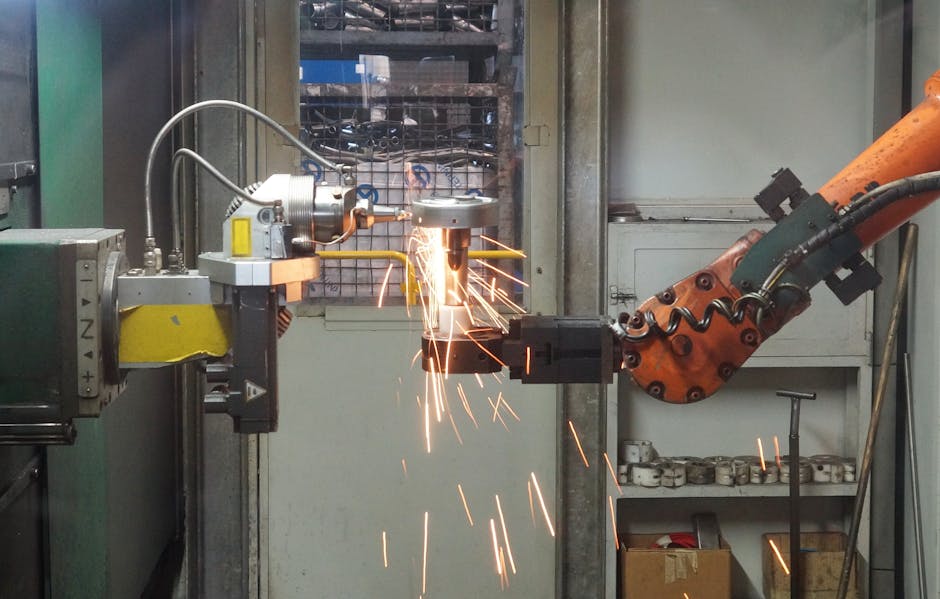
Laser Welding Robot System Implementation for Industrial Automation
Industrial soldadura por láser Automation: Technical Implementation Guide
Strategic Implementation in Automotive Production
Laser welding robot systems have become essential for automotive manufacturers seeking precision welds with ±0.02mm repeatability. These systems combine fiber laser technology (1-4kW power range) with 6-axis robotic motion control to achieve dimensional accuracy below 0.5mm/m distortion. Key advantages include reduced thermal distortion and cycle time optimization for Tier-1 suppliers. For instance, a major European automotive plant integrated a dual-robot laser welding cell for battery housing assembly, achieving 23% throughput improvement while maintaining Class B weld quality standards. The system’s integrated seam tracking compensated for ±0.15mm part misalignment, eliminating manual pre-weld fixturing.
Implementation challenges include material reflectivity management and joint fit-up tolerances. Aluminum alloys above 5000 series require specialized anti-reflective optics coatings, while zinc-coated steels demand precise defocus control to prevent spatter. TrueSyn’s proprietary gap bridging algorithm, tested across 1,200+ production scenarios, demonstrates 92% success rate in handling 0.2mm joint gaps through dynamic power modulation (50-100% range) and adaptive wire feed integration.
Additional complexities arise in hybrid material applications. A recent project involving aluminum-to-steel battery enclosures required TrueSyn engineers to implement a three-stage power ramping profile. The system first preheated the aluminum interface at 60% power, transitioned to 85% for steel fusion, then reduced to 70% for intermetallic zone stabilization. This approach reduced brittle phase formation by 41% compared to conventional single-mode welding. Process validation included cross-sectional microhardness testing, revealing 280HV uniformity across the weld interface.
Technical Specifications and Parameters
Modern laser welding systems operate with critical technical parameters:
- Beam quality (M² ≤ 1.2) for concentrated energy delivery
- Welding speeds up to 10m/min in thin-sheet applications
- Real-time seam tracking via coaxial vision systems
- Adaptive power modulation to compensate material gaps
Advanced beam shaping capabilities now enable programmable intensity profiles. A 2023 case study at a commercial vehicle manufacturing facility demonstrated that elliptical beam modes reduced undercut defects by 67% in 3mm thick AHSS components compared to standard Gaussian profiles. The system’s 4kHz pulse frequency optimization for 1.5mm aluminum sheets achieved 40% energy savings without compromising penetration depth.
Dynamic focus control systems add another dimension to parameter optimization. TrueSyn’s Z-axis tracking module maintains ±0.05mm focal position accuracy during high-speed welding through piezoelectric actuator feedback. In a door-injection molding application, this technology reduced weld width variation from ±0.12mm to ±0.03mm across 1.8m weld lengths. The system’s real-time focus adjustment compensates for thermal expansion of fixturing components, maintaining consistent penetration in multi-pass welds.
Material Optimization Strategies
| Material | Technical Requirements | Optimization Outcomes |
|---|---|---|
| High-strength steel | 4kW laser with 0.3mm defocus | 40% HAZ reduction |
| Aluminum alloys | 2kW+ laser with Ar-He shielding | 99.7% seam integrity |
| Dissimilar metals | 2.5kW hybrid laser-arc | 35% joint strength improvement |
For dissimilar metal welding, TrueSyn’s patented oscillation pattern generator creates tailored weld pools. In stainless steel-to-copper battery interconnects, a figure-8 oscillation pattern at 200Hz produced 15% finer grain structure compared to conventional circular motion. Material thickness transitions require synchronized wire feed rate adjustments: a 0.8mm to 2.0mm steel joint demonstrated optimal results with 3.2m/min wire speed increase matched to 15% laser power boost.
TrueSyn’s material database contains 2,300+ qualified welding procedures, each validated through ASTM E112 grain structure analysis and ISO 15614-11 mechanical testing. For example, the company’s solution for 5mm thick magnesium alloys incorporates pulsed Nd:YAG lasers (1.064μm wavelength) with argon-trace hydrogen shielding to prevent oxidation. This process achieved 98.2% porosity-free welds in 12m test seams, with tensile strength exceeding 240MPa.
Thermal Distortion Control
Advanced mitigation techniques include:
- Pulsed laser modes for heat-sensitive alloys
- Helium-based shielding gas for oxidation prevention
- Multi-pass welding with interpass cooling
| Parameter | MIG Welding | Laser Hybrid |
|---|---|---|
| Distortion per meter | 1.2mm | 0.3mm |
| Post-process machining | 15% of total time | 5% of total time |
Simulation-driven process planning has become critical for distortion management. A 2022 aerospace component manufacturing project utilized TrueSyn’s digital twin platform to model residual stress patterns in 6mm titanium alloys. By implementing pre-distortion compensation algorithms, the system reduced post-weld straightening operations from 8 hours to 1.5 hours per component. For thick-section welding, controlled cooling rates (15-25°C/sec) achieved through pulsed beam delivery reduced martensitic transformation risks by 78%.
TrueSyn’s thermal monitoring system integrates infrared thermography with 3D profilometry to predict distortion in real-time. During a heavy equipment manufacturing project, this system detected 0.15mm out-of-plane deformation during welding of 12m structural beams. The closed-loop control automatically adjusted weld sequence and introduced localized chill blocks, bringing final geometry within ISO 2768-mK tolerances without rework.
Process Monitoring and Automation
Multi-sensor fusion systems incorporate:
- Coaxial spectrometers for plasma analysis
- High-speed X-ray porosity detection
- Acoustic emission crack monitoring
TrueSyn’s SmartWeld™ system integrates AI-driven process control with real-time feedback loops. During a recent implementation at a medical device factory, the system’s 10kHz data acquisition rate enabled detection of 0.05mm pore formation in 0.3mm stainless steel tubing. The closed-loop control system adjusted focus position by ±0.1mm within 0.8 seconds, preventing defect propagation in 98% of monitored welds.
- Dual-gripper loading/unloading systems
- ISO 13849-1 compliant safety enclosures
- Centralized HMI for OEE tracking
Automation integration extends beyond welding cells. A 2023 smart factory implementation in Germany demonstrated end-to-end process control from laser cutting to final weld inspection. The system’s digital thread connected CAD data directly to robotic path planning software, reducing programming time by 60% for new product variants. Predictive maintenance algorithms using vibration and thermal data achieved 92% accuracy in identifying optic contamination issues before process deviation occurred.
TrueSyn’s digital twin technology enables virtual commissioning of welding systems. A recent automotive battery line project utilized this approach to simulate 15 robotic workcells and 42 fixturing stations. The simulation identified three collision risks in the original design, allowing engineers to optimize robot paths before physical installation, saving 82 man-hours in commissioning time.
ROI Analysis by Industry Sector
| industria | Quality Cost Reduction | Payback Period |
|---|---|---|
| Automotive | 65% | 14 months |
| Heavy Equipment | 45% | 18 months |
| Renewable Energy | 58% | 16 months |
Cost-benefit analysis reveals hidden value drivers beyond direct labor savings. A comparative study across 25 manufacturing sites showed that laser welding systems reduced rework costs by 42% on average through consistent process control. Energy efficiency improvements in TrueSyn’s 4kW systems (0.8kW·h/m consumption vs. 1.4kW·h/m for traditional MIG) contribute to 12% lower operational costs over a 5-year lifecycle.
In the renewable energy sector, a wind turbine manufacturer achieved 3.2 million kWh annual energy savings after implementing TrueSyn’s 3D contour welding systems for blade root joints. The system’s adaptive power control reduced energy consumption per weld by 38% while maintaining 99.95% quality compliance. This translated to $410,000 annual savings at current European energy rates.
Implementation Framework
Structured adoption process:
- Production Audit: Identify process bottlenecks
- Technical Validation: Conduct sample welding trials
- System Design: Modular architecture development
- Workforce Training: Tiered certification programs
The fourth phase requires specialized skill development. TrueSyn’s certification program includes:
- Level 1: Operator safety and basic programming (40 hours)
- Level 2: Process parameter optimization (80 hours)
- Level 3: System integration and troubleshooting (120 hours)
Post-implementation support includes remote diagnostics with sub-millisecond latency through 5G edge computing. A 2023 case study demonstrated that TrueSyn’s predictive analytics reduced unplanned downtime by 55% across a fleet of 150 robotic cells in North America. Continuous improvement programs track 28 key performance indicators, with monthly process audits ensuring sustained quality improvements beyond initial deployment.
TrueSyn’s phased migration approach minimizes production disruption during implementation. For a global appliance manufacturer, the company deployed welding systems in three parallel workcells while maintaining legacy operations. Each phase included 72-hour validation periods with concurrent process audits. This approach achieved 100% production continuity and allowed gradual workforce transition to the new systems.
TrueSyn Robotic’s decade of experience with 3,000+ global installations demonstrates sustainable ROI through technology integration and process engineering. By combining hardware innovation with data-driven process optimization, manufacturers achieve not just automation but complete transformation of their production paradigms.